Cathodic protection and pipeline reliability at AMPP 2026
During the AMPP Annual Conference + Expo 2026, Stephanie Workman, Southwest Regional Sales Manager at Advance Products & Systems (APS), addressed one of the most critical challenges in the energy and industrial sector: long-term pipeline protection against corrosion. In this context, cathodic protection emerges as the central element for ensuring the structural and operational integrity of this infrastructure.
In addition, the expert highlighted how integrating electrical isolation and mechanical support components helps extend pipeline service life and reduce risks associated with operational failures.
APS: specialization in solutions for demanding environments
In this scenario, Advance Products & Systems positions itself as a manufacturer with extensive experience in developing solutions for corrosion prevention. Founded in 1978, the company designs and supplies products for sectors such as oil & gas, water and wastewater, the chemical industry, and mechanical applications.
Likewise, the company focuses its offering on products designed to support the entire pipeline life cycle, with an emphasis on safety, reliability, and technical performance. Its international presence and engineering capabilities make it possible to tailor each solution to the specific conditions of every project.
Structural optimization: the role of casing spacers
First, casing spacers play a key role in pipeline installation and operation.
These elements act as mechanical supports designed to maintain system integrity over time.
According to Workman.
In addition, their design is tailored to each project’s specific load calculations, enabling balanced weight distribution within the casing. This is essential at pipeline crossings, where structural stresses can compromise system durability.
In this way, casing spacers not only facilitate carrier pipe installation, but also contribute to continuous protection against deformation and wear.
Operational advantages: monolithic isolating joints
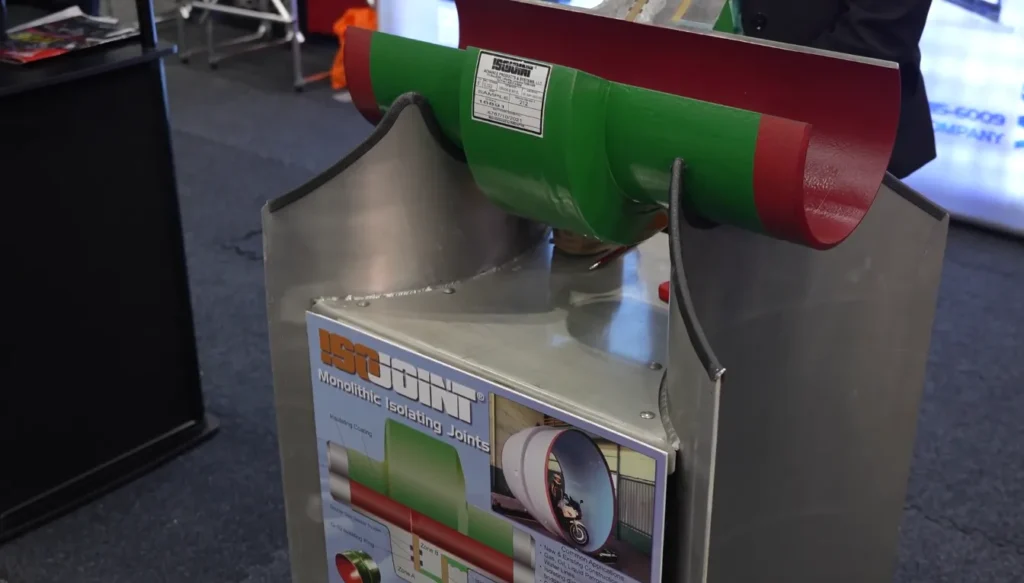
On the other hand, monolithic isolating joints represent an evolution over traditional flange isolation systems. They are single-piece steel components that provide electrical isolation without the need for multiple elements.
In this regard, their main advantage lies in installation simplicity, as they are integrated directly by welding. This eliminates the complexity associated with assemblies made up of multiple components.
Likewise, these systems are designed to last the entire service life of the pipeline without requiring periodic maintenance. Unlike conventional systems, where bolts can lose tension over time, monolithic joints prevent recurring interventions and reduce operating costs.
Corrosion control: gasket kits and electrical isolation
As for flange isolating gasket kits, their main function is to prevent electrical current from passing between metal components. To do so, they eliminate metal-to-metal contact at flange connections, creating an effective barrier against stray currents.
In addition, these systems are integrated into cathodic protection schemes, where they allow the pipeline to be electrically segmented into different controlled zones. This isolation is essential to ensure that the applied current works efficiently in preventing corrosion.
As a result, system tightness is maintained while the infrastructure is protected against electrochemical deterioration.
Cathodic protection as the foundation of durability
At this point, cathodic protection stands out as the determining factor in pipeline longevity. As Workman emphasized, without this system, any isolation solution loses effectiveness against corrosion.
In fact, the absence of cathodic protection leads to the progressive appearance of rust, material degradation, and ultimately structural failures. By contrast, when combined with appropriate isolation solutions, it creates an integrated system capable of ensuring pipeline durability for decades.
Thus, cathodic protection should not be seen as an add-on, but as the foundation on which any asset integrity strategy is built.
Industry impact: efficiency and risk reduction
Consequently, integrating these technologies has a direct impact on sectors such as oil & gas, water, and the chemical industry. Improved pipeline reliability translates into fewer operational interruptions and greater facility safety.
In addition, eliminating maintenance for certain components and optimizing electrical performance help reduce long-term costs. This approach enables operators and industrial companies to manage their assets more efficiently.
Likewise, custom component design makes implementation easier in projects with demanding technical requirements, reinforcing their applicability in complex environments.
Solutions designed for the long term
Finally, Stephanie Workman’s presentation at AMPP 2026 highlights the importance of adopting a comprehensive approach to pipeline protection. The combination of mechanical support, electrical isolation, and cathodic protection addresses one of the industry’s main challenges.
In this context, APS presents itself as a supplier capable of delivering solutions tailored to each project, with a clear focus on durability and technical performance. The company remains committed to serving as a resource for customers and professionals looking to optimize the protection of their infrastructure.
For more content about AMPP 2026, please visit our LinkedIn profile.
Source: Inspenet.