
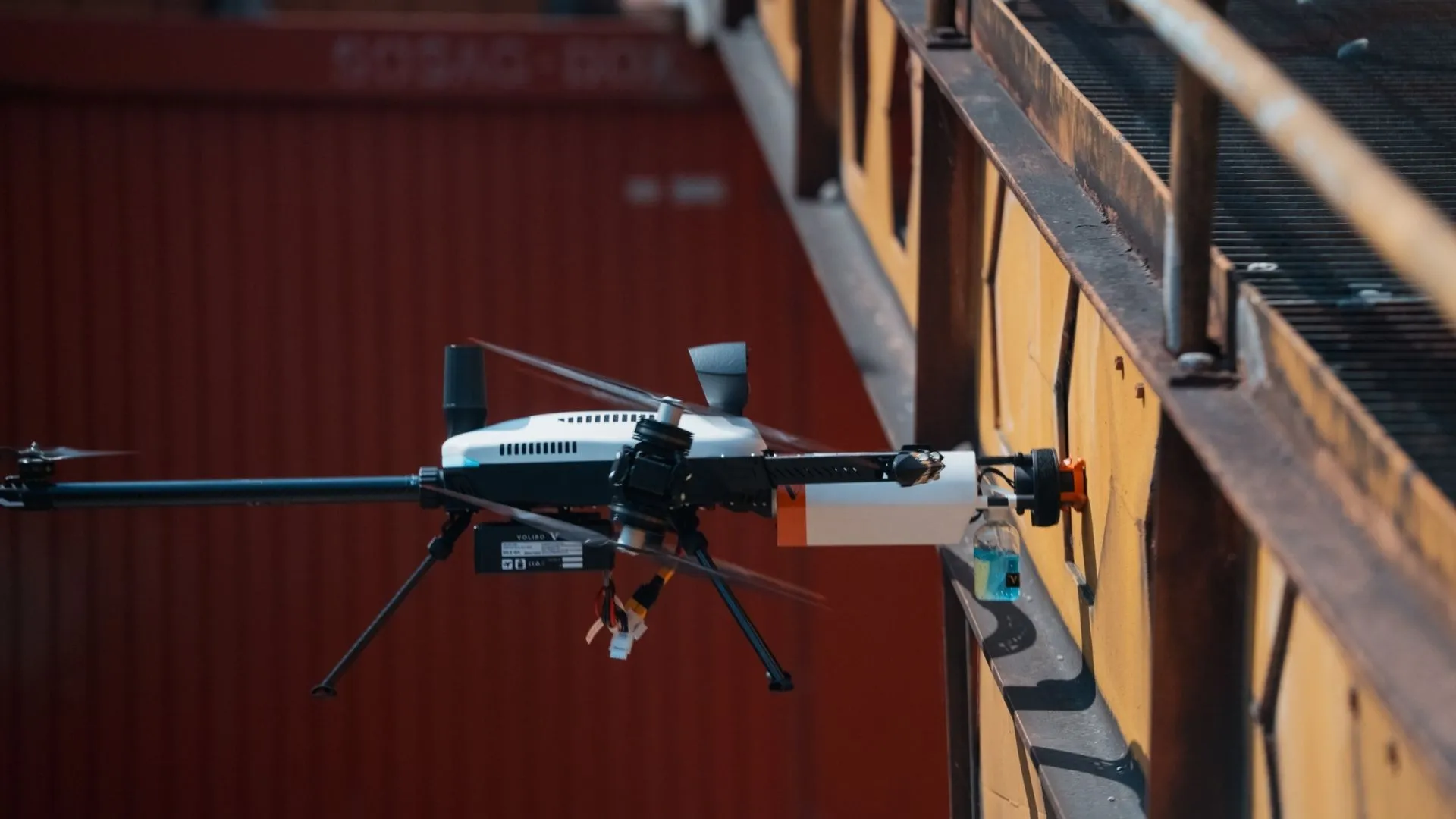
The use of drones for ultrasonic thickness (UT) measurements is transforming industrial maintenance processes. Companies such as Voliro have developed specialized aerial platforms that allow reliable data to be obtained in areas that are difficult to access, without the need for scaffolding or direct human intervention on structures.
The technological opportunity of ultrasonic inspections
Historically, UT inspections required operators at height, either by rope access or temporary structures. These tasks involved operational risks, long times and complex logistics. Today, technologies such as the Voliro T drone allow up to 200 thickness measurements per hour, with only two operators on the ground.
The system uses a drone-mounted contact ultrasonic transducer that transmits signals into the material to detect corrosion or erosion. The readings, compatible with standards such as API 653 and ASME B31.3, are displayed in real time by A-scan at a ground station and stored with geolocated metadata.
Designed to operate outdoors in moderate wind conditions, these drones can inspect tanks, chimneys or vertical pipes up to 250 meters high. The ability to maintain stable contact even on curved surfaces improves the accuracy of the results compared to fixed or manual solutions.
While manual inspections require several hours of preparation, specialized personnel and physical access to the structure, drones reduce the total inspection time. In addition, they allow multiple assets to be covered in a single day without affecting plant operations.
Early detection of thinning in metallic structures is key to avoid unexpected leaks or failures. By integrating airborne UT into predictive maintenance programs, industries canBy integrating airborne UT into predictive maintenance programs, industries can reduce downtime and increase operational safety.
Source and photo: Voliro