
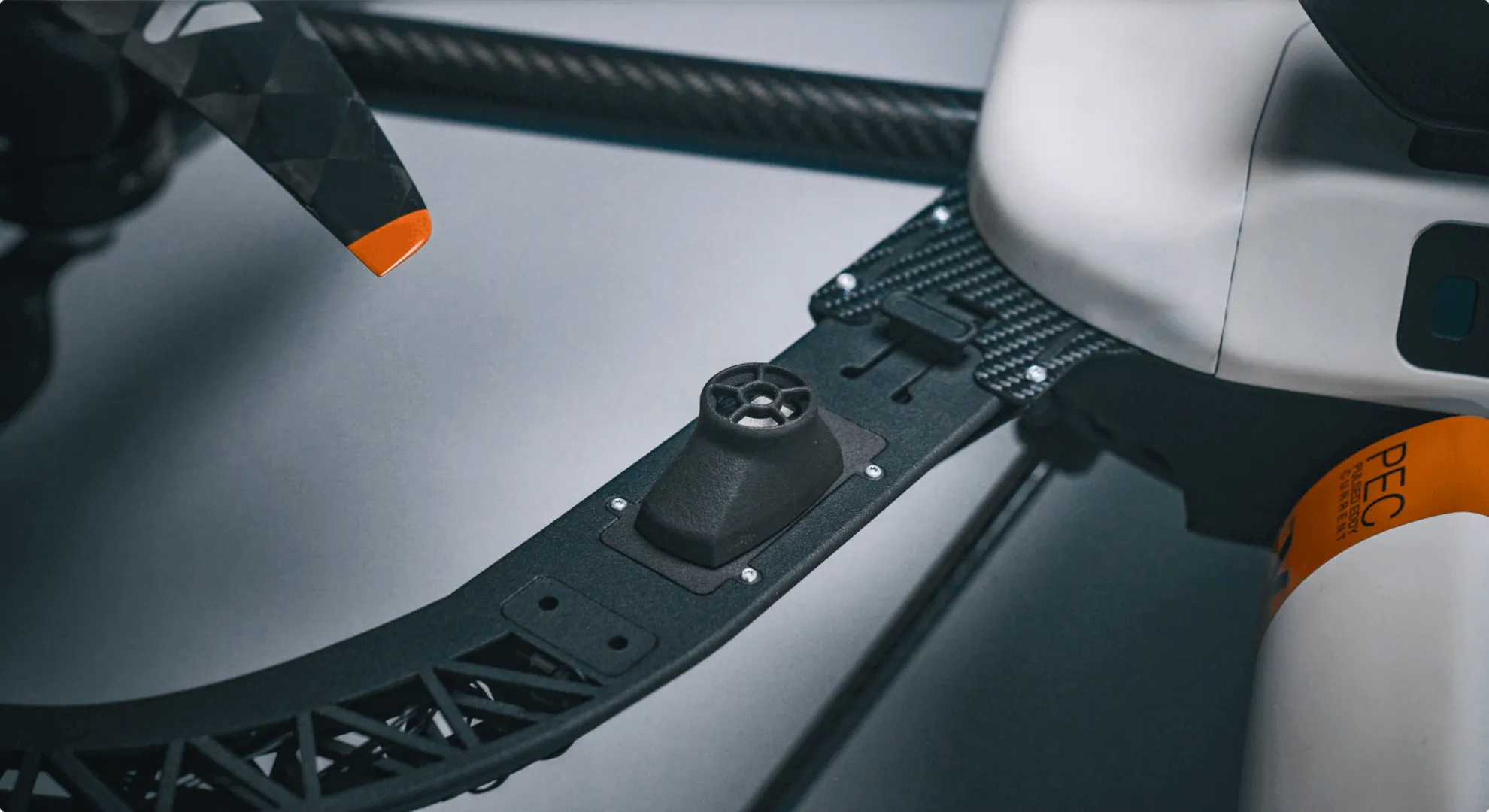
Voliro, an aerial robotics company specializing in the development of drones for inspection and work at height in industrial environments, has integrated real-time flammable gas detection into the Voliro Tat no additional cost for subscribers. This decision seeks to solve:
- Hazardous blind spots: When inspecting operating industrial assets (such as chimneys, tanks or pipelines), flammable gases (such as methane, propane, etc.) may be leaking. These gases are invisible.
- Data in the wrong place: Gas sensors fixed on the ground or carried by personnel cannot measure the atmosphere exactly where the drone is flying. This forces teams to make decisions based on assumptions.
- Safety vs. data: Without real-time information, operators must choose between flying very conservatively and perhaps not obtaining the necessary inspection data and risk the drone inadvertently entering an area with hazardous gas.
The solution: A drone with an electronic “nose
The new real-time %LEL (Lower Explosivity Limit) detection functionality allows monitoring directly from the drone of the atmosphere where it is flying, enabling operators to receive immediate alerts if gas concentrations exceed configurable thresholds, allowing quick decisions on flight path or the need to interrupt the operation.
The gas detection system integrates natively with the NDT (Non Destructive Testing) payloads already available on the Voliro T, without altering the inspection workflow or requiring additional configurations.
What detection technology do you use?
The Voliro T uses a Molecular Properties Spectrometer (MPS) based sensor developed by NevadaNano that, unlike traditional catalytic bead sensors, is a very powerful and reliable sensor:
- It does not require field calibration during its lifetime.
- It is more resistant to extreme conditions and less susceptible to contaminants.
- Calculates the flammable risk based on the thermodynamic properties of the gas, not on a single substance.
This allows accurate and reliable readings to be obtained under varying conditions of pressure, temperature and humidity.
Closing a historic gap in aerial inspections
Prior to this integration, drones operated in an atmospheric blind spot, and while industrial plants often have fixed sensors, they do not reflect what is happening at altitude or near a localized leak. With this upgrade, the Voliro T not only collects structural data, but provides a critical safety layer directly from the point of inspection.
Source: Voliro