

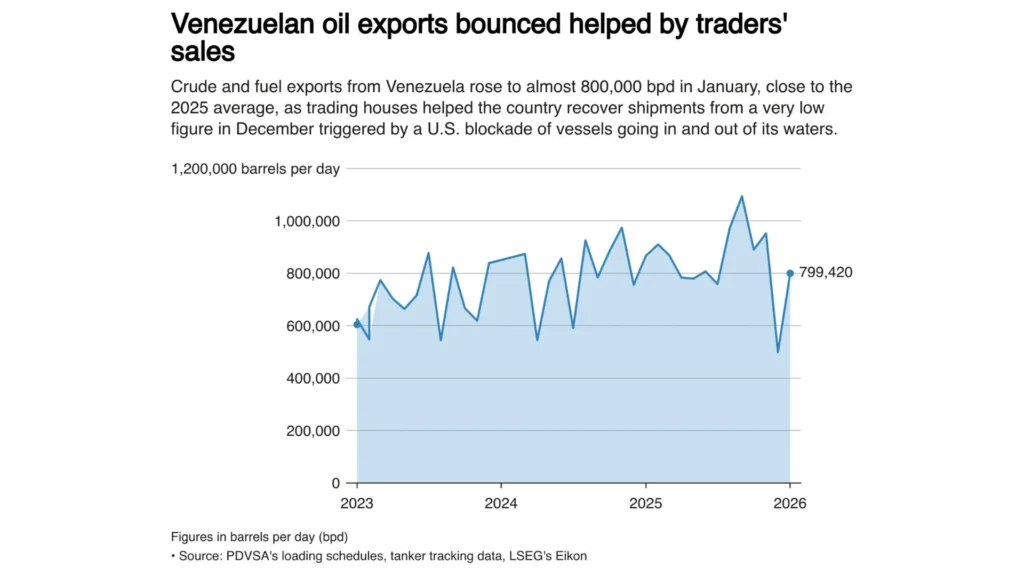
The $2 billion oil agreement between Washington and Caracas has triggered a sharp increase in Venezuelan crude imports, causing a mismatch between supply and demand in Gulf Coast refineries. During January, exports from Venezuela to the United States tripled, reaching 284,000 barrels per day.
However, the market has not been able to absorb this rebound. Traders confirm that several refineries have begun to reject cargoes as too expensive compared to other sources such as Canadian WCS crude, which offers a greater discount relative to Brent crude. Brent.
Pricing and licensing, a complex scenario for marketers
The trading houses Vitol and Trafigura, together with Chevron, obtained special licenses to resell Venezuelan crude oil. Venezuelan crude oil following the change of leadership in Venezuela. While the first shipments found buyers in the US and Europe, the pace of sales has slowed. Currently, the differentials offered are below $10 against Brent, still insufficient to compete with WCS.
Chevron’s CEO, Mike Wirth, pointed out that its refining network can absorb 150,000 barrels per day, but its production in Venezuela is already close to 250,000 bpd. This gap forces it to find alternative buyers or assume storage costs.
Technical adjustments and lower demand limit capacity
The situation is not only due to price. Some refineries require technical modifications to process Venezuelan heavy crude. Meanwhile, U.S. demand remains weak. Phillips 66 has stated that its interest depends strictly on competitiveness against other supply options.
India could absorb excess Venezuelan crude oil
Given the low absorption in the US, operators are beginning to look to India as a possible destination for excess barrels. The reconfiguration of the Latin American oil flow could imply new logistical and diplomatic challenges, especially if current licenses are not extended.
Market dynamics will continue to depend on regulatory decisions in Washington, leadership developments in Caracas and strategic moves by companies such as Chevron, Vitol and Trafigura.
Source and internal photo: Reuters
Main photo: Shutterstock