
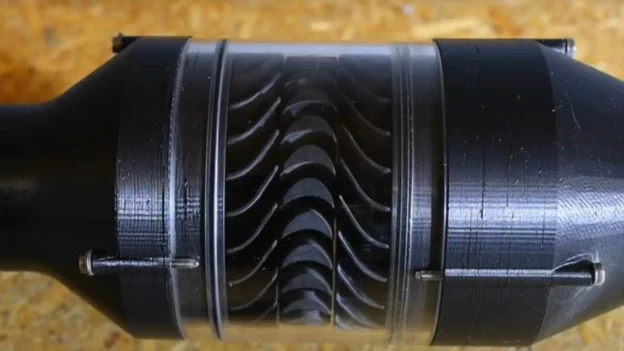
A new approach to decentralized energy is taking shape from a domestic workshop thanks to 3D printing and collaborative ingenuity.
Functional design with 3D printing: Stirling engine
Behind the project is Baptiste, an amateur engineer known as @myengines2443 who has been experimenting with home-built regenerative engines for years. His goal: to develop a thermoacoustic Stirling engine that anyone can build using a 3D printer and affordable components.
This type of engine converts heat into mechanical energy by means of sound waves, avoiding parts such as pistons or crankshafts. This drastically reduces friction, wear and the need for maintenance. Thanks to additive manufacturing and advances in reinforced technical filaments, many of the parts can be printed withstanding up to 12 bar pressure with thin walls.
Clean and affordable energy from home
The current prototype runs on biogas generated from organic waste, supplementing a solar installation at night or on cloudy days. This combination allows maintaining a continuous source of energy with no net carbon emissions. and without relying on the network.
The design is available as an open source project and can be adapted to various environments: from rural homes to small urban workshops. By applying 3D printing, anyone can produce functional parts economically, without industrial machinery.
Stirling engine: from sketch to power
Development is ongoing and faces several technical challenges. The thermoacoustic cycle is currently being optimized and new heat exchanger designs are being explored. Options for converting the energy into electricity are also being evaluated: from linear generators to rotary turbines.
The use of helium as a working gas and the pressurization of the system could multiply the available power. High-temperature parts could be manufactured in ceramic or metal using specialized printers or conventional techniques.
A maker community driving change
More than a hobby, this project is emerging as an open platform for engineers, students or energy enthusiasts to collaborate in the design and improvement of the Stirling engine. The commitment to free hardware, coupled with the use of low-cost 3D printers, can transform the way we access electricity.
The impact goes beyond the household level. In places where the electricity grid is unstable or non-existent, a heat and biogas-based system can offer a sustainable, scalable and affordable solution.
In short, the 3D printed thermoacoustic Stirling engine is much more than an experiment: it is a real commitment to a freer and more distributed energy.
Source: My enegies