
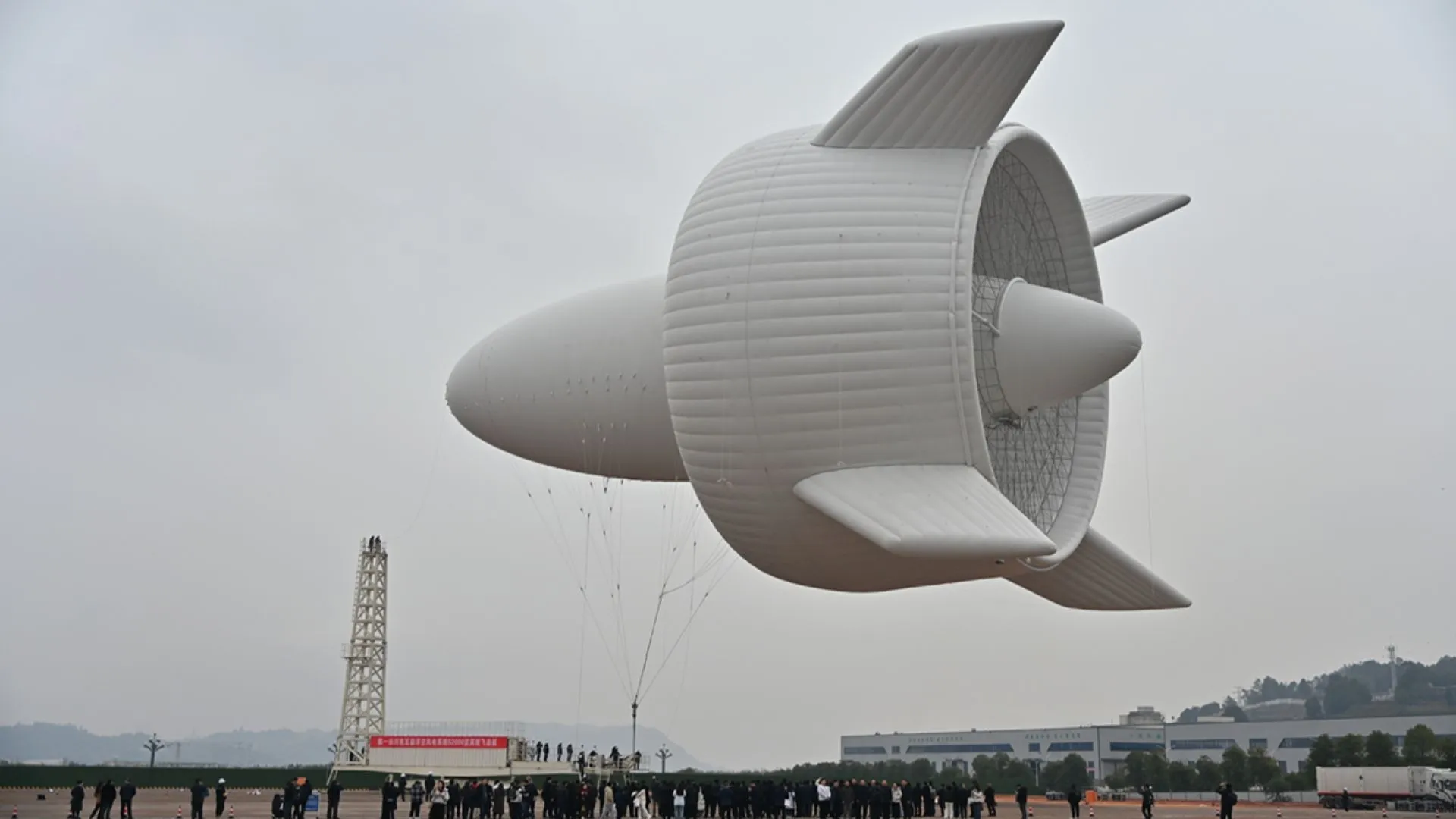
The S2000 Stratosphere Airborne Wind Energy System(SAWES) has successfully completed its test flight. This technical breakthrough allows the validation of a megawatt-class system, which for the first time is oriented for use in urban and high-density areas.
Technological advances in the SAWES system
This device reached an altitude of 2000 meters, after only half an hour of ascent. During the operation, the unit generated 385 kilowatt-hours of electricity and achieved formal connection to the power grid.
The immediate integration capability is what sets Sawes Energy Technology’ s proposal apart from previous prototypes. The structure, which measures 60 meters long and 40 meters wide, uses a blimp platform to capture much more powerful and constant air currents than those available at ground level.
It is also important to mention the logistical efficiency of the S2000 model. In contrast to wind farms which require months of construction and large tracts of land, this system is transported in containers and can be operational within eight hours.
The design has been improved over the S1500 model, integrating greater resistance to inclement weather. This allows the equipment to operate reliably both in desert regions and in urban perimeters, where space is a limited and valuable resource.
Some industry experts point out that the progress of the technology will depend on the balance between recovery costs and the energy injected into the grid. Nevertheless, the figures are relevant: a single unit has a projected power output of 3 megawatts.
With the rate of growth of installed capacity in China, which exceeds 600 million kilowatts in wind powerThe introduction of flexible airborne systems is emerging as a strategic technology for the energy autonomy of cities.
Source and photo: Global Times