
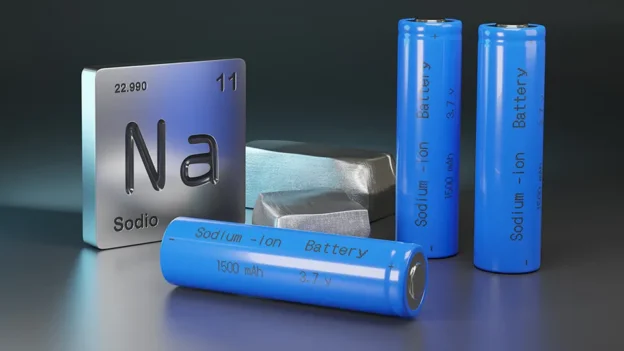
A new breakthrough led by Professor Shinichi Komaba of Tokyo University of Science (TUS) has shown that scandium doping offers a direct solution to the problem of rapid capacity degradation during charge and discharge cycles of sodium batteries especially in cathodes based on sodium and manganese oxides (Na₂/₃MnO₂).
What was the problem with Na₂/₃MnO₂?
During each charging cycle, Na⁺ ions enter and leave the cathode material, a process that repeatedly alters the oxidation states of manganese between Mn³⁺ and Mn⁴⁺. As Mn³⁺ forms, the atomic lattice undergoes Jahn-Teller distortion, a phenomenon that eventually weakens the cathode structure and drastically reduces its useful capacity.
Previous attempts to dope the material with other metals, such as ytterbium or aluminum, failed to solve the underlying problem. That’s where scandium comes in.
The role of scandium doping in structural stability
The TUS research team focused their study on the P′2 polytype of Na₂/₃MnO₂, a structural variant with cooperative Jahn-Teller distortion. By introducing scandium (Sc) into this type of cathode,
- The formation of smaller and more uniform particles.
- Preservation of cooperative distortion without loss of crystallinity.
- A natural barrier against reactions with liquid electrolyte and moisture.
- An altered crystalline growth that favors the longevity of the cathode.
Results: up to 60% capacity after 300 cycles
In semi-cell tests, P′2 cathodes doped with 8% scandium maintained 60% capacity retention after 300 cycles, unthinkable for undoped composites. Moreover, unlike other polythiophenes such as P2, the benefits were unique to P′2, demonstrating a unique synergy between cooperative structure and scandium doping.
The doping also resisted well to the use of precyclization techniques, suggesting real industrial viability for the technology.
The next phase and considerations
Scandium is an expensive metal, the researchers acknowledge this, but their study proves the feasibility of the concept, so now the challenge is to optimize the amount used or find ways to make it economically viable for high-performance batteries. Scandium doping, so far an underexplored strategy, could become an essential tool in the transition to more sustainable and robust storage systems.
Source: Tokyo University of Science