
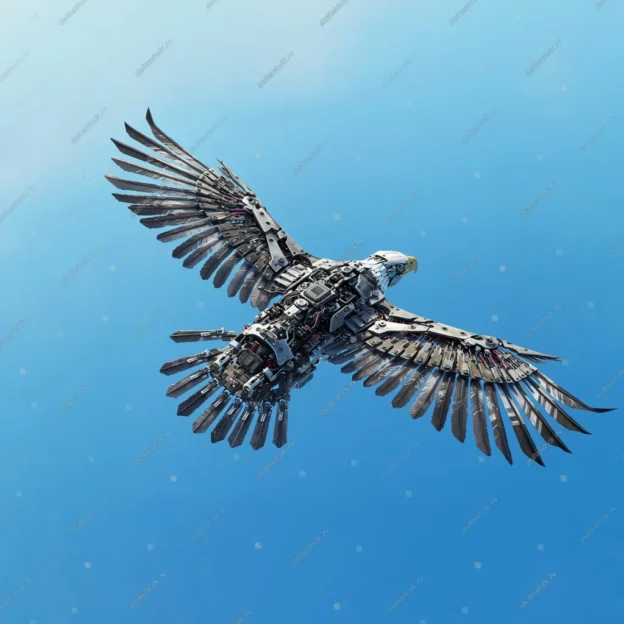
Scientists in China have developed RoboFalcon2.0, a flying robot that accurately mimics bird takeoff using a reconfigurable wing system. Inspired by avian kinematics, the device incorporates a coordinated flapping, sweeping and folding (FSF) sequence, replicating the natural movements of species such as hawks and geese during low-speed flight.
Thinking wings: a revolution in robotic aerodynamics
The key to RoboFalcon2.0 lies in its wing architecture, which allows its shape to be modified in real time to adapt to flight conditions. Through mechanical decouplers and a lightweight structure, the flying robot is able to modify the sweep amplitude up to 25 degrees, altering the aerodynamic center of the body to improve pitch stability during takeoff.
Flying Robot: Wind tunnel validated
Engineers at Northwestern Polytechnic University developed a conical rocker mechanism that integrates flapping, sweeping motion and folding into a single initial flight cycle.
Wind tunnel simulations and tests confirmed that the FSF motion produces high lift coefficients and high lift coefficients and effective pitch control, thanks to the generation of vortices at the leading edge of the wing. In real conditions, the flying robot took off in a pattern similar to that of flying vertebrates: pitching forward, flapping rapidly and rising without external assistance.
Flying robot applications and limitations: towards bio-inspired flight.
Weighing 800 grams and with a wingspan of 1.2 meters, RoboFalcon2.0 could have applications in surveillance, environmental monitoring and low-profile operations. Although its slow flight performance has been promising, the robot still faces stability challenges at high speeds due to the absence of rear control surfaces, an aspect that the team plans to improve in future versions.
This innovation could pave the way for future bird-inspired vehicle designs. bird-inspired vehicle designsThis innovation could pave the way for future bird-inspired vehicle designs that use very similar motion principles to vertebrates, which will allow for more biomimetic flapping wing designs.
Science and nature at the service of the robotics of the future
The study, which was published in Science Advances, indicates how the robot mimics the flap-sweep-fold (FSF) motion observed in birds as they perform their slow flight movement.
The development of RoboFalcon2.0 represents an important step in biomimetic aerial robotics. By replicating not only the shape, but also the functional dynamics of bird flight, this project lays the groundwork for new generations of robots that interact with the air in a more efficient, flexible and natural way.
Source: Interesting Engineering