
The contract changing the global energy map
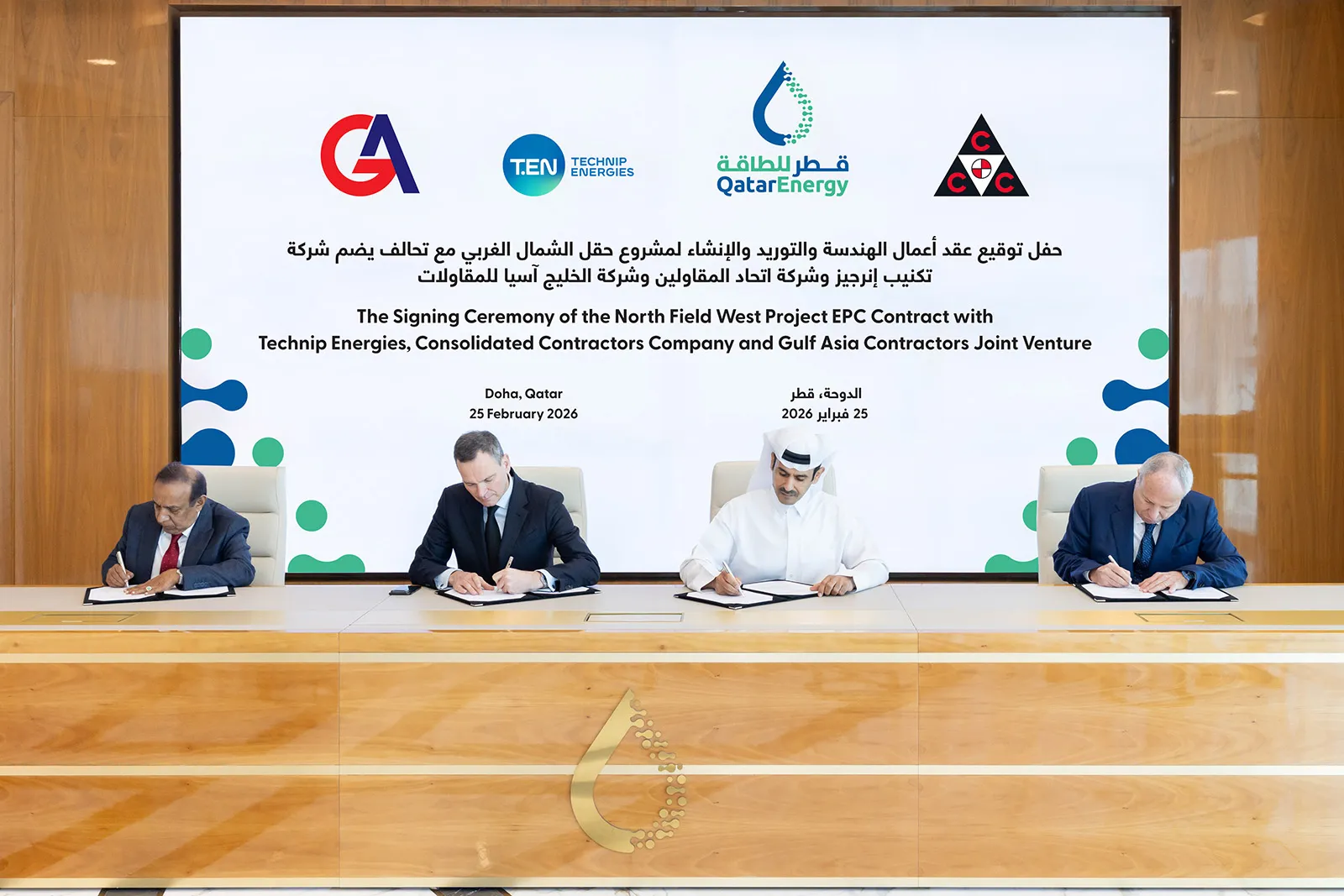
QatarEnergy has officially awarded the engineering, procurement, and construction (EPC) contract for the onshore plant of the North Field West (NFW) project, the final link in the most ambitious liquefied natural gas expansion on the planet.
The NFW project joins the already awarded North Field East, with 32 MTPA, and North Field South, with 16 MTPA, completing an unprecedented expansion trilogy in the gas industry.
Each of these projects has been designed with state-of-the-art environmental criteria, making Qatar a benchmark not only for its volume but also for its industrial sustainability standards. The signing ceremony brought together the top executives from the global energy sector.
The magnitude of this expansion places Qatar far ahead of its direct competitors in the LNG market, including Australia and the United States, which have also bet heavily on this transition fuel.
Two mega-trains and 16 MTPA of new production capacity
The scope of the EPC contract includes the construction of two LNG mega-trains with a combined capacity of 16 MTPA, along with facilities for gas treatment, liquid recovery, and helium extraction.
The winning consortium is composed of Technip Energies, Consolidated Contractors Company (CCC), and Gulf Asia Contractor (GAC), three firms with extensive experience in large-scale energy infrastructure projects. This technical alliance represents one of the most significant EPC awards of the year in the sector.
The first LNG shipment from the NFW project is scheduled for late 2031, marking a clear execution horizon for one of the most complex industrial projects in the world.
The surprising fact: solar energy for a fossil gas project
Here is the unexpected twist that sets North Field West apart from any other LNG project in the world: a significant portion of its electricity needs will be met by solar plants located in Qatari territory.
In other words, the largest fossil gas project on the planet will be powered, in part, by the same energy that its environmental critics advocate as an alternative. This decision is not just symbolic; it concretely reduces the operational carbon footprint of the industrial complex.
This approach is part of a broader strategy by QatarEnergy to demonstrate that the gas industry can evolve toward cleaner operating models. Solar energy in the Qatari desert offers unbeatable irradiation conditions, with capacity factors that exceed global standards.
Qatar aims to sequester 11 MTPA of CO₂ by 2035
The NFW project will include a carbon capture and sequestration (CCS) capacity of 1.1 MTPA of CO₂, in line with QatarEnergy’s commitment to reach more than 11 MTPA of captured CO₂ by 2035.
Additionally, jetty boil-off gas recovery systems will reduce emissions equivalent to another 0.42 MTPA of CO₂. These figures place the NFW project among the industrial complexes with the most active decarbonization infrastructure in the world.
The global energy sector is watching closely to see if this model, which combines massive scale with decarbonization tools, can become a replicable standard. For many developing economies that still rely on coal, Qatar’s low-carbon footprint LNG could represent a viable energy transition.
Source: https://www.qatarenergy.qa
Photo: Shutterstock