
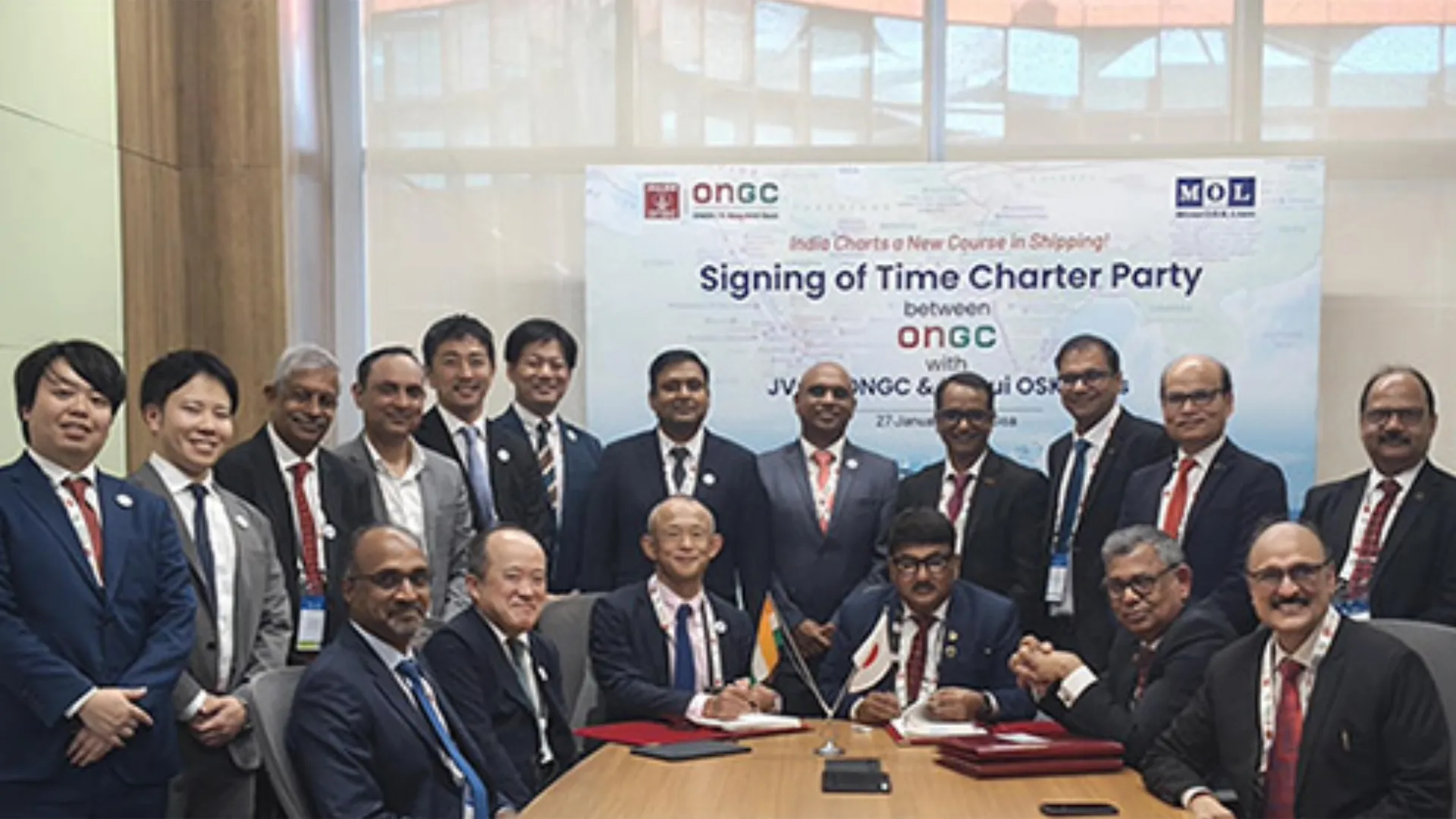
Japan’s Mitsui OSK Lines (MOL) has signed a landmark contract with India’s state-owned Oil and Natural Gas Corporation Limited (ONGC) for the long-term charter of two large liquefied ethane carriers(VLECs), with the aim of creating the world’s largest VLEC fleet. The agreement was formalized during India Energy Week 2026, and includes the chartering of the two new vessels for a period of 15 years,
Formalization of ethane carrier fleet
The state-of-the-art VLECs, which will have a capacity of 100,000 cubic meters, will be built at the Samsung Heavy Industries Samsung Heavy Industries shipyard in South Korea, with delivery scheduled for the end of 2028. These vessels will be equipped with dual-fuel engines, capable of using ethane as fuel,.
Moreover, the agreement expands MOL’s VLEC fleet to a total of 16 vessels, consolidating the Japanese company as a global benchmark in the transportation of liquefied ethane. Since starting its ethane transportation business in 2016, MOL has been a pioneer in the operation of VLECs, and now with this new alliance, it continues to reaffirm its position in the maritime sector.
The vessels will be intended for the transportation of liquefied ethane from the United States to India, specifically to supply ethane to the petrochemical plant operated by ONGC’s subsidiary ONGC Petro Additions Limited in Dahej, Gujarat. This agreement is part of MOL’s strategy to expand its commercial presence in the Asian region, with a special focus on India’s economic growth and energy opportunities.
The agreement between MOL and ONGC increases the importance of the Special Economic Zone in Gujarat, India, where the two companies have established two joint ventures to operate the new vessels. These companies will manage the ethane transports, contributing to a more stable and efficient supply for India’s growing energy demand.
Moreover, this contract is part of MOL’s strategy to transform its business portfolio, focusing on expanding LNG and VLEC fleets, the largest in the world, and securing stable revenues through long-term contracts.
Source and photo: MOL