
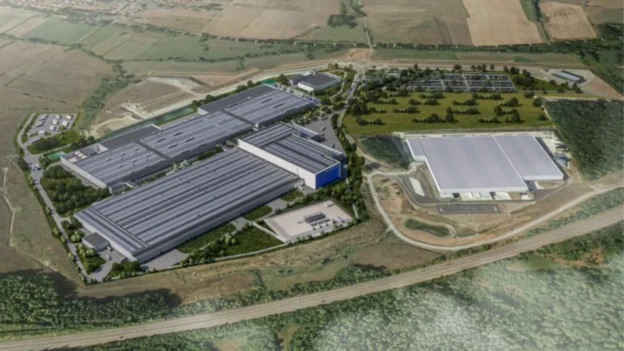
Hambach to host the most advanced photovoltaic plant on the continent
HoloSolis has begun deployment of what will be Europe’s largest photovoltaic cell and module production plant. Located in Sarreguemines-Hambach in northeastern France, this facility will have an annual capacity of 5 GW and will be able to manufacture more than 10 million solar panels per year, enough to supply one million homes.

A commitment to reindustrialization and energy transition
Covering an area of 50 hectares and backed by entities such as EIT InnoEnergy, TSE and the IDEC group, HoloSolis is positioned at the heart of the European strategy to reindustrialize the photovoltaic sector. The solar gigafactory represents the main ingredient in the continent’s energy autonomy plans and a firm step towards the consolidation of the energy transition.
State-of-the-art technology at the service of solar efficiency
The complex will specialize in the production of TOPCon n-type solar cells, one of the most efficient on the market. In addition, the research and development team will explore tandem technology that combines silicon and perovskite to improve the performance of solar cells. This technological adaptability is one of the pillars of the project.
A decisive project: The European Union’s Green Deal.
The Holosolis gigafactory is a strategic project for the success of the European Union’s Green Deal Industrial Plan. It is also one of the flagship initiatives carried out within the framework of the European Solar and Photovoltaic Industrial Alliance (ESIA) to reindustrialize Europe sustainably.
Timeline for the execution of the solar gigafactory
Construction of the buildings is scheduled for 2026. The plant will start operations in 2027, when production of the first modules is expected to begin. At full capacity, up to 1,900 direct jobs will be created, strengthening the local and regional economic impact.
Project phases: from planning to production
The roadmap includes three key stages: the development of the preliminary project with administrative permits and land acquisition; the raising of funds necessary for infrastructure development; and finally the construction of the buildings and production lines. The solar gigafactory is designed to scale according to the future technological needs of the European solar sector. technological needs of the European solar sector.
Source and photo: HoloSils