
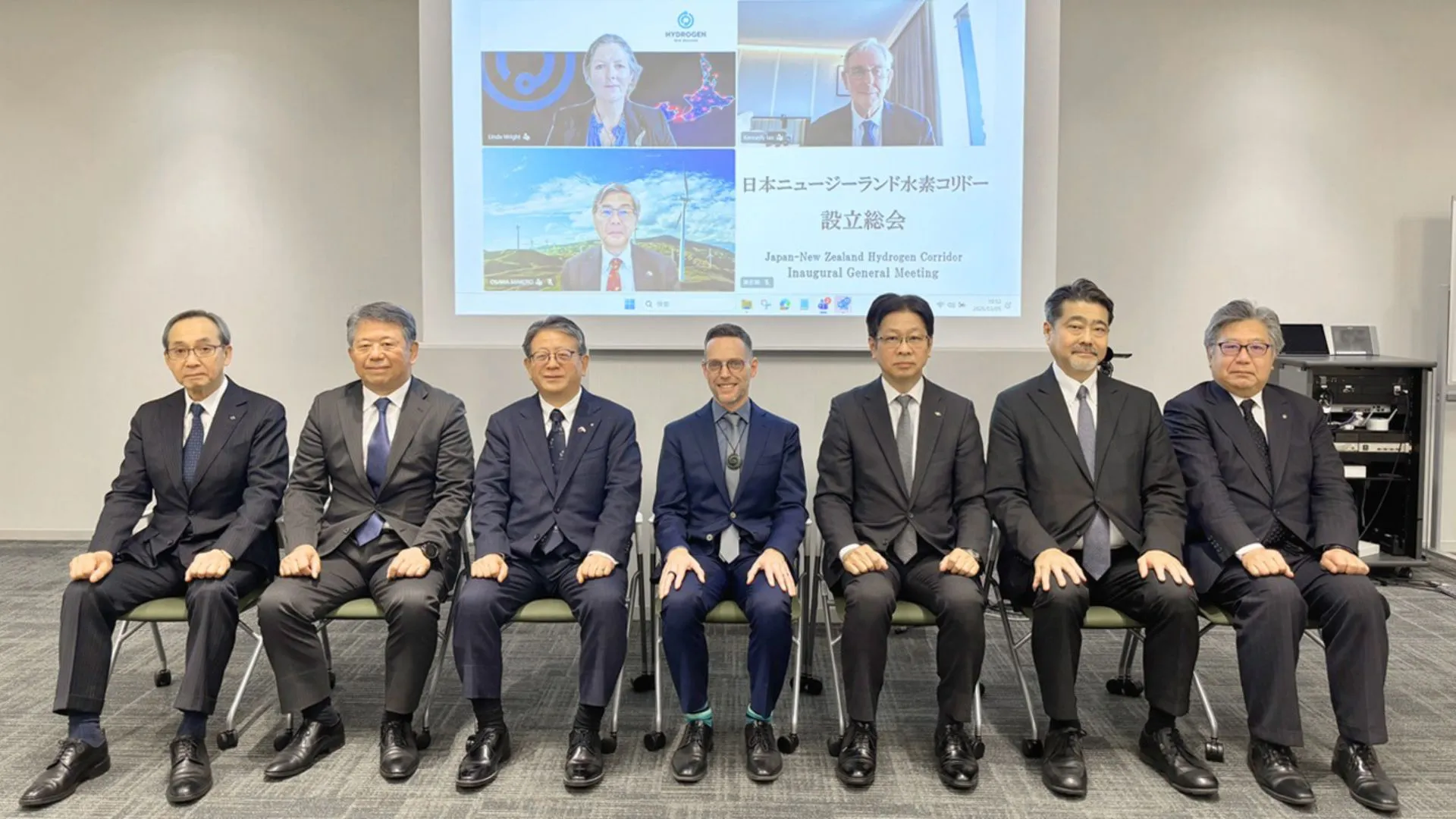
March 5 marked the official launch of the Japan-New Zealand Hydrogen Corridor, an initiative led by Japanese companies Mitsui O.S.K. Lines, Obayashi Corporation, Kawasaki Heavy Industries, and Chiyoda Corporation. The consortium has agreed to proceed with joint studies to enable green hydrogen production on New Zealand soil and establish its systematic export to Japan.
Japan, with an energy self-sufficiency of barely 15%, faces the challenge of diversifying its clean energy sources. Despite advances in renewable generation, the country recognizes that its internal capacity will not be sufficient to meet future demand for clean hydrogen. This is where New Zealand comes in, a country with over 85% of its electricity generated from renewable sources such as hydroelectric, geothermal, and wind.
Renewable production and hydrogen corridor development
The plan includes the development of production infrastructure in New Zealand, utilizing its abundant availability of renewable energy. The goal is to build a supply chain that will enable the efficient export of green hydrogen to Japan by the early 2030s. These exports target hard-to-decarbonize sectors such as steel, the chemical industry, and maritime transport.
The companies involved bring solid technical and logistical support to the table. Mitsui O.S.K. Lines will handle maritime transport, while Obayashi will focus on facility construction. Kawasaki Heavy Industries and Chiyoda will provide technology for hydrogen liquefaction, storage, and conversion.
An initiative with institutional backing
Government support is key to this initiative. New Zealand’s Hydrogen Action Plan, published in 2024, reinforces the role of the private sector and promises to reduce regulatory barriers. In parallel, Japan continues to promote strategies for clean fuel imports as part of its carbon neutrality plan for 2050.
Feasibility and logistics chain design studies will begin in fiscal year 2026. The ultimate goal is to position New Zealand as a hub for green hydrogen production and export to Asia-Pacific, while strengthening Japan’s energy security.
This collaboration establishes a model of international energy integration based on sustainability, technology, and diplomatic cooperation.
Source and photo: MOL