
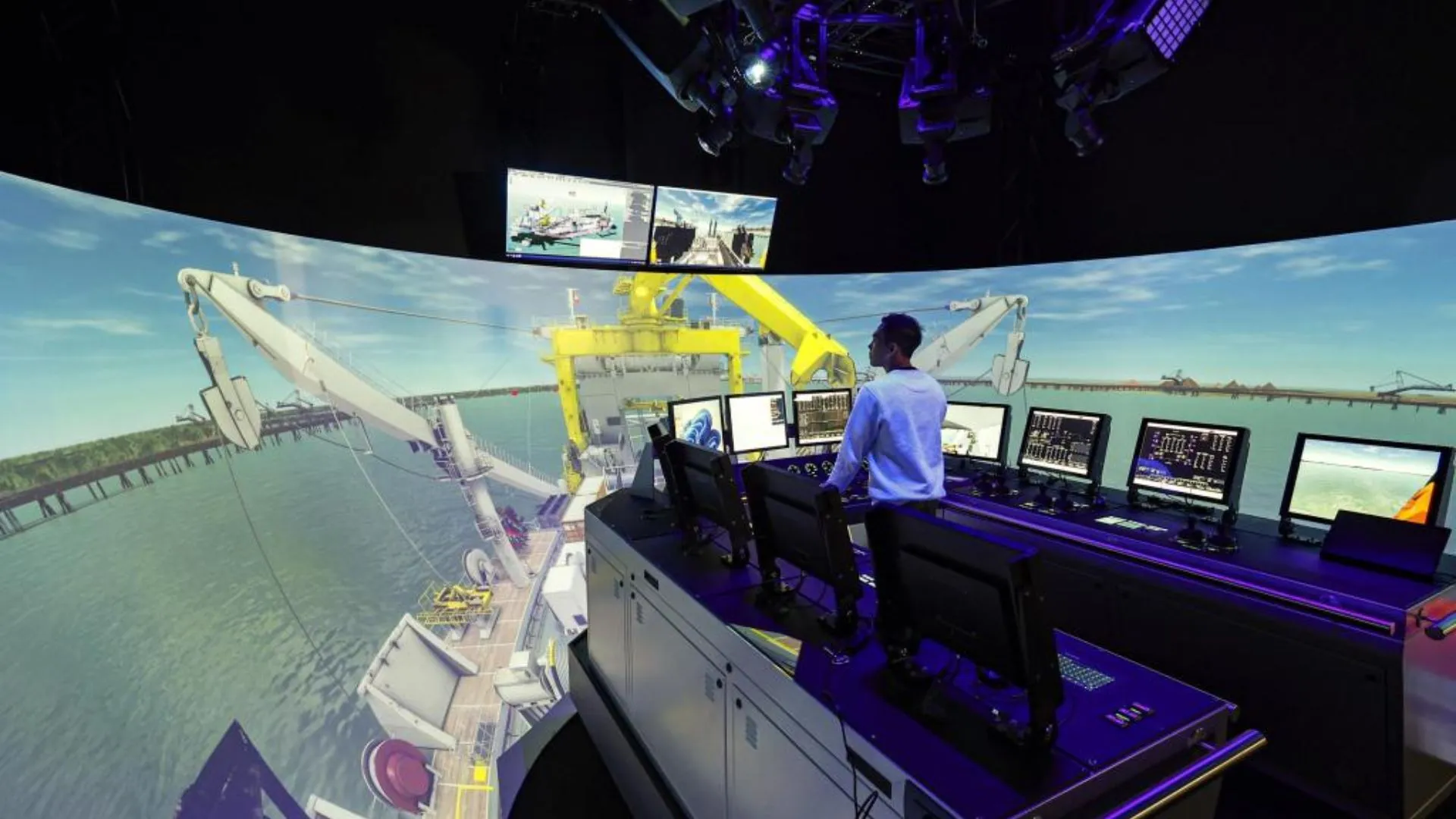
At its headquarters in Aalst, Belgium, Jan De Nul is about to launch its offshore wind simulator designed for training on wind farm installations. The most prominent one faithfully reproduces the maneuvers performed with cranes on board specialized ships. specialized vessels such as the Voltaire and the Les Alizés.
Thanks to a digital twin that replicates these new-generation ships, the new generation vessels, the simulatorthe simulator allows operators to practice wind turbine installation installation of wind turbines and large-scale and large-scale foundations in realistic conditions, including high waves, shifting winds and seabed subsidence. The foundations handled in the exercises can reach two thousand tons, similar to the weight of several commercial aircraft.
Crane simulator for collaborative training
The company is committed to training that goes beyond technical operation. The simulator includes the possibility of training up to four roles at the same time, each from separate rooms, simulating onboard communication during a real operation. This approach makes it possible to detect coordination failures and improve teamwork before going to sea.
Stefan Bruggeman, head of simulators at Jan De Nul, explained that the aim is to minimize risks through thorough preparation that takes into account all possible scenarios. The training environment features a wrap-around dome seven meters in diameter, providing a 360-degree view to fully immerse the operator.
Dredging and cutting simulation
In addition to the crane simulator, the company has also developed a specific simulator for cutter and suction dredgers such as the Willem van Rubroeck. This vessel is used to remove hard materials from the seabed, a crucial task in preliminary phases of offshore projects. With this simulator, teams can rehearse complete dredging operations before setting sail.
The implementation of these simulators represents a step forward in the preparation of offshore wind offshore wind projectsprojects, allowing Jan De Nul and its partners to improve safety, efficiency and communication on board their vessels during complex offshore operations.
Source and photo: Jan De Nul