
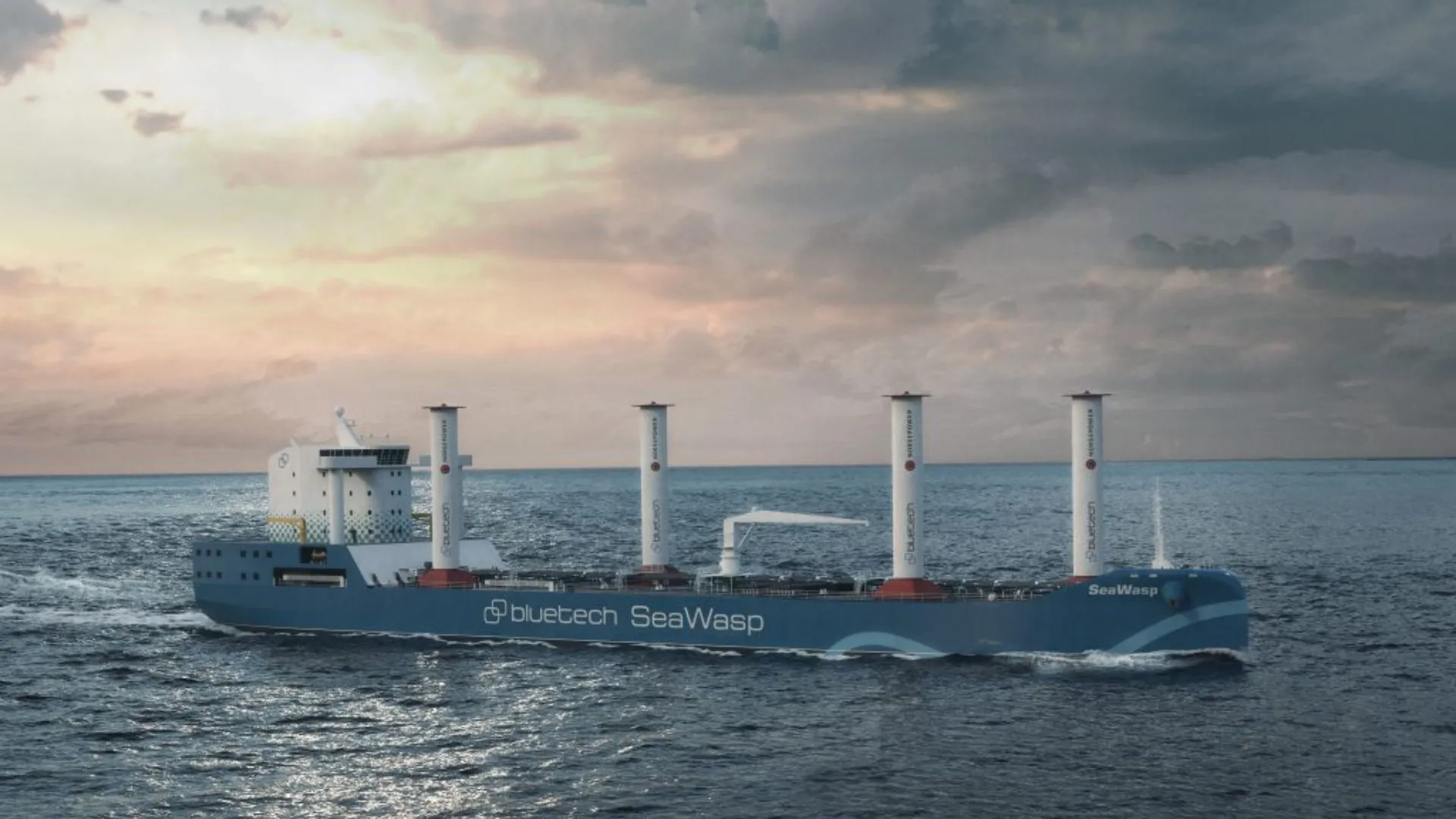
In a collaboration that redefines maritime energy efficiency, International Seaways (INSW), Bluetech and Norsepower have demonstrated the real potential of wind propulsion in the transport of crude oil. potential of wind propulsion in the transport of crude oil.. The SeaWasp project, focused on the design of a sail-based tanker optimized from the ground up for wind, has exceeded expectations in terms of fuel savings and emissions reductions.
The new vessel incorporates two rotor sails Norsepower 35 meters high by 5 meters in diameter, capable of generating thrust equivalent to 876 kW of propulsive power. This translates into an estimated savings of 597.2 metric tons of marine fuel per year on representative routes such as San Francisco-South Korea. According to Bluetech, the hull design alone provides a 13.5% improvement under certain operating conditions.
Sail tanker design for real operations
Unlike other models that simply adapt wind solutions to existing vessels, the design of the Rotor Sail design has been specifically conceived to take full advantage of wind wind assistance. Michael LaGrassa, INSW’s director of Performance and New Construction, stressed that the focus of the project was to ensure that the vessel would meet the usual commercial constraints without compromising its carrying capacity or unduly increasing construction costs.
Key innovations include a streamlined superstructure and semi-enclosed mooring stations to reduce wind resistance. Below the waterline, a so-called “blueSURF” fin system has been integrated, which, according to CFD simulations, contributes significantly to hydrodynamic performance and energy savings.
Evaluation in various routes and conditions
The study was not limited to ideal conditions. Less favorable wind conditions were also simulated, such as the South Korea-Singapore route, where savings of 185.9 metric tons per year were still achieved. This reinforces the feasibility of the design as a practical solution for global trade routes.
In addition, comparisons were made between different sail configurations. Although four 24 x 4 meter sails provided good performance, the cost-benefit analysis favored the use of two 35 x 5 meter sails as the most efficient option.
WASP technology as the backbone of efficiency
SeaWasp is an example of an advanced application of Wind Assisted Ship Propulsion (WASP) technology. Bluetech’s Sam Robin explained that a design was achieved that preserves the essential functionalities of a tanker while increasing its operational efficiency.
For his part, Ville Paakkari, R&D manager at Norsepower, highlighted the potential that these developments have when combined with intelligent control systems such as Norsepower Sentient Control, which could translate into even greater savings in future implementations.
The joint initiative not only evidences a technical breakthrough, but also positions wind propulsion as a viable and efficient option for the decarbonization of heavy shipping.
Source and photo: Norsepower