
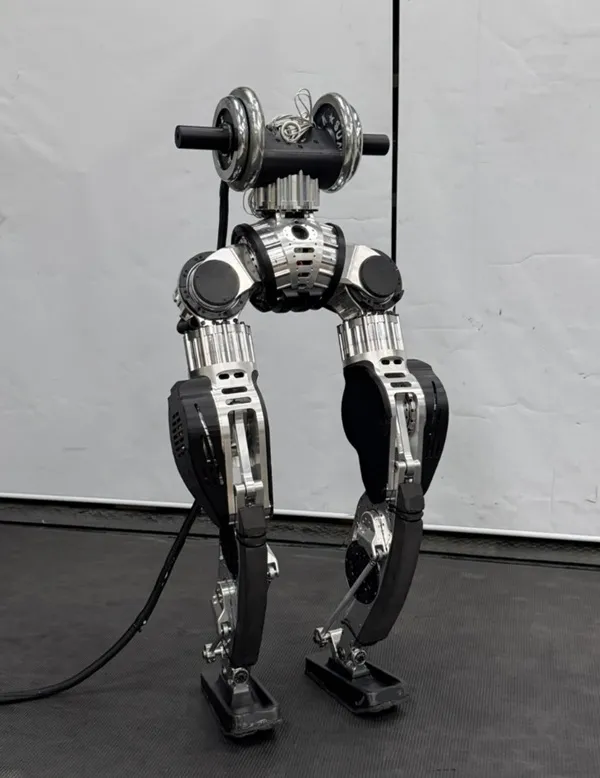
Capable of walking on uneven terrain and with the potential to operate in complex lunar and industrial environments, KAIST introduces a new humanoid robot that marks a breakthrough in robotic autonomy and control.
Full control from hardware to artificial intelligence
The research team at the Center for Humanoid Robots (HuboLab), led by Professor Hae-won Park of KAIST’s Department of Mechanical Engineering, has independently developed a new bipedal robotic platform.
This system stands out for its mobility performance, with a maximum speed of 12 km/h and the ability to overcome steps of up to 30 cm.
The robot’s design, with human proportions (165 cm in height and 75 kg in weight), is intended to operate in human-centered spaces. KAIST has manufactured all the essential components, from motors to controllers, consolidating its technological independence in the field of robotic hardware.
From simulation to reality: a humanoid robot
The implementation of an artificial intelligence controller trained by reinforcement learning in simulated environments has been one of the most relevant aspects, achieving later its successful application in real scenarios.
This transition overcomes the challenge known as the simulation-reality gap, opening up new possibilities for the deployment of robots in demanding conditions. deployment of robots in demanding conditions very extreme conditions.
The humanoid robot has been tested with complex movements, demonstrating its dynamic stability even without visual feedback. In addition, it can run continuously and maintain balance on uneven surfaces.
International cooperation and development of complete systems
This breakthrough is part of a larger project that aims to build a complete humanoid robot. To do so, KAIST is collaborating with MIT and other internal divisions such as the Kim Jaechul School of AI and the Department of Electrical Engineering. The goal is to integrate arms, hands, navigation and manipulation to create a system capable of operating doors, carrying heavy objects or manipulating valves while walking.
Acrobatic maneuvers of Jumping Robots
In parallel, the team has developed a one-legged humanoid robot that achieves repetitive jumps and 360-degree somersaults. These experiments were conducted without biological reference models, relying on a proprietary AI controller based on center-of-mass velocity and landing impact reduction.
Presentations and publications
The results were presented at the international conference “Humanoids 2025” and the “Conference on Robot Learning (CoRL)”, highlighting both hardware development and artificial intelligence achievements. Researchers JongHun Choe, Dongyun Kang and Gijeong Kim have been instrumental in these advances.
The project has been funded by the South Korean Ministry of Trade, Industry and Energy and the Korea Evaluation Institute of Technology (KEIT), cementing Korea as a leader in the development of autonomous humanoid robots for extreme environments.
Source: Kaist