
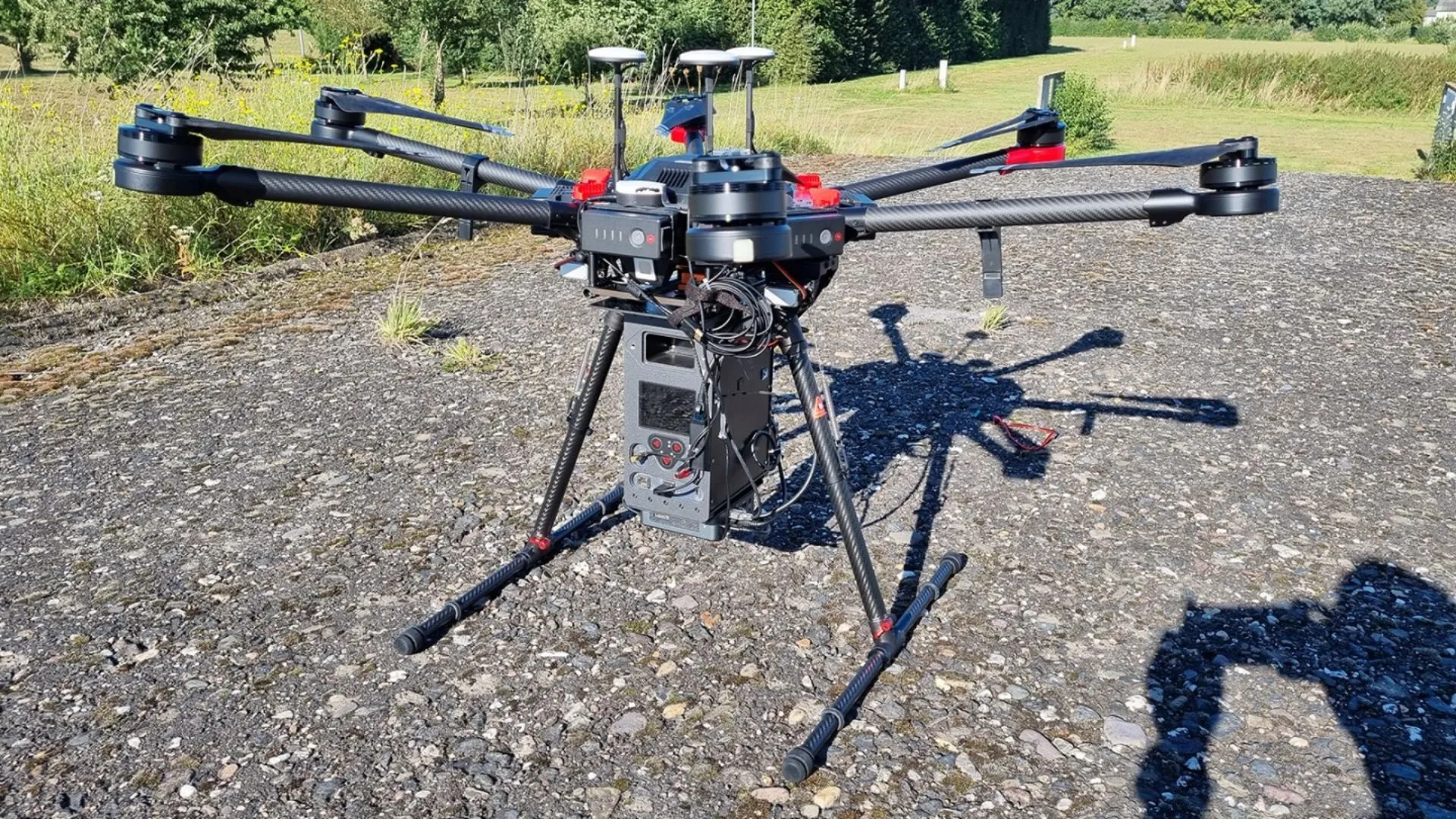
The detection of radioactive materials by drones and robots in emergency contexts no longer relies exclusively on manual operations and extensive searches with hand-held instruments. Researchers at the Fraunhofer Institute FKIE have developed a system consisting of drones (UAS) and ground robots (UGV) that makes it possible to identify and locate radioactive sources in a matter of minutes.
An automated aerial system with metric precision
The core of the system is a UAS equipped with gamma sensors, infrared cameras, LTE modules, GPS and an IMU that records the trajectory in 3D. After a first scanning phase that scans the target area, the drone adapts its flight pattern autonomously when it detects a radioactive anomaly. Thanks to stochastic algorithms, the system probabilistically estimates the location of the material and generates reference points that allow its rapid identification.
During tests at the WIS facility in Münster, the prototype was able to track a radioactive source to within a few meters in less than ten minutes. According to the researchers, a cesium capsule like the one lost in Australia in 2023 would have been located in record time with this technology.
Drones and robots for ground support and safe handling
UGVs complement aerial work in high-risk environments for humans. Equipped with CBRNE sensors, manipulator arms and autonomous autonomous navigationThe robots map heat in real time and allow manipulation of radioactive objects through assisted control. Thanks to the click-and-grab function, it is possible to move hazardous materials with precision from a remote interface.
In addition, new 3D visualization and operator-worn sensor control functions facilitate more intuitive remote intervention, even by non-specialized personnel. These capabilities make it possible to map security corridors and estimate the extent of the threat with geo-referenced data.
Practical application in civilian and military contexts
The project is being developed on behalf of the Bundeswehr through the Research Institute for Protective Technologies (WIS). It is structured in two phases: HUGIYN, aimed at detecting iodine and gamma emitters, and SLEIPNIR, focused on simultaneous tracking of multiple moving nuclides and increasing the aerodynamic efficiency of the system.
This technology not only optimizes CBRNE threat defense operations, but also represents a critical tool for civil protection, contaminated area control and industrial disaster response. industrial or nuclear or nuclear disasters.
Sensor integration, automation and real-time analysis
The key to the system lies in the fusion of data from multiple sensors and autonomous onboard processing, without the need for constant connection to the control center. This allows an agile and localized reaction, reducing exposure times and improving operational decision making.
Simulations in real scenarios such as Zwentendorf and ELROB have validated the effectiveness of the system, laying the groundwork for its implementation in critical environments both in Germany and in other European countries.
Source and photo: Fraunhofer