
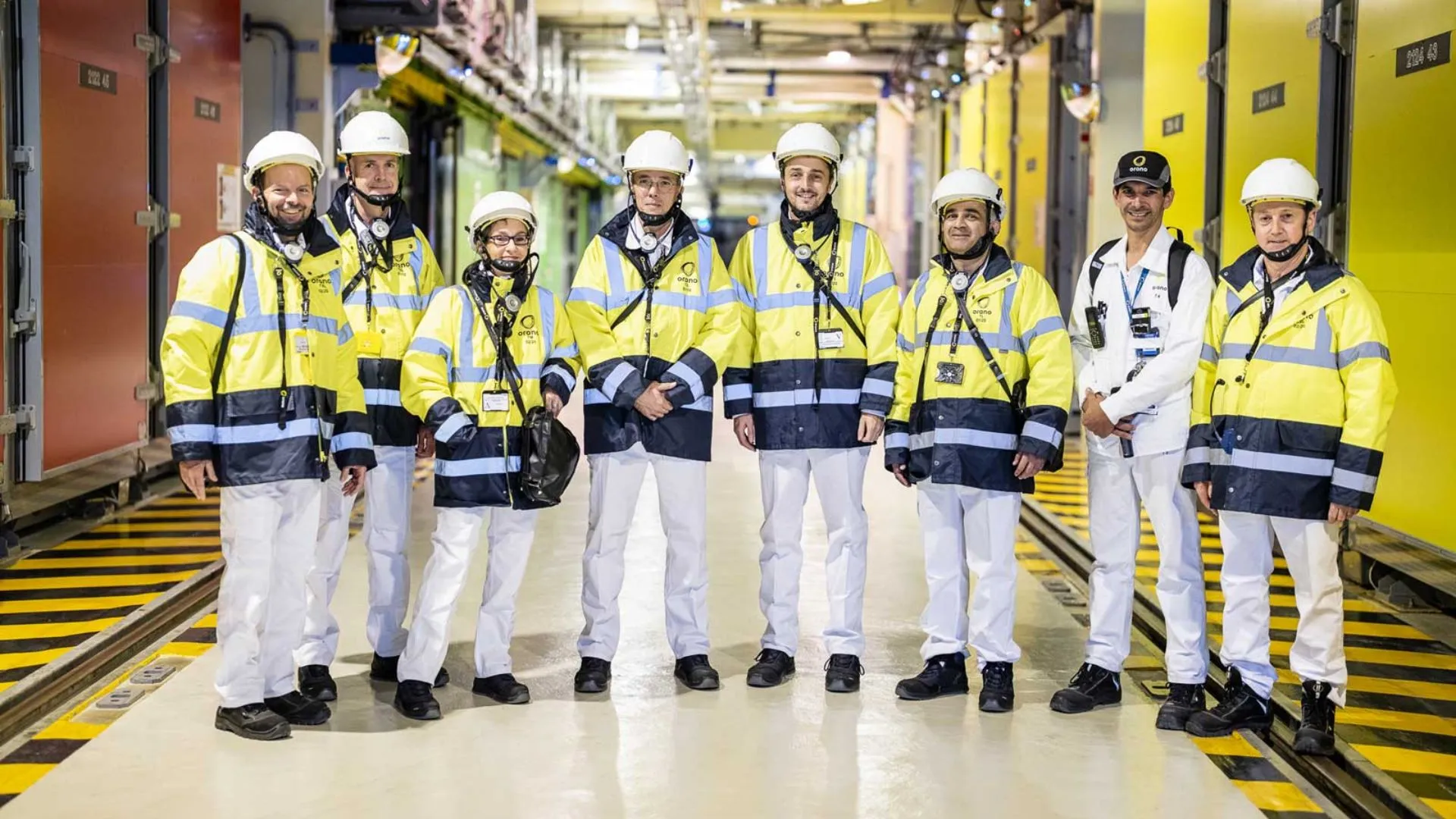
Orano recently welcomed a delegation from the European Investment Bank (EIB) to showcase the tangible progress made in expanding the Georges Besse 2 uranium enrichment plant, which is on schedule and within budget.
The European Union’s financial institution, which granted a €400 million loan for this project in March 2025, thus reaffirmed its commitment to a key infrastructure for the energy transition and the security of European supply. This investment is part of the RePowerEU program, aimed at reducing the EU’s dependence on external energy sources, especially Russian.
Energy production for 120 million households
Since its launch in October 2023, the Georges Besse 2 project has mobilized more than 180 companies, many of them regional, for the execution of works to add four new modules to the fourteen existing ones. These units will start operating from 2028 and will be fully functional by 2030.
With this expansion, enriched uranium production capacity will increase significantly, with the potential to supply low-carbon energy to approximately 120 million European households each year. This is a decisive step towards a cleaner and more autonomous energy matrix.
Georges Besse 2 and European energy sovereignty
Orano’s CEO, Nicolas Maes, stressed the importance of the project as a strategic pillar for European energy sovereignty. In addition to the geopolitical impact, this expansion boosts the French industrial ecosystem by integrating numerous SMEs into the development of state-of-the-art European nuclear technology.
For his part, EIB Vice-President Ambroise Fayolle stressed that supporting this type of infrastructure strengthens both the continent’s autonomy and its ability to respond to unstable energy scenarios.
A work within the calendar and with a climate focus
At present, More than 70% of the concrete required for the project has already been poured, reflecting the steady pace of execution. This is indicative of the steady pace of execution. According to Orano, strict safety and efficiency standards have been implemented, in line with the European Union’s climate objectives.
François Lurin, executive vice president of Orano, highlighted the joint commitment of the teams and partners involved.
Thanks to a shared effort, we are moving towards a more energy-independent Europe.
said during the EIB visit.
The Tricastin plant is thus shaping up to be an essential infrastructure in Europe’s energy future, combining European technology, public investment and industrial collaboration.
Source and photo: Orano