
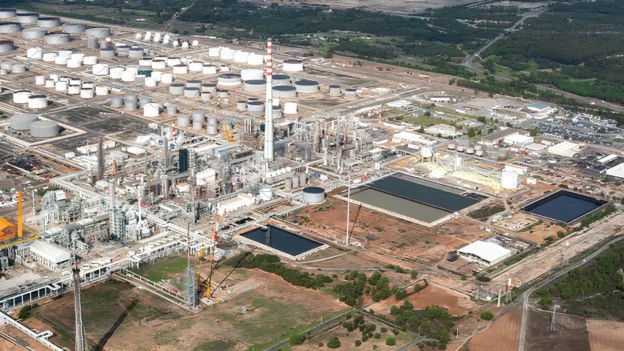
Galp has announced that its ambitious HVO@Galp project, aimed at the production of advanced biofuels, will be operational in 2026. Located at the Sines refinery, the complex will produce renewable diesel (HVO) and sustainable aviation fuel (SAF), two alternatives with a lower climate impact than traditional fossil fuels.
What will these fuels be made from?
The new biofuel plant will use used cooking oils, animal fats and other biological waste as feedstocks, combined with green hydrogen generated at Galp’s H₂ Park. This synergy will make it possible to transform waste into energy, within a circular and low-carbon economy model.
From an environmental standpoint, the project will reduce greenhouse gas emissions by up to 88%, and will prevent the discharge of approximately 800 thousand tons of CO₂ per year. In addition, water use will be minimized through the reuse of rain and treated water along with actions to preserve local species such as the Cabrera rat.
Million-dollar investment with impact on employment and local development
With an investment of 400 million euros, the HVO@Galp project will generate up to 1,050 jobs during its construction phase. Once operational, it is estimated that between 226 and 276 direct and indirect jobs will be created.
The complex will be integrated into the existing infrastructure of the Sines refinery and on land in the Sines Industrial and Logistics Zone (ZILS), covering more than nine hectares and three operational areas: feedstock pretreatment, production unit and auxiliary systems.
Biofuels ready for today’s transportation
One of the strengths of the project is that the fuels produced will be fully compatible with current infrastructure and engines, both in road transport and aviation. This will enable progress to be made in decarbonization without the need to renew the vehicle fleet or build new distribution networks.
In addition to HVO and SAF, the plant will produce bionaphtha, biopropane and renewable gas, expanding the portfolio of clean energies available in Portugal and contributing to meeting the objectives of the PNEC 2030, the RED II directive and the RNC 2050 strategy.
Source: Galp