
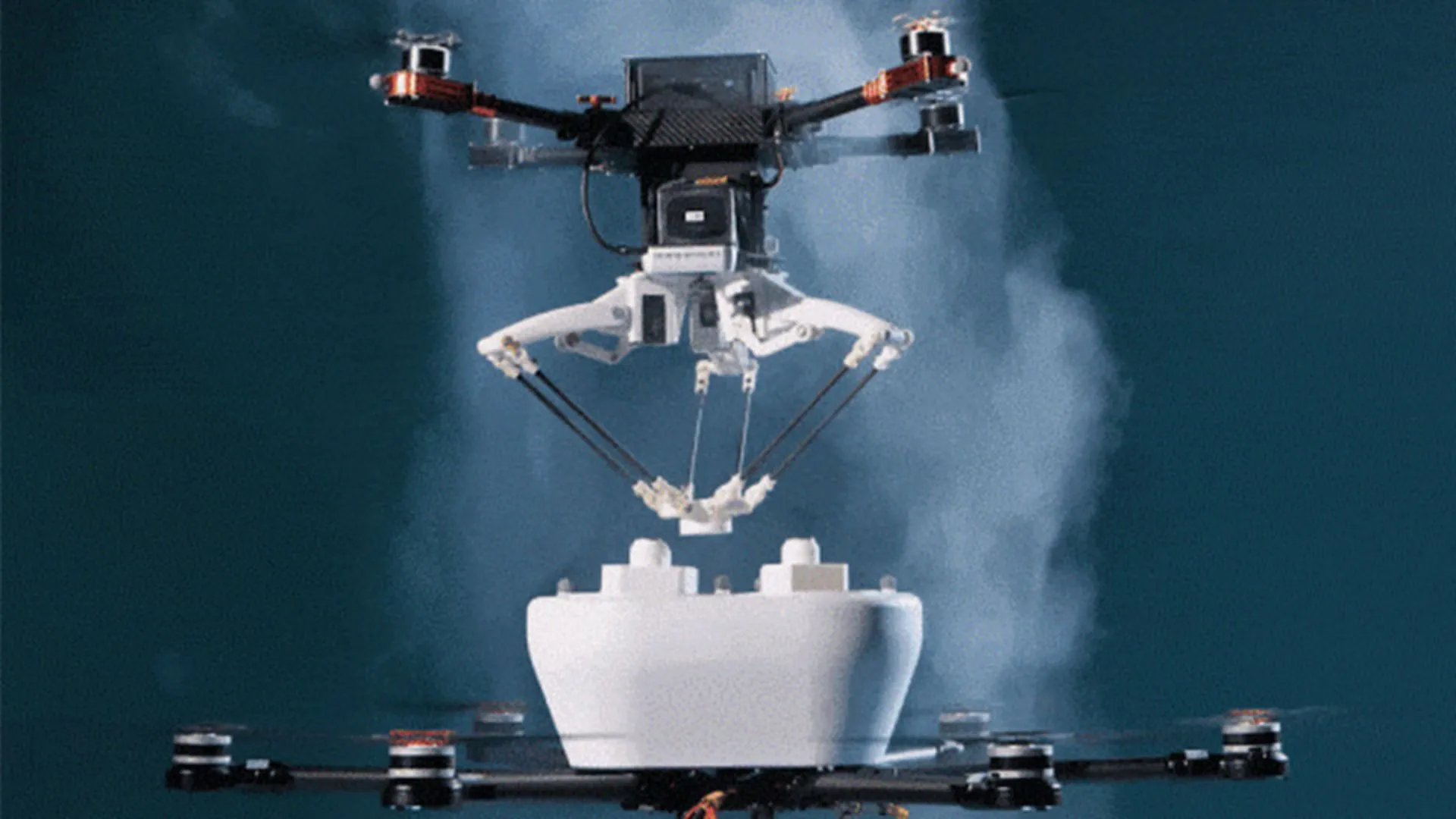
A collaboration between Westlake and Loughborough universities has achieved a remarkable breakthrough in aerial manipulation. Through a new system called “Flying Toolbox,” researchers have demonstrated that it is possible for one drone to deliver tools to another in mid-flight, without human intervention.
The key to this development lies in the coordinated use of two types of drones: one acts as a manipulator arm capable of performing specific tasks, while the other functions as a transport platform equipped with various tools. Both operate in vertical formation, overcoming turbulence caused by downwash.
Drone cooperation: high-precision operations
The system incorporates magnetic couplings, visual tracking via QR codes and real-time airflow prediction algorithms. These elements allow the manipulator drone to attach to the desired tool with an accuracy of less than one centimeter, even in unstable air conditions.
The researchers compare this dynamic to the interaction between a surgeon and a nurse during an operation: the drone with tools “delivers” them one by one, while the aerial manipulator executes the specific task.
Applications in high-risk environments
The potential of this technology goes beyond technical demonstration. The drones could be deployed to perform inspections and repairs on vertical infrastructure such as electrical towers, wind turbines and tall buildings, which currently require operators exposed to risk.
It is also considered useful in rescue or maintenance operations in areas affected by disasters.
In addition, the system is designed to be scalable. Multiple drones can be integrated into one operation, opening the door to true cooperative aerial teams capable of executing complex tasks through the dynamic exchange of tools.
Importantly, the team is already working on adapting the system to outdoor environments and on more versatile robotic arms to expand the range of tasks that can be performed from the air.
Details of the research were published in the journal Nature.
Source and photo: Loughborough University