
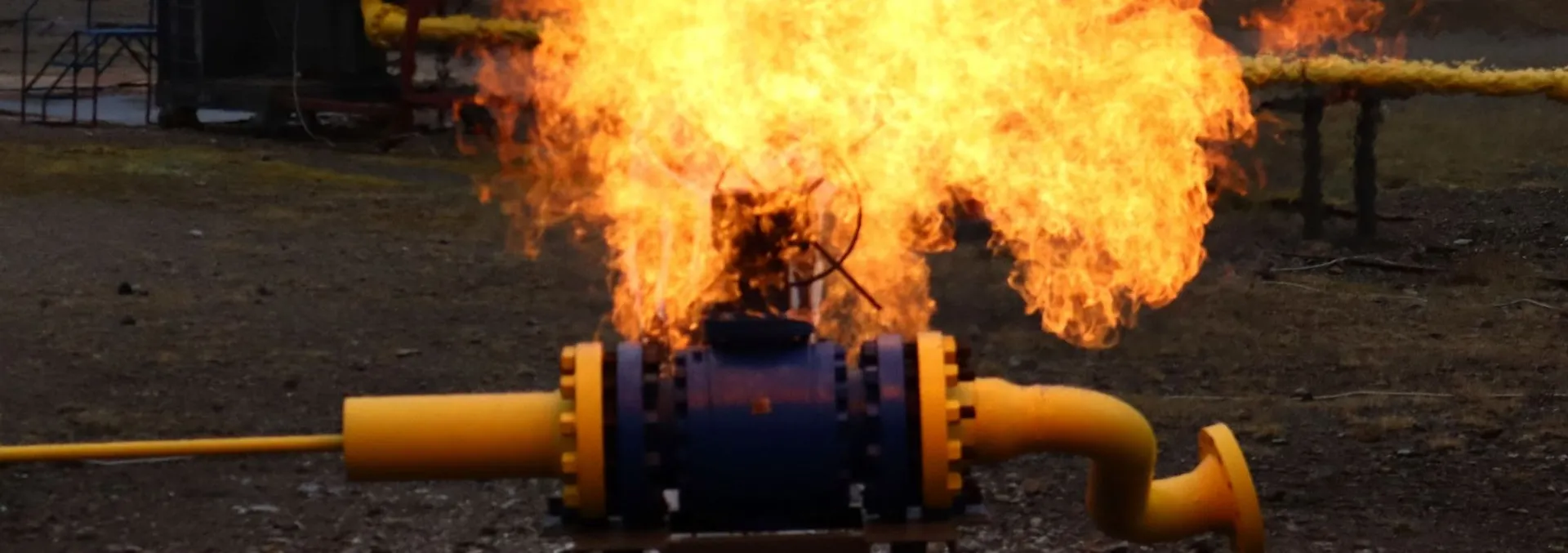
New standard for 3D mapping of detectors
The international certification and risk management organization DNV announced the launch of recommended practice DNV-RP-A102, aimed at strengthening the design and validation of three-dimensional mapping of flame detectors in process facilities.
JOSEEThe document establishes technical criteria for determining the optimal number, location and orientation of detectors within oil and gas plants, chemical facilities and high-risk energy assets.
The recommended practice follows a review of existing studies, which identified limitations in traditional 3D coverage calculation methods, especially the use of simplifying assumptions that do not reflect the actual physical behavior of the detectors.
Uncertainty and ALARP in technical decisions
One of the most relevant contributions of RP-A102 is the explicit incorporation of uncertainty in detection coverage models. Traditionally, studies assumed deterministic parameters without quantifying operational or environmental variations.
The new approach integrates probabilistic analysis and performance evaluation under different fire scenarios, aligning the design with the ALARP (As Low As Reasonably Practicable) principle, widely adopted in process safety.
This makes it possible to technically justify the number of detectors installed, avoiding both under-coverage (which increases risk) and unnecessary over-installation that raises costs without significantly improving mitigation.
Impact on high-risk industries
The industrial context supports the relevance of this initiative. Between 2015 and 2024, IOGP member companies reported between 70 and 100 fires and explosions annually in the energy sector.
Likewise, insurance market reports indicate that fires represent a significant percentage of the major global oil and gas losses, often associated with mechanical failures that escalate rapidly.
RP-A102 proposes that 3D mapping is not just a geometric exercise, but a comprehensive analysis that considers lines of sight, structural obstructions, detector spectral sensitivity, release scenarios and thermal propagation.
Source: https://www.dnv.com
Photo: Shutterstock