
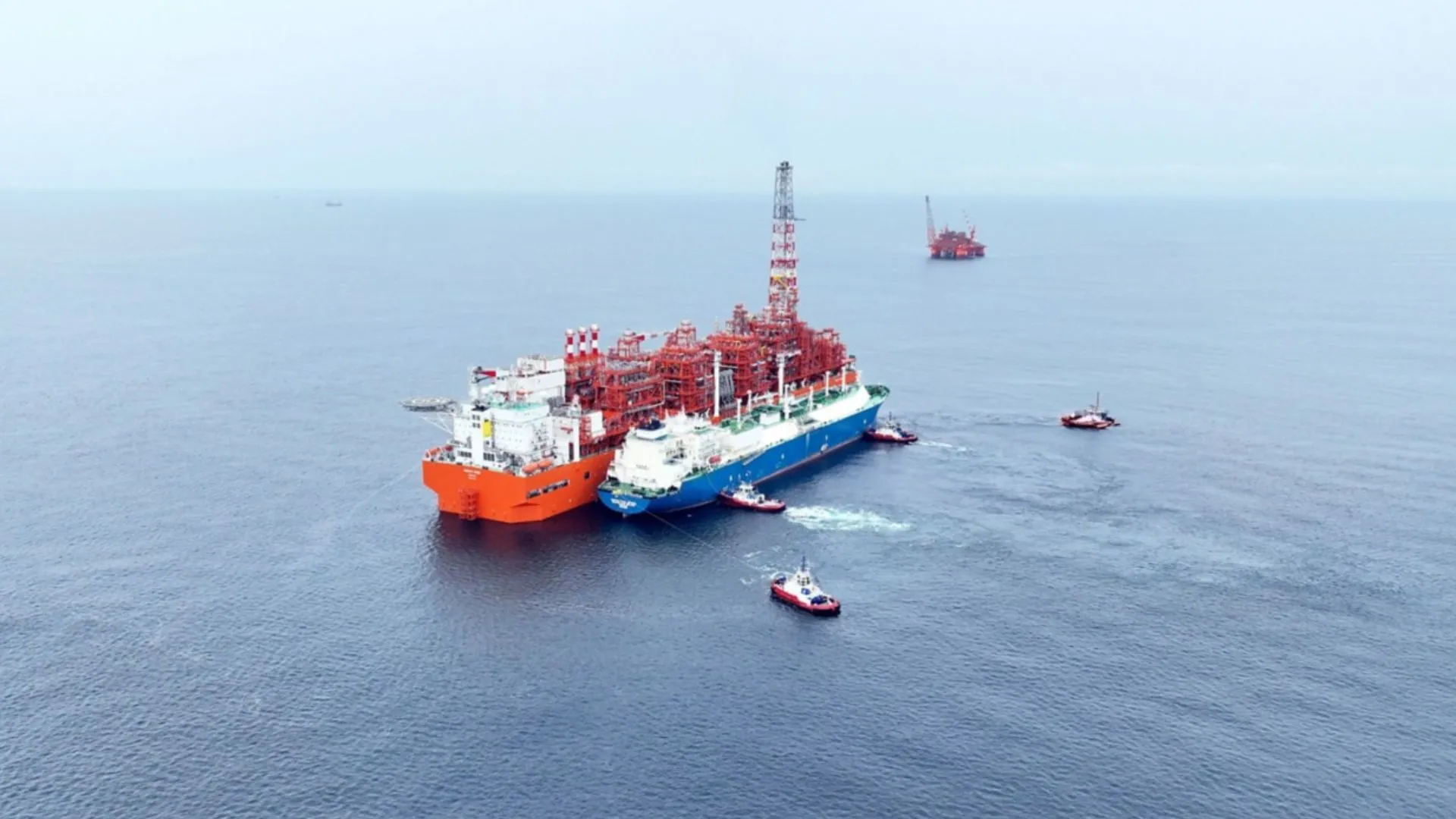
The President of the Republic of Congo, Denis Sassou N’Guesso, and Eni’s CEO, Claudio Descalzi, led the reception of the first cargo of liquefied natural gas corresponding to Phase 2 of the Congo LNG project, formally initiating a new stage of exports from the country.
Installed capacity supporting the Congo LNG project
With this operation, Eni consolidates the commercial start-up of a floating infrastructure designed to meet the growing international demand for gas. The Nguya FLNG unit unit converts offshore resources into exportable volumes with tight lead times and a competitive cost structure.
With the entry into operation of Phase 2, Congo LNG reaches a total liquefaction capacity of 3 million tons per year. This production is supported by the development of the Nené and Litchendjili fields, located in the Marine XII marine license.
Likewise, the integration of producing fields and floating technology allows for greater operational flexibility compared to other projects. onshore. This scheme reduces lead times, optimizes investments and improves the response to global LNG market conditions.
The company mentions that Phase 2 was completed in a timeframe below the industry average. The construction and commissioning of Nguya FLNG was completed in just 35 months, a time that reinforces Eni’s position as an operator specialized in rapid liquefied gas developments.
This development increases the availability of gas for international markets and is in line with the group’s strategy to expand its LNG portfolio to 20 million tons per year by the end of the decade, with projects distributed in different geographies.
The energy company has been present in the Republic of Congo since the late 1960s and is today the country’s main producer of associated and non-associated gas. It is also part of that production that goes to supply the national power plant, which covers about 70 % of the local power generation.
At the same time, the oil company participates in initiatives related to energy transition, agro-industrial development and improving access to basic services. These actions seek to integrate gas activity with long-term economic and social benefits for the communities.
Source and photo: Eni