
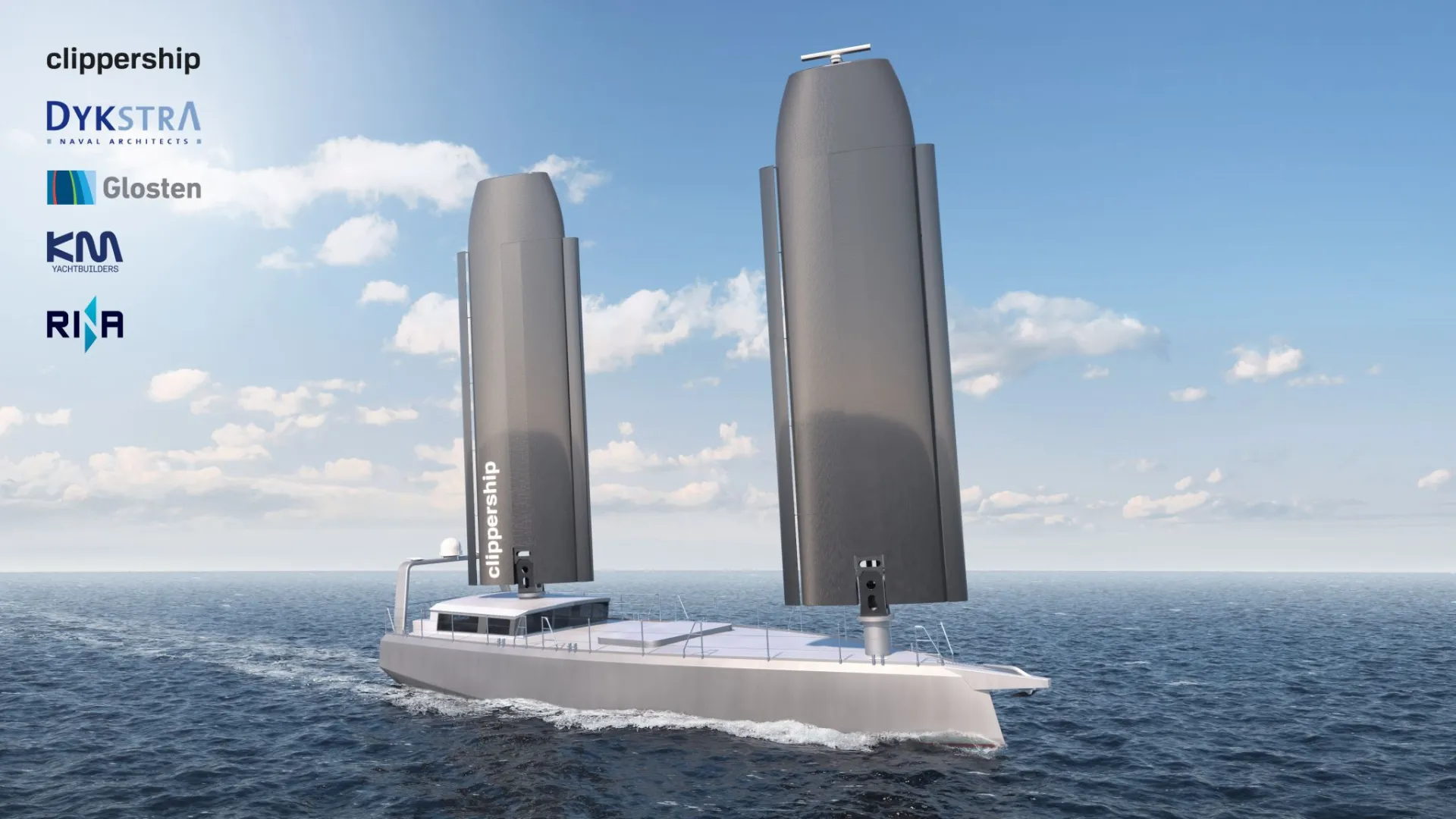
U.S.-based Clippership has confirmed the completion of the design of its first 24-meter autonomous cargo ship, powered primarily by wind energy. The project will be built by KM Yachtbuilders, a firm known for its expedition vessels and mastery of aluminum construction, at its facility in the Netherlands.
The vessel is expected to be launched by the end of 2026, flying the Maltese flag and operating on transatlantic, Caribbean and South American routes. This development represents a convergence between autonomy, sustainability and efficiency in the maritime cargo transport.
Characteristics of the vessel
The vessel will have twin folding rigid wings to provide the main wind propulsion and will have a cargo capacity of up to 75 europallets in a climate-controlled hold, ideal for medium and short routes.
Its structure will be made of aluminum, built under strict safety and sustainability standards. The entire project is aligned with RINA classification standards, ensuring international compliance in terms of safety and emissions.
International collaboration
The naval design has been in charge of Dykstra Naval Architects, responsible for emblematic sailing ships such as the Maltese Falcon and the Black Pearl. On the other hand, the structural engineering was developed by the American firm Glosten, specialized in naval architecture and marine engineering. marine engineering.
The autonomy systems and rigid wing technology have been developed in-house by Clippership, enabling more effective integration between hardware and software to maximize operational efficiency.
Beyond the Ship: A Transformative Vision
Founded in a Los Angeles garage, Clippership seeks to transform ocean logistics through small, automated, wind-powered vessels. Its approach aims not only to reduce environmental impact, but also to revive small ports and establish point-to-point trade routes that are currently not viable with traditional vessels.
With the launch of this 24-meter unit, Clippership hopes to initiate regular commercial operations that will serve as a pilot for a larger future fleet of autonomous cargo vessels.
A boost to the future of sustainable transportation
The signing of the contract and the start of construction represent a concrete step towards low-emission shipping. By integrating cutting-edge technologies with wind propulsion and autonomy, the Clippership vessel opens a new stage for the industry.
With support from leaders in design, engineering and construction, and a clear vision of sustainability, Clippership positions its first vessel as a replicable and scalable model for future cleaner and more efficient shipping routes.
Source and photo: KM Yachtbuilders