
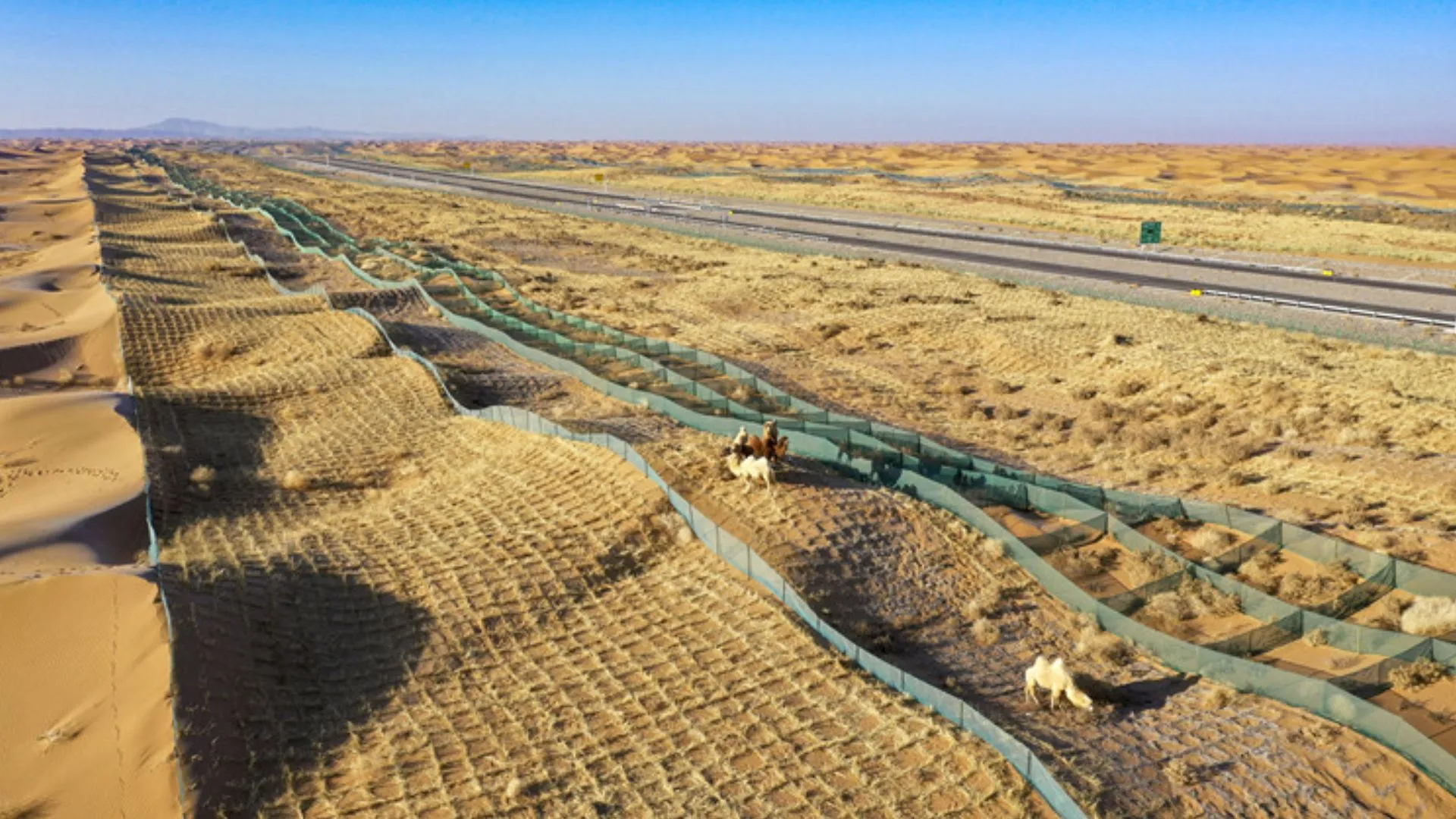
A team of researchers from the Northwest Institute of Eco-Environment and Resources, part of the Chinese Academy of Sciences, have demonstrated an initiative that would improve industrial waste management and the fight against desertification. This group has succeeded in converting out-of-service wind blades into porous barriers with the capacity to slow down the advance of sand in desert regions such as the Gobi.
Utilization of decommissioned wind turbine blades
These wind turbine blades, which are usually discarded after 20 to 25 years of use, can now be recycled directly in the arid areas where many wind farms are located. Through their high resistance to extreme conditions and abrasive wear, the new use prolongs their service life and reduces waste in the energy sector.
In addition, their flexural strength has been shown to be up to 14 times higher than that of conventional materials such as wood composite board. This ensures long life in hostile terrain, and also makes them effective structures for modifying sand flow close to the ground, according to wind tunnel tests and computer simulations.
Unlike straw or reed barriers, which degrade over time, these new structures maintain their integrity for years. Their implementation also offers a sustainable and efficient alternative to the growing environmental challenge posed by desertification in northwestern regions of China.
With the scheduled retirement of thousands of turbines under the ongoing five-year plans, the researchers propose that this method can be applied on a large scale to reduce the environmental impact of these wastes, making the most of the resources available in each area.
This project responds to the urgent need for integrated environmental solutions within the renewable energy industry. The initiative is led by Liu Benli and He Chenchen and represents a clear example of how applied research can generate multiple benefits: soil protection, efficient recycling and adaptation to climate change.
Source and photo: Northwest Institute of Eco-Environment and Resources