
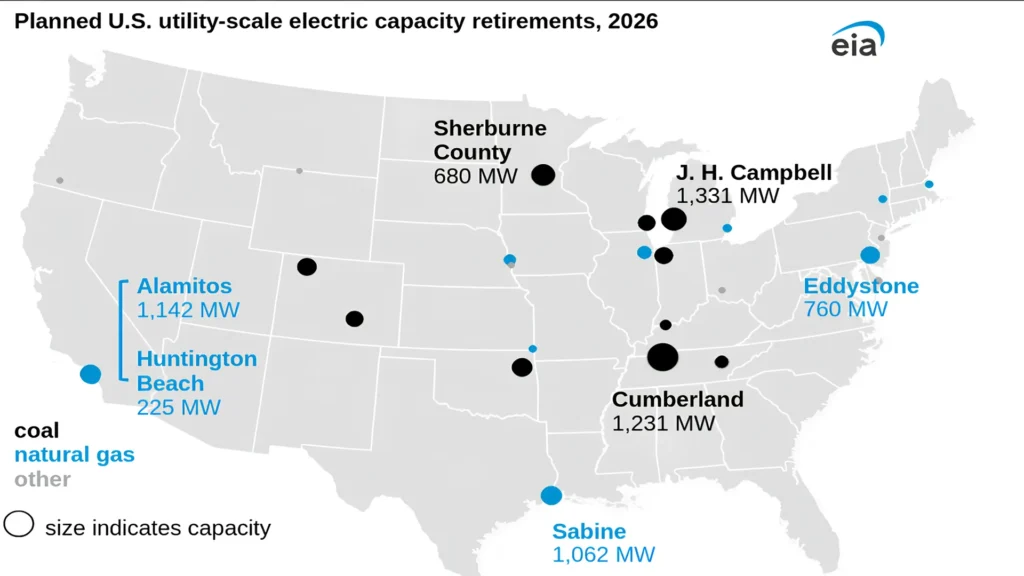
Power plant owners and operators in the United States plan to retire nearly 11 gigawatts (GW) of electric generating capacity through 2026, according to data from the Energy Information Administration (EIA). Most of this capacity comes from coal-fired plants (58%) and simple-cycle natural gas turbines (42%).
However, the trend of delays could be repeated. In 2025, 12.3 GW were planned for retirement, but only 4.6 GW were retired, the lowest figure since 2008, due to emergency orders from the Department of Energy (DOE), which kept several plants operational in the face of the need to ensure grid stability.
Coal is still present in the energy mix
6.4 GW of coal-fired generation capacity is expected to be retired this year, representing about 4% of the operational coal fleet by the end of 2025. However, this figure could change.
Several closings that were scheduled for 2025 were postponed to this year, among them:
- JH Campbell (Michigan): 1,331 MW
- South Oak Creek (Wisconsin): 616 MW
- RM Schahfer (Indiana): 722 MW
- Craig Station and Comanche (Colorado): 762 MW in total
- FB Culley (Indiana): 90 MW
In addition, the retirement of Unit 2 at Cumberland (Tennessee), with 1,231 MW, is one of the largest of the year.
Natural gas: technological transition
As for natural gas, 4.6 GW are projected to be retired, equivalent to 1 % of the current fleet. Most of this capacity corresponds to old steam turbines, which are less efficient than modern combined cycle units.
Two plants located in California, AES Alamitos and Huntington Beach, total 1,368 MW and mark the most significant retirements in this segment. These units had been scheduled for closure in 2020 and 2023, but were extended due to high electricity demand.
Other planned closures include:
- Elwood Energy (Illinois): Units 1 to 7, with 1,050 MW
- Sabine (Texas): Units 1, 3 and 4, with 1,062 MW.
- Eddystone (Pennsylvania): Units 3 and 4, with 760 MW (also previously postponed)
Energy policies and grid security
Regulatory decisions have been decisive. The Department of Energy has used its ability to issue emergency orders, allowing critical plants to remain operational in the face of consumption peaks or risks of outages.
This situation generates a domino effect; while new, more efficient plants are being planned, the older ones are not being taken out of the system as quickly as expected, which affects the energy transition objectives.
What to expect in 2026?
The U.S. electricity sector is at a crossroads: on the one hand, the need to move towards a cleaner and more efficient grid, and on the other, the urgency of maintaining supply reliability in the face of growing demand and extreme weather conditions. extreme weather conditions.
Unless conditions change significantly or more robust alternatives are developed, delays in retiring power generation capacity could become a constant beyond 2026.
Source: Energy Information Management