
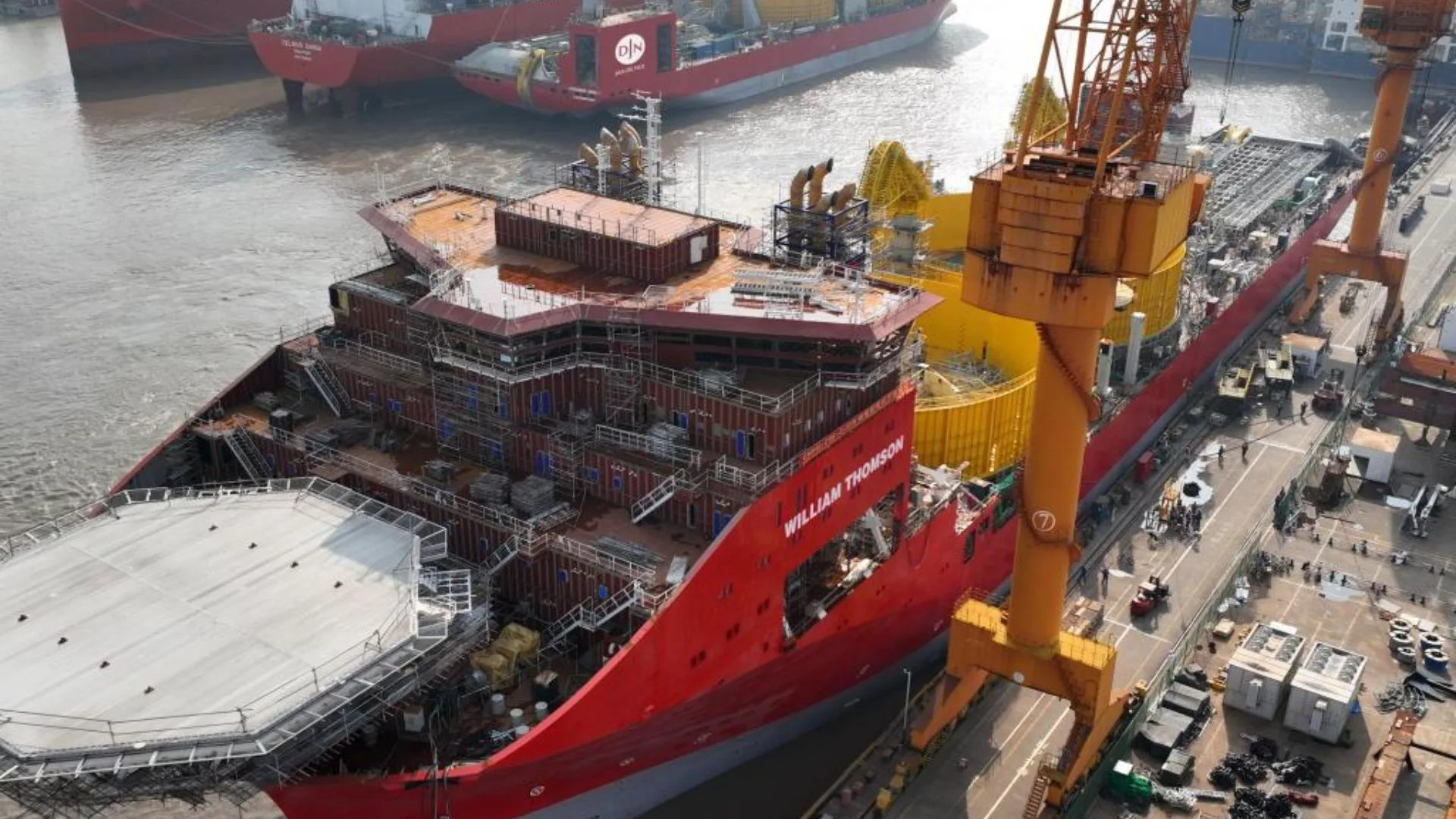
Jan De Nul, a company specializing in maritime engineering and offshore works, has launched the William Thomson vessel, one of the world’s largest cable-laying vessels. Together with its sister vessel Fleeming Jenkin, it will take part in the installation of more than 2,800 kilometers of subsea cables, facilitating the transmission of renewable energy between regions.
Technical specifications of the William Thomson vessel
The William Thomson vessel has a load capacity of 28,000 tonnes and a length of 215 meters. It is also equipped with three cable carousels and an additional hold for fiber optics, enabling it to install up to four cables simultaneously.
The vessel’s design is intended to operate in both shallow waters and at depths of up to 4,000 meters, thanks to its ramp and laying wheel system, along with tensioners capable of handling up to 150 tonnes.
Key to Europe’s energy transition
The William Thomson vessel will play a significant role in strategic projects such as the TenneT 2 GW program or the development of the Princess Elisabeth energy island in Belgium.
In terms of sustainability, the vessel incorporates ultra-low emissions (ULEv) technologies, and its filtration system removes up to 99% of nanoparticles and significantly reduces nitrogen oxides. It can also operate on biofuels and green methanol, while its hybrid electric battery system with 2.5 MWh optimizes energy consumption and reduces CO₂ emissions.
Jan De Nul’s strategic expansion
This vessel is part of Jan De Nul’s broader strategy to expand its specialized fleet. The company plans to add five additional new vessels for the installation and protection of subsea cables.
This commitment strengthens its position in an increasingly demanding market, where offshore infrastructure is essential to ensure a reliable and sustainable energy supply.
Source: Jan De Nul