
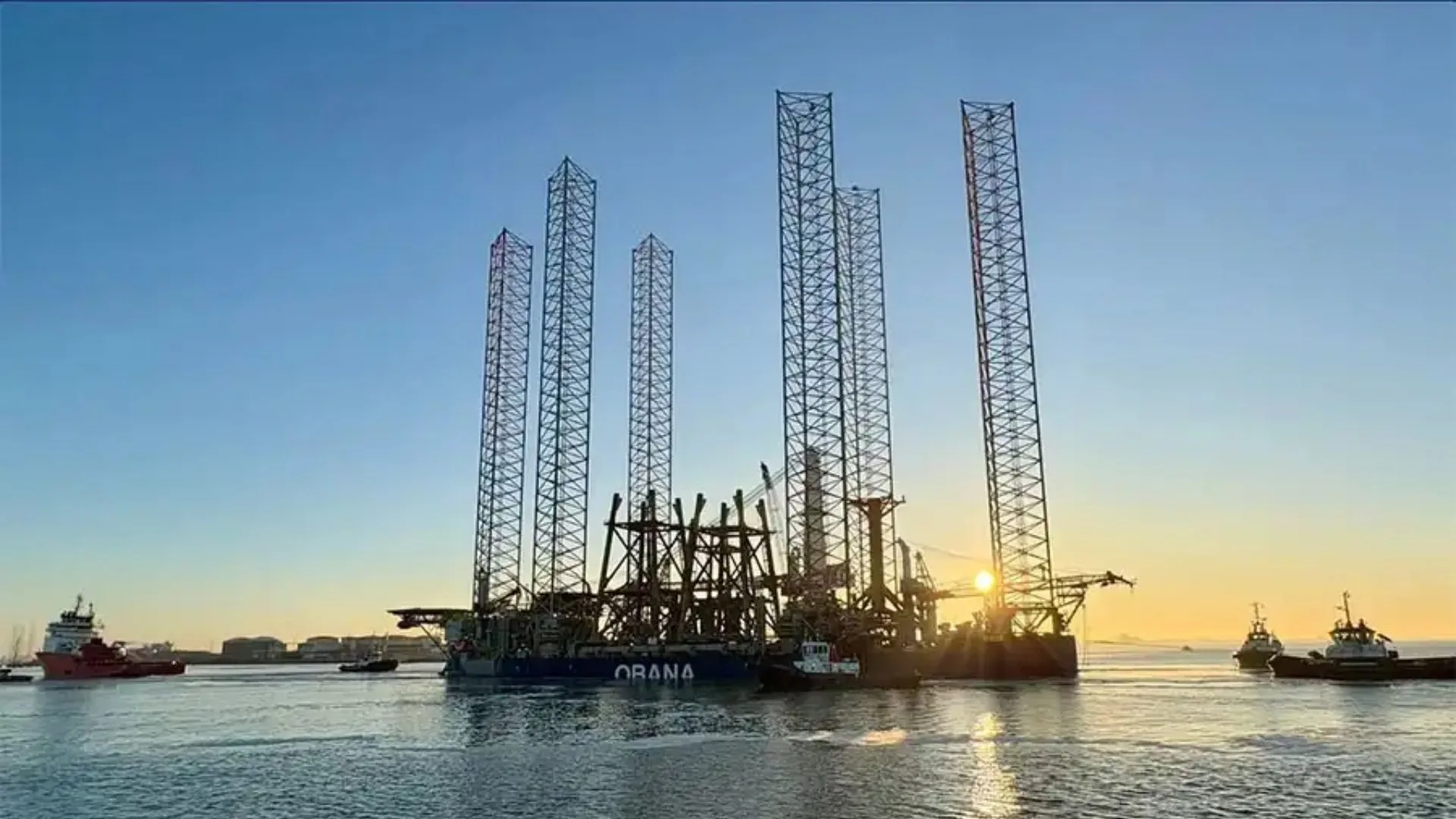
The jack-up vessel Obana, considered the world’s largest high-capacity jack-up vessel, has begun its first commercial offshore decommissioning operation in the UK sector of the North Sea. The unit has been deployed to execute a complex project for Perenco UK, marking a significant step forward in the removal of energy infrastructure.
An inaugural project with multiple platforms
First, the vessel is heading to the Galahad platform, located in block 48/12a. There, it will carry out the complete removal of the topside and the steel jacket.
Subsequently, the Obana will move to the Amethyst field, where it will decommission three support structures identified as C1D, A2D, and B1D. All recovered material will be transported to the Netherlands for processing, recycling, and final disposal.
Jack-up vessel Obana and its advanced marine engineering
Furthermore, the design of the Obana meets current offshore decommissioning requirements. The vessel can operate in depths of up to 65 meters and is equipped with a 2,000-ton main crane, along with a 3,800-square-meter work deck.
One of its most notable features is its 12,000-ton deck load capacity. Additionally, it incorporates a custom skidding system that allows for the reorganization of large structural modules at sea.
Thanks to this capacity, the vessel can dismantle and transport multiple platforms in a single campaign without needing to return to port, reducing operational time and logistics costs.
Circular economy applied to offshore decommissioning
In terms of sustainability, the Obana represents an innovative approach within the industry. Approximately 85% of its structure is made from recycled steel.
The vessel was developed by integrating two retired drilling rigs, Brage and Gabrus, combined with a new midsection built in Dubai. Final integration was completed at the Damen shipyard in Rotterdam.
This approach reinforces the role of the circular economy in the energy supply chain, especially in the context of closing mature offshore assets.
Outlook in the North Sea
Finally, after completing the work with Perenco UK, Petrodec plans to deploy the Obana for new decommissioning projects throughout the North Sea region.
The growth of these activities reflects a rising trend in the energy industry, where the safe and efficient removal of infrastructure has become an operational and environmental priority.
Source and photo: Dixstone