
Dual Engineering Drives Efficient Offshore Execution
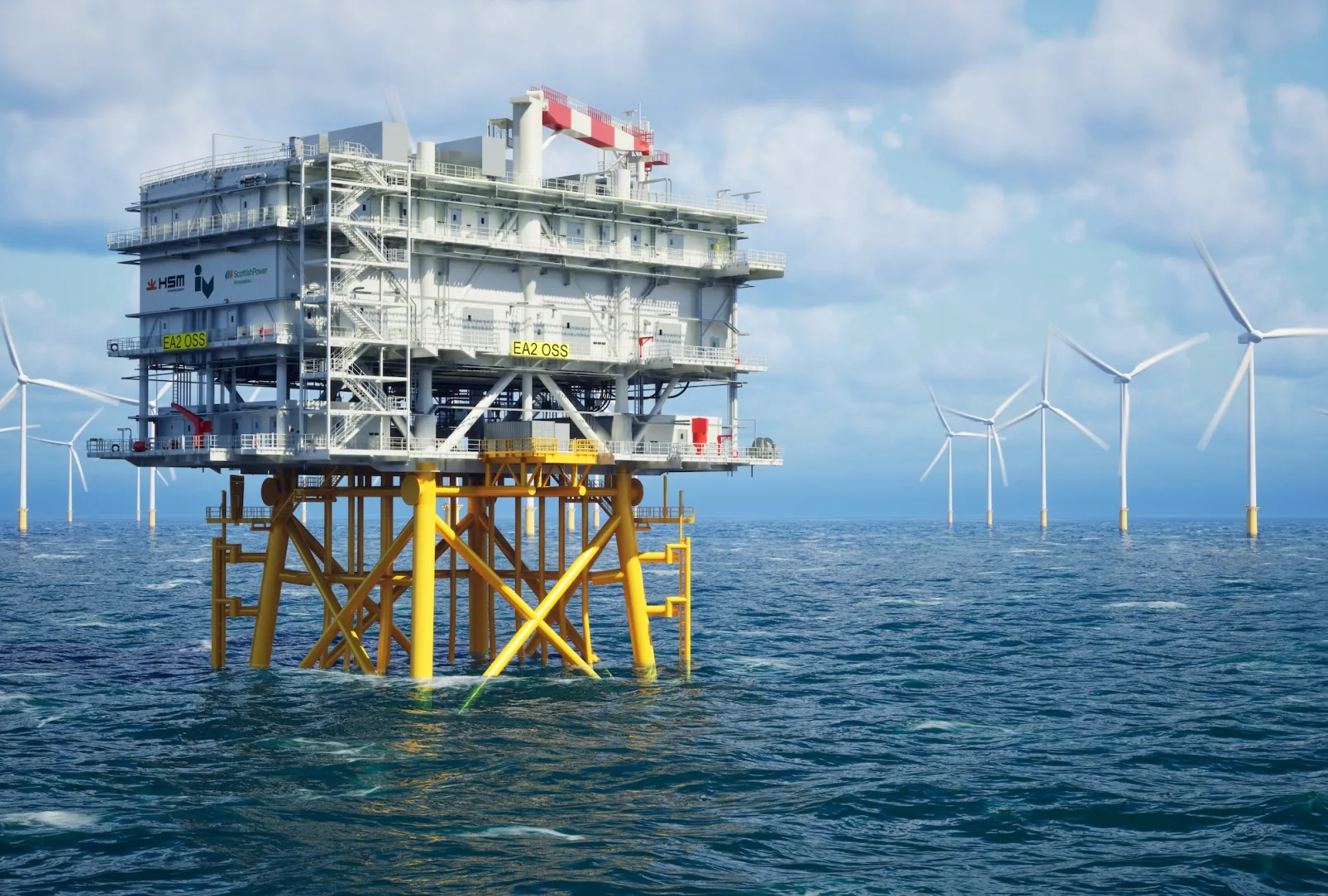
Smulders HSM, a subsidiary of Eiffage Métal, has begun construction of the offshore substation for the East Anglia TWO project, following the EPCIC award by ScottishPower Renewables, part of Iberdrola.
The project redefines its execution strategy by segmenting manufacturing across two strategic locations: Stormpolder in the Netherlands, and Newcastle in the United Kingdom. This dual logistics approach not only optimizes timelines but also reduces supply chain risks.
This approach enables highly coordinated parallel execution, a decisive factor in offshore projects where operational constraints often concentrate on the fabrication and transport of large structures.
East Anglia Two Dimensions Reveal Critical Structural Complexity
The substation’s superstructure will measure approximately 58 x 35 x 30 meters, with a weight close to 5,100 metric tons. The jacket (support structure) will have dimensions of 40 x 32 x 58 meters and a weight of 3,450 tons.
This data reveals the project’s most interesting element: the substation is not just an electrical node, but a critical infrastructure for converting and stabilizing offshore energy, subjected to extreme conditions.
From a technical perspective, the design of East Anglia Two must withstand complex dynamic loads: waves, wind, structural fatigue, and vibrations induced by high-voltage electrical equipment.
Offshore Substation: Core of Electrical Stability
The true value of the project lies in the role of the offshore substation within the electrical system. Its function is to step up the voltage generated by the wind turbines and efficiently transmit it to shore.
Here arises the essential component of the system: the efficiency of the wind farm depends not only on generation (960 MW) but also on the quality of its transmission. A poorly designed substation can lead to significant losses.
Therefore, the design integrates high-reliability equipment, reactive compensation systems, and redundant architectures that ensure operational stability even under partial failure conditions.
Energy Impact and Regional Industrial Strategy
Located approximately 33 km off the Suffolk coast, the East Anglia Two wind farm will have the capacity to supply nearly 950,000 homes, consolidating its position as a pillar of the UK’s energy security.
Furthermore, partial manufacturing in Newcastle introduces a strategic component: the development of a local value chain, aligned with British industrial and energy policies.
This hybrid approach—continental engineering and local manufacturing—represents a growing trend in offshore projects: maximizing technical efficiency without sacrificing regional economic impact.
Source and photo: https://smulders-hsm.com/