
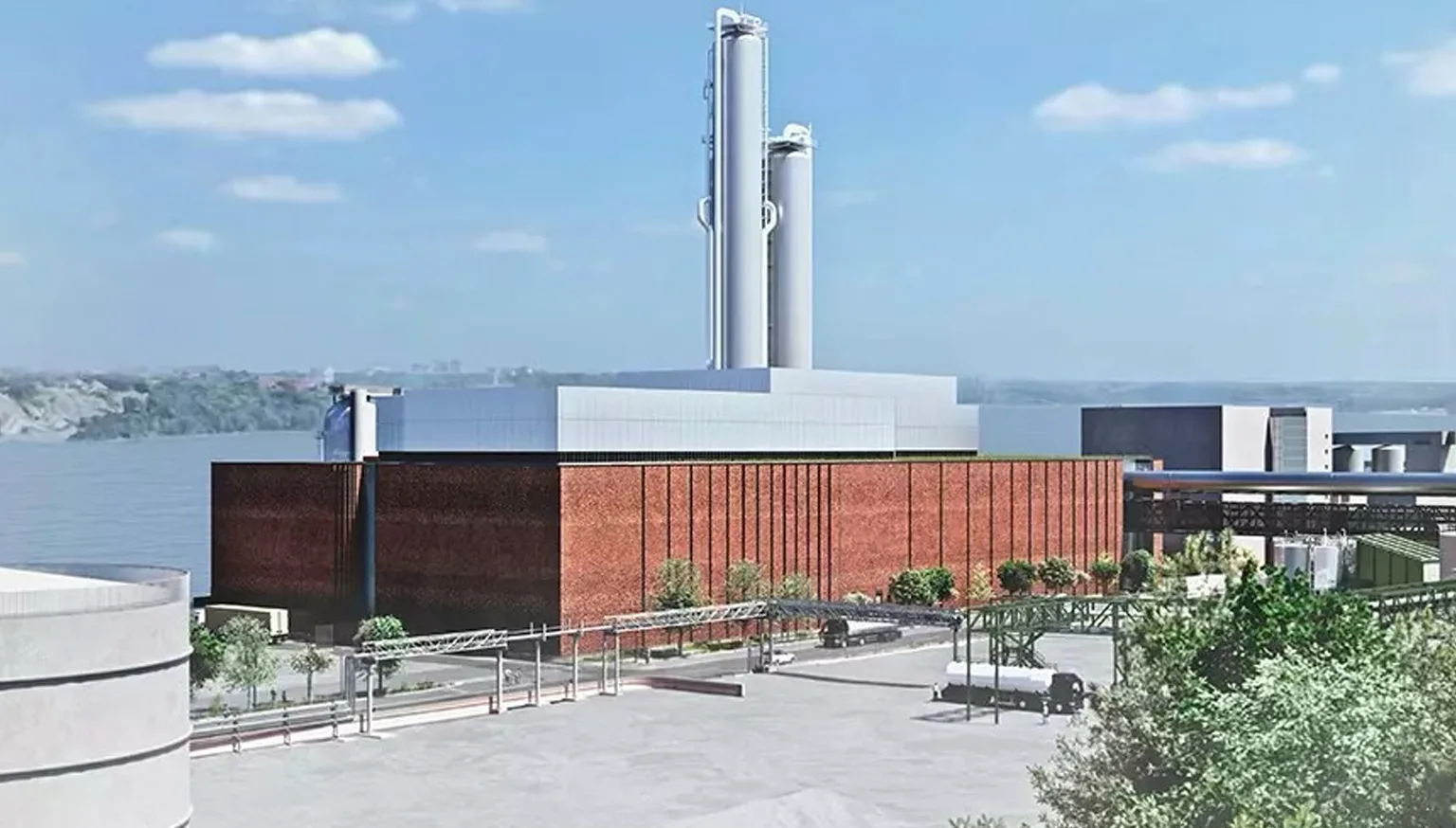
OTS simulation will enable validation of the BECCS process
Stockholm Exergi awarded Inprocess the development of an OTS simulator for its BECCS plant at Värtaverket, integrating advanced dynamic OTS simulation into one of Europe’s most ambitious carbon capture infrastructures.
The most relevant aspect of the project is not only its capture capacity, but the incorporation of OTS as a pre-validation tool for the complete process, enabling analysis of dynamic behavior before the industrial startup scheduled for 2028.
This approach significantly reduces operational risks in BECCS systems, where the interaction between biogenic combustion, chemical capture, and CO₂ liquefaction introduces transient complexities that cannot be evaluated with traditional static models.
Dynamics replicate actual capture and control: OTS Simulation
The system developed by Inprocess will include a high-fidelity dynamic model that will reproduce the entire BECCS process, from combustion gases to compression and liquefaction of carbon dioxide for transport.
A key component will be the integration of a complete replica of the SPPA-T3000 distributed control system, which will enable validation of control logic, operating strategies, and response to disturbances in a safe virtual environment.
Additionally, the OPC simulation-based architecture will ensure interoperability between models, control, and hardware, facilitating startup, shutdown, and abnormal scenario testing—essential in processes where thermal and chemical stability is critical for capture efficiency.
Early training reduces operational risk
The OTS will enable operator training before startup, simulating real operating conditions, failures, and complex transients, which represents a key advantage in next-generation plants with integration of multiple technologies.
Stockholm Exergi’s BECCS plant will capture up to 800,000 tons of CO₂ annually, exceeding the city’s traffic emissions, which requires a level of operational reliability aligned with critical infrastructure.
The simulator, operational in 2027, will not only train personnel but will also enable design optimization and operational parameter adjustment, consolidating the use of digital twins as a standard in large-scale carbon capture and storage projects.
Source: https://inprocessgroup.com
Photo: Shutterstock