
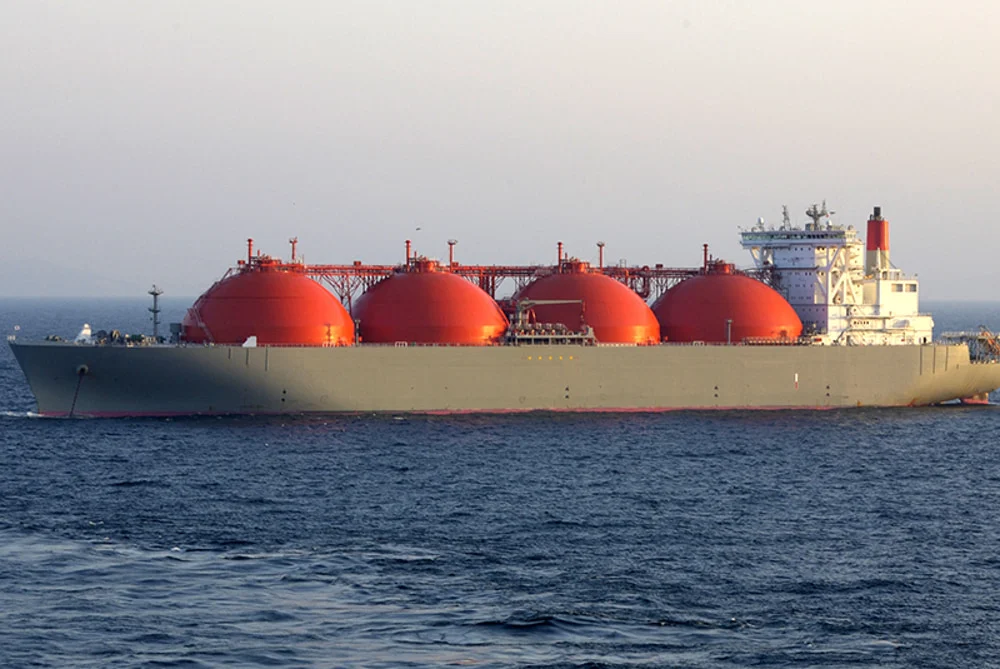
EXIM finances LNG expansion
The Export-Import Bank of the United States (EXIM) has approved more than $2 billion in credit insurance to support liquefied natural gas (LNG) exports to Egypt.
The measure aligns with the strategy of positioning the United States as a dominant provider of reliable energy in key international markets, especially in regions with growing energy demand.
This financing will allow US exporters to compete on favorable terms, mitigating commercial risks and facilitating long-term contracts in strategic markets.
Financial engineering: crucial for unlocking projects
Unlike projects such as Golden Pass LNG, where the main challenge is technical-operational, the determining factor here is the financial engineering applied to energy trade.
Export credit insurance acts as a risk reduction mechanism that guarantees payment to the exporter, even in scenarios of geopolitical volatility or contractual default.
These types of instruments make LNG operations viable that, although technically mature, require robust financial structures to be executed in emerging markets.
Egypt: a strategic node in the energy market
The participation of the Egyptian General Petroleum Corporation (EGPC) positions Egypt as a decisive energy hub in the Eastern Mediterranean.
The country combines existing regasification and export infrastructure with a privileged geographical location to redistribute gas to Europe, Africa, and the Middle East.
In this context, the supply of US LNG not only covers domestic demand but also strengthens Egypt’s role as a regional energy trading platform.
Significant: the true value lies in the risk
A particularly interesting fact is that the more than $2 billion approved does not directly finance gas molecules, but rather the risk associated with their commercialization.
This reflects a critical reality of the modern LNG market: operational constraints are no longer solely production or liquefaction, but the ability to structure bankable contracts in uncertain environments.
In comparison, while other terminals invest billions in physical assets, instruments like those from EXIM unlock equivalent trade flows without the need to build new infrastructure.
Global impact and energy competition
The agreement, which involves contracts managed by Hartree Partners, is projected for shipments between 2026 and 2027, consolidating medium-term commercial relationships.
This move strengthens the position of the United States against other major LNG exporters such as Qatar and Australia, especially in markets undergoing energy transition.
Furthermore, it reinforces a clear trend: global energy dominance no longer depends only on reserves or infrastructure, but on the ability to integrate financing, logistics, and geopolitics into the same equation.
Source: https://www.exim.gov
Photo: U.S. Department of Energy