
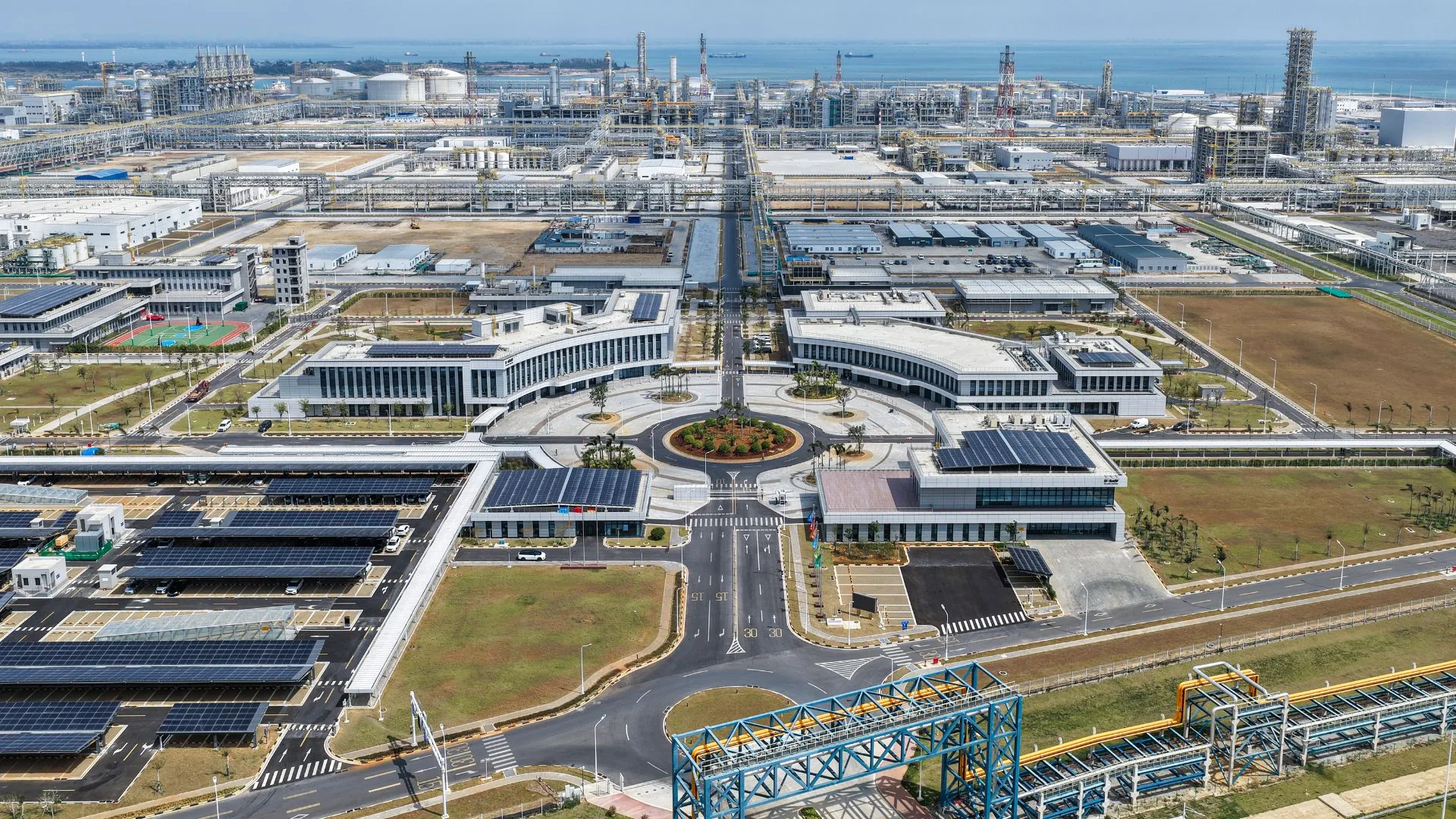
BASF has officially inaugurated its new Verbund chemical complex in Zhanjiang, solidifying its commitment to the world’s largest chemical market and strengthening its local production strategy.
A Strategic Project in the Chinese Chemical Market
With an investment of nearly 8.7 billion euros, the Zhanjiang complex is positioned as one of BASF’s most significant industrial developments globally. The facility, spanning approximately four square kilometers, is already the company’s third-largest site worldwide.
Furthermore, this project reflects a shift in multinational strategy, where China is consolidating its position as a key market for chemical production and consumption.
Verbund Chemical Complex and Integrated Production
The complex operates under the Verbund model, a system that integrates multiple industrial processes to optimize resources, reduce costs, and improve energy efficiency.
In this regard, the plant will produce a wide range of chemical products, including basic, intermediate, and specialty chemicals, destined for sectors such as transportation, electronics, consumer goods, and personal care.
This integration also allows BASF to maintain more efficient value chains and ensure a stable supply to the local market, aligning with its “local for local” approach.
Sustainability and Process Electrification
One of the complex’s most notable features is its focus on industrial sustainability. Thanks to the combination of renewable energies and advanced technologies, CO₂ emissions can be reduced by up to 50% compared to conventional plants.
The site’s electricity supply is based on green energy agreements and investments in offshore wind farms, allowing it to operate with 100% renewable electricity.
Additionally, the steam cracker plant incorporates electric compressors powered by clean energy, marking an advance in the electrification of chemical processes.
In parallel, BASF has implemented digitalization and advanced process control solutions that optimize energy consumption in real time, improve operational efficiency, and reduce the complex’s environmental footprint.
Industrial Capacity and Operational Deployment
Currently, the complex boasts over 18 plants and 32 active production lines, manufacturing more than 70 different products. The facility employs over 2,000 people and is designed to operate with flexible raw materials such as naphtha and butane.
Furthermore, the site’s development has been executed in phases, allowing for the progressive commissioning of key units and facilitating the integration of new technologies as the project advances.
The cracker unit has a production capacity of up to 1 million tons of ethylene per year, reinforcing BASF’s position in the global petrochemical market.
Currently, the complex has over 18 plants and 32 active production lines, manufacturing more than 70 different products. The facility employs over 2,000 people and is designed to operate with flexible raw materials such as naphtha and butane.
The cracker unit has a production capacity of up to 1 million tons of ethylene per year, reinforcing BASF’s position in the global petrochemical market.
Driving Innovation and Regional Growth
Moreover, the Zhanjiang complex is projected as a key platform for BASF’s future growth in Asia. The company aims to drive innovation alongside customers and partners in one of China’s most dynamic economic regions.
This development also positions the site as a benchmark in sustainable and integrated chemical production, in line with global industry trends.
A Long-Term Commitment
With over 140 years of presence in Greater China, BASF continues to expand its production infrastructure in the country. The new complex not only strengthens its industrial capacity but also consolidates its role as a key partner for multiple industries.
Source and photo: BASF