
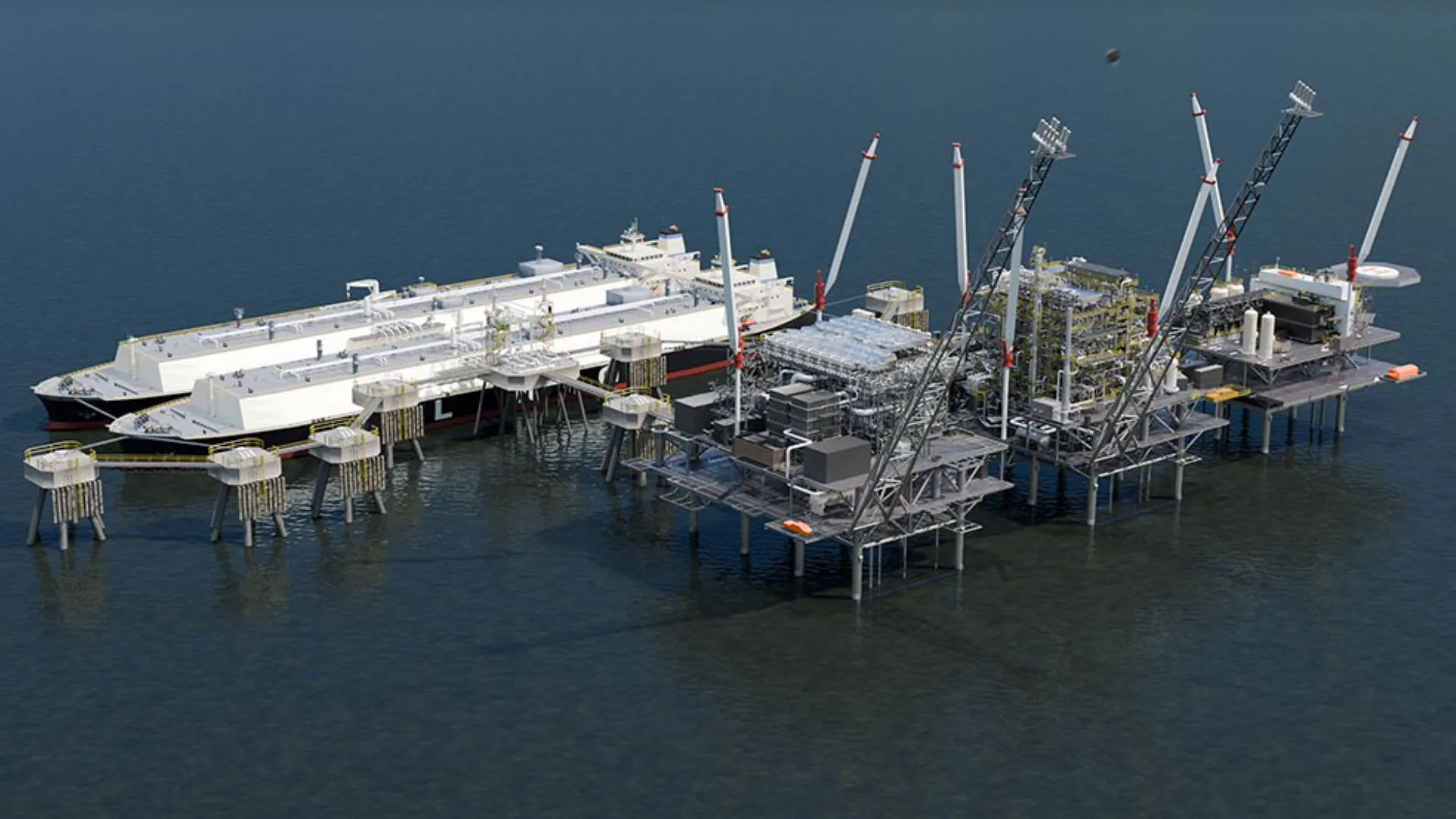
Baker Hughes has been selected by ST LNG as the technology provider for its offshore liquefied natural gas terminal (LNG) located off the coast of Matagorda, Texas. The agreement includes the supply of critical gas compression and power generation systems for a facility with a planned total capacity of 8.4 million tonnes per year (MTPA).
Strategic contract for offshore LNG development in the U.S.
In this context, ST LNG’s project is shaping up as one of the most significant initiatives in the LNG export segment in the United States. The facility will consist of up to four liquefaction units mounted on fixed platforms, each with a capacity of 2.1 MTPA.
Likewise, the first phase of the development includes an initial production of 2.1 MTPA, with start-up expected in the second quarter of 2030. The choice of Baker Hughes reflects the need to integrate proven technology in complex offshore environments.
Offshore LNG technology for production
As part of the agreement, Baker Hughes will supply two centrifugal compressor trains driven by LM6000PF gas turbines, along with three power generation packages based on NovaLT™16 turbines.
These solutions will ensure the operating capacity required in the project’s first phase, optimizing energy performance and enabling more emissions-efficient operations.
In addition, the company will provide technical support during project development, reinforcing its role as a technology partner in offshore LNG infrastructure.
A key step toward the final investment decision
Selecting Baker Hughes marks significant progress in moving the project toward the Final Investment Decision (FID). This milestone is essential to confirm the economic and technical viability of the liquefied natural gas export terminal.
According to Sharad Tak, CEO of ST LNG, Baker Hughes’ experience in LNG projects and its ability to operate in marine environments provides confidence in meeting the planned schedule.
Likewise, Lorenzo Simonelli, CEO of Baker Hughes, noted that the company’s technology portfolio is designed to adapt to both large onshore facilities and specialized offshore applications.
Offshore energy infrastructure with an efficiency focus
The development of this offshore terminal in U.S. federal waters responds to growing global demand for liquefied natural gas and the need to diversify export infrastructure.
In this regard, the use of advanced gas compression and power generation technology will improve the project’s operational efficiency, while helping reduce its carbon footprint compared with traditional solutions.
The collaboration between ST LNG and Baker Hughes reinforces the trend toward more complex offshore energy projects, where technology integration becomes a decisive factor for viability.
Source: Baker Hughes
Photo: ST LNG