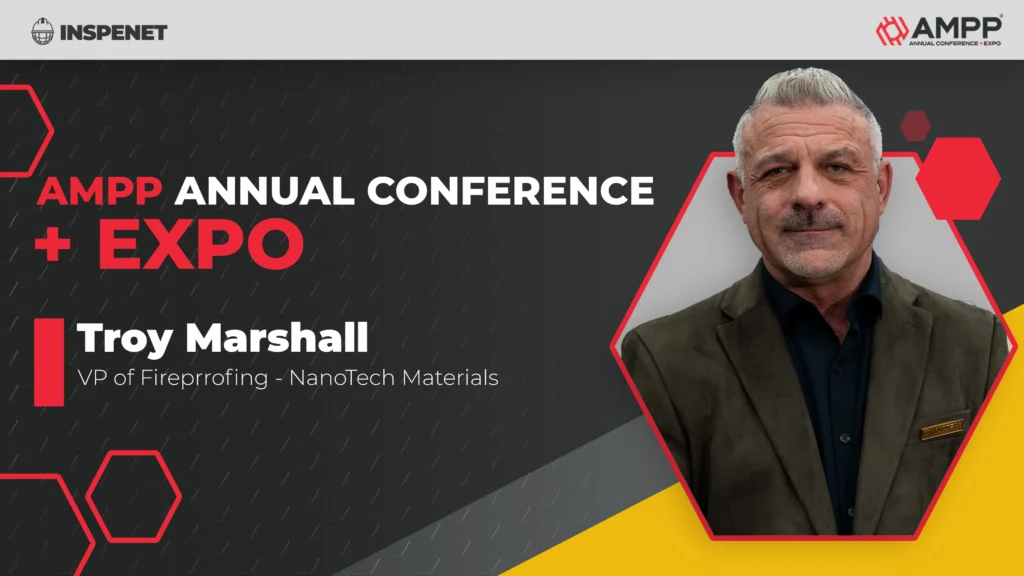
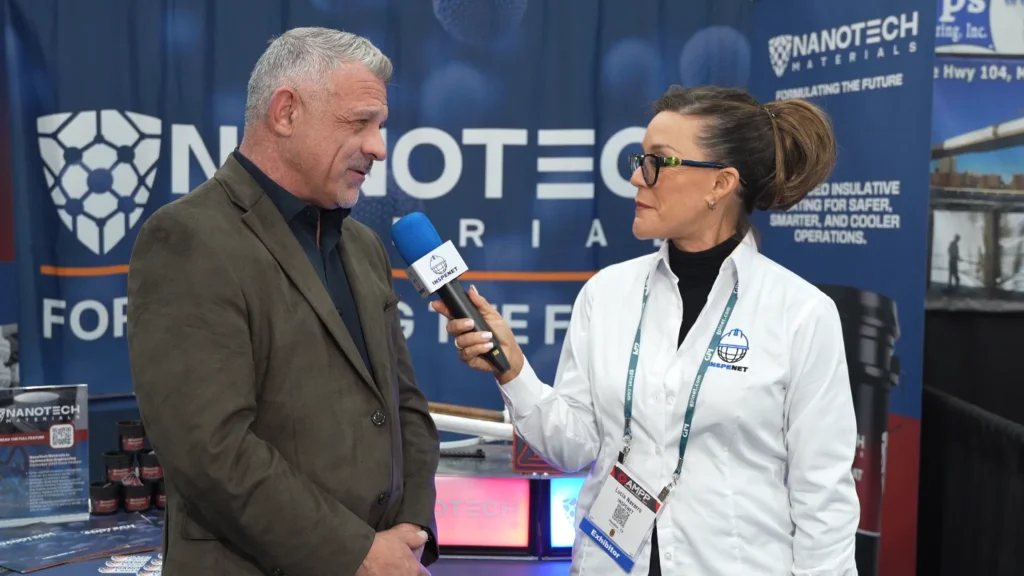
During the AMPP Annual Conference + Expo 2026, one of the companies capturing the sector's attention was NanoTech Materials, specialized in developing thermal management coatings and advanced heat control solutions. Troy Marshall, the company's Vice President of Fire, explained the firm's focus and its technological proposal aimed at solving real-world challenges in industrial environments.
From its headquarters in Katy, Texas, NanoTech Materials focuses on manufacturing protective coatings based on ceramic particles with insulating properties. Its goal is to improve the energy performance of infrastructure and equipment, especially in contexts where temperature control and resistance to demanding conditions are critical.
At the core of the company's technology is a patented particle known as ICP (insulative ceramic particle). This material features a combination of low thermal conductivity and high emissivity, allowing it to efficiently reflect and reject heat.
As Marshall explained, this thermal reflection capability allows for significantly reducing the surface temperature of the assets where the coating is applied. Unlike other traditional systems, these coatings act as an active barrier against heat, contributing to improved energy efficiency and protecting the underlying materials.
Furthermore, the technology is compatible with different types of resins, such as epoxies, water-based acrylics, or vinyl esters, expanding its use across multiple industrial environments. This versatility facilitates implementation in scenarios where corrosion, humidity, or extreme temperatures represent a constant challenge.
One of the most relevant aspects of thermal management coatings is their adaptability to different applications. These materials can be used on pipelines, cold water systems, industrial roofing, and structures exposed to adverse environmental conditions.
In particular, their use on pipelines helps prevent condensation, a frequent problem that can lead to corrosion or operational failures. Additionally, their application on large flat roofs helps reduce the thermal load inside buildings.
Regarding application conditions, these coatings can be installed across a wide temperature range, from approximately 4°C to over 37°C, provided the surface is dry. This flexibility facilitates their use in various climates and operating environments.
One of the highlights of the interview is the use case in large commercial areas. NanoTech Materials has worked over the last few years with a major national retail chain, applying its coatings to the roofs of multiple establishments.
After analyzing data over a four-year period, the company recorded an average savings of 46% in the energy consumption of HVAC systems. This result demonstrates the direct impact of thermal management coatings on reducing operating costs and improving the energy efficiency of buildings.
This type of data is especially relevant in a context where companies seek to optimize their energy resources and reduce exposure to variable costs.
Another differentiating factor of this technology is its ability to deliver results with reduced thicknesses. Depending on the type of resin and the application environment, coatings can be applied in layers between 3 and 8 millimeters in a single pass.
This feature optimizes installation times and reduces the weight added to structures. In specific applications, such as preventing condensation on pipes, it is possible to achieve results with thicknesses even below 80 mils.
Additionally, the company highlights the use of water-based formulations with zero volatile organic compounds (VOCs), facilitating integration into projects with increasingly demanding environmental requirements.
The participation of NanoTech Materials at AMPP 2026 reflects the sector's growing interest in solutions that combine energy efficiency, asset protection, and ease of application. In an increasingly demanding industrial environment, technologies like thermal management coatings are positioned as key tools for improving operational performance.
Based in Texas with a clear focus on the practical application of innovation, the company continues to develop solutions that meet specific market needs. Its presence at international events reinforces its positioning within the advanced coatings and functional materials industry.
For more content about AMPP 2026, please visit our LinkedIn profile.
Source: Inspenet.