The energy and industrial sectors are facing a profound shift in how corrosion is managed. In this context, Steve Strachan, VP of Sales at Eddyfi Technologies, highlights the need to move toward more predictive models, where non-destructive testing plays a crucial role. The goal is no longer just to detect failures, but to anticipate them through more accurate data and continuous asset monitoring.
Today, industries such as oil & gas, refining, and petrochemicals depend on asset integrity to maintain operational continuity. However, corrosion remains one of the main threats, driving high costs and operational risks. Adding to this is a structural issue: a shortage of qualified non-destructive testing professionals.
Given this scenario, the sector is looking for new ways to operate. The key is no longer just to inspect, but to do it more efficiently, more frequently, and with better information.
In response to these challenges, Eddyfi Technologies has focused its strategy on developing advanced non-destructive testing solutions that combine sensors, software, and robotics. The goal is clear: detect corrosion more accurately and generate data that supports informed decision-making.
As Strachan explained, the company is working on both manual and automated tools. These include robotic systems and wireless sensors capable of operating in complex environments without the need for constant field personnel intervention. This approach increases the amount of data collected and improves its quality.
These technologies are also designed to integrate into critical assets such as pipelines, tanks, and pressure vessels. As a result, operators can continuously monitor the condition of their infrastructure more reliably.
The shift from spot inspections to continuous monitoring marks a key difference in industrial asset management.
One of the most relevant examples shared during the interview is the adoption of wireless ultrasonic sensors in the refining sector. Eddyfi has deployed this technology in more than 100 refineries in the United States, demonstrating its maturity and market acceptance.
These sensors are installed directly on the assets and take periodic measurements of material thickness. Over time, they build a history that makes it possible to calculate corrosion rates and understand each asset’s real behavior.
This approach offers several advantages. On the one hand, it eliminates the need to repeatedly send personnel into the field to take manual measurements. On the other, it makes it possible to detect trends that would go unnoticed in traditional inspections.
In addition, the data collected becomes an important decision-making tool. Operators can determine when to intervene, when to keep an asset in operation, or when to retire it before a failure occurs.
The shortage of qualified non-destructive testing professionals is one of the sector’s main challenges. This situation forces companies to rethink their operating models and adopt technologies that reduce reliance on the human factor.
In this context, automation plays a fundamental role; robotics- and sensor-based solutions make it possible to carry out inspections without the need for constant physical presence. This improves safety and optimizes available resources.
According to Strachan, the goal is not to replace personnel, but to complement their work. The technologies developed by Eddyfi allow human teams to focus on higher-value tasks, supported by accurate data generated automatically.
The company also works with technical experts who analyze specific applications and develop solutions tailored to each environment. This approach combines human expertise with advanced technological capabilities.
The result is a transition toward a model where work is done more intelligently, with better tools and greater efficiency.
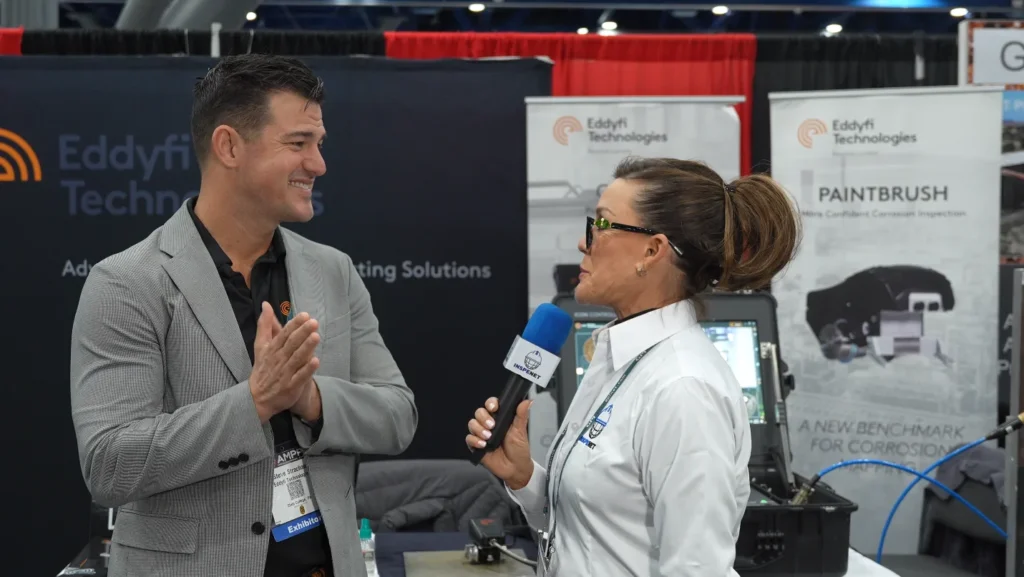
The adoption of advanced non-destructive testing technologies has a direct impact on how companies manage their assets. The availability of real-time data makes it possible to anticipate problems and optimize operations.
Key benefits include:
In addition, the ability to continuously monitor assets makes it possible to identify degradation patterns and act before they become critical failures. This represents a significant shift from traditional models based on periodic inspections.
On the other hand, digitalization makes it easier to integrate this data into broader management systems, opening the door to more advanced predictive maintenance strategies.
The non-destructive testing sector is undergoing a clear evolution toward more digital, connected, and automated models. The combination of sensors, data analytics, and robotics is redefining how industrial assets are monitored.
Eddyfi Technologies is positioning itself as one of the players leading this change, with an offering that ranges from measurement technologies to remote monitoring solutions. Its presence in more than 110 countries reflects the growing global demand for these types of solutions.
Looking ahead, the trend points to greater technology integration and an expansion of these systems into international markets. The need to optimize operations and improve safety will continue to drive the adoption of advanced solutions.
In this context, non-destructive testing stops being a one-off activity and becomes a continuous, data-driven, efficiency-focused process.
For more content about AMPP 2026, please visit our LinkedIn profile.
Source: Inspenet.