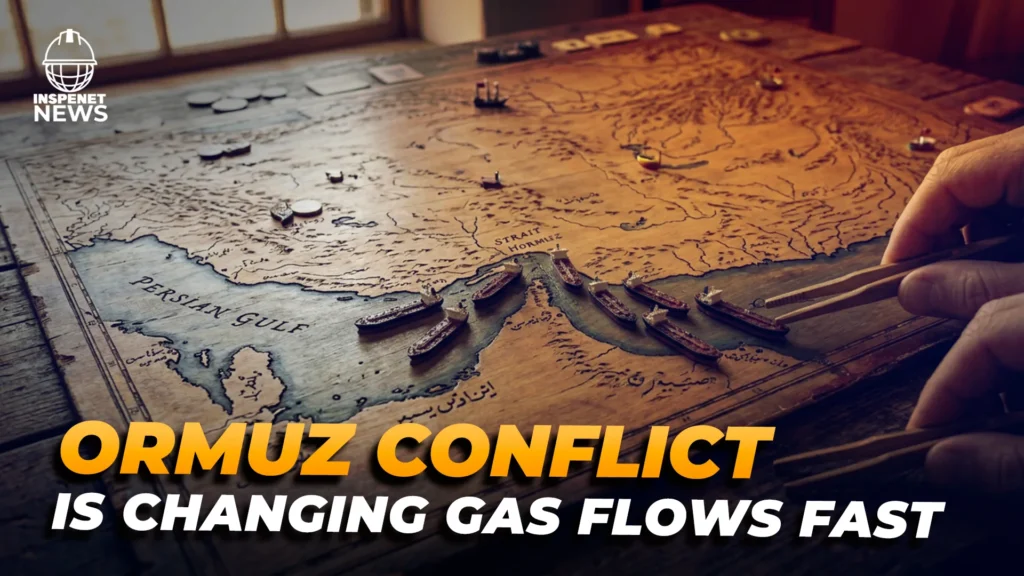
The LNG market for marine bunkering closed March with a shift that changes the reference between Asia and Europe. Singapore began trading at a premium against Rotterdam after several weeks of supply tension and increased buying pressure in Asia.
Furthermore, the movement does not respond to a single isolated session; during the start of 2026, the Asian port had shown discounts against the European hub. However, that relationship narrowed throughout March until it reversed and consolidated a new signal for shipowners, operators, and marine fuel suppliers.
Specifically, on March 31, the price of LNG for bunker in Rotterdam stood at $19.20 per MMBtu while in Singapore it reached $20.749 per MMBtu. That difference left the Asian hub with a premium of $1.55 per MMBtu against the Dutch port.
Previously, the situation was different. Between January 1 and February 27, Singapore had registered an average discount of $1.86 per MMBtu compared to Rotterdam. That scenario reflected more contained demand in Asia and a more comfortable regional supply.
Then, the differential began to compress in March as the market absorbed new threats to global supply. On March 3, the most visible jump occurred when Singapore marked a premium of $6.42 per MMBtu over Rotterdam. Although that gap moderated afterward, the overall balance for the month maintained an advantage for the Asian hub.
On the other hand, LNG volatility was linked to the deterioration of the geopolitical environment and concern over supply flows. The attacks by the United States and Israel against Iran altered the perception of risk in the market and triggered a rapid reaction in international gas prices.
Subsequently, the declaration of force majeure by QatarEnergy added more pressure. The production disruption reduced the expectation of availability of Qatari volumes and forced Asian buyers to compete more intensely for cargoes from the United States and West Africa.
Thus, the Asian market regained momentum in a short time; that bid to secure supply raised the JKM index and drove up LNG pricing in Singapore. With that reference on the rise, the differential against Rotterdam left behind the discount phase that had dominated the early stages of the year.
Meanwhile, demand in Asia offered additional support to the upside; the improvement in JKM reinforced the profitability of placing cargoes in Northeast Asia and increased competition for available molecules at a time of less stability for supply.
Likewise, the behavior of the European market was more competitive from the start of the crisis. Rotterdam continued to show attractive prices compared to other marine fuels but failed to sustain the relative advantage it had maintained against Singapore in January and February.
In this way, the maritime market began to read the spread between both ports as an operational signal. When Asia pays more for LNG, the logic of supply changes, and with it change the decisions on diversions, purchases, and port call planning.
In practice, the new differential between Singapore and Rotterdam affects the economics of bunkering and conditions the decision-making of shipping companies and traders. A sustained spread can modify trade routes, refueling ports, and hedging strategies.
Also, that change impacts the LNG logistics chain; suppliers adjust their arbitrage between basins and buyers review the best time to lock in prices or secure availability. In high-traffic maritime corridors, that adjustment translates into rapid market movements.
At the same time, the episode confirms that the maritime LNG market remains highly exposed to external events. The combination of geopolitics, supply cuts, regional indices, and comparison with other fuels generates an environment of strong sensitivity for all sector participants.
PETRONAS maintains constant monitoring of fuel supply in Malaysia to ensure energy stability amid the conflict in the Middle East. Although the country produces oil, nearly 40% of its crude depends on routes passing through the Strait of Hormuz. The nearly 40% increase in oil prices has raised costs for safe transportation and logistics, which pressures the supply system.
Domestic demand continues to exceed local production, so the company uses its integrated network to guarantee sufficient gasoline and diesel. PETRONAS seeks to maintain approximately 50% of the market while the Government maintains subsidies to contain the impact on consumers. Authorities have also requested avoiding excessive purchases to avoid aggravating the situation.
Turkey will intensify its oil and gas exploration and drilling activities in the Black Sea and off Somalia in April. The country will activate several vessels such as the Abdülhamid Han and the Fatih while adding new units to its energy fleet. With these additions, it now has six drilling vessels and positions itself among the largest fleets globally.
Operations focus on expanding local production with special attention to the Sakarya gas field, considered the country's largest discovery with approximately 720,000 million cubic meters. Additionally, Turkey will begin drilling in Somalia, marking its expansion toward international operations. This strategy is also supported by seismic vessels that allow identifying reserves before drilling.
The Netherlands initiated studies for the Delta-Rhine West Corridor, an infrastructure project that will connect industrial zones between Rotterdam, Moerdijk, and Boxtel. The network will allow transporting hydrogen and captured CO₂ to offshore storage points with the objective of reducing industrial emissions. The work is being carried out by Fugro and Sweco, who are already conducting soil analyses along a 70-kilometer section.
The investigations include geotechnical tests, geophysical studies, and environmental assessments to understand ground conditions and potential risks. Factors such as historical heritage, soil contamination, and archaeological remains are also analyzed. This information will serve to define the system design and ensure safe construction, especially in sensitive areas such as the Hollands Diep river crossing.
Solstad Maritime confirmed the contract extension for its support vessel Normand Energy with a new firm period of eight months. The agreement will begin on April 1, 2026, and will remain in effect until November 30 of the same year as a direct continuation of the current contract. Additionally, the agreement includes additional options that would allow further extending its operation.
This extension ensures that the vessel will remain active while the company advances in securing a longer-term contract scheduled to begin in the first quarter of 2027. With this, Solstad secures operational stability and continuity in the use of one of its specialized maritime assets.