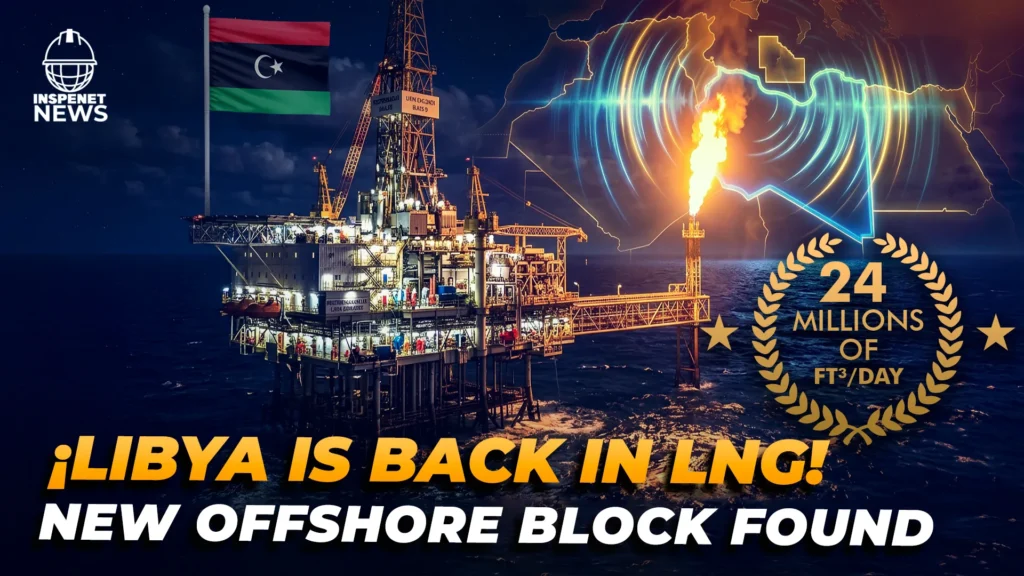
The Libyan National Oil Corporation and Eni North Africa announced a new offshore gas discovery in Block D. The J1-4/16 well is located about 95 kilometers off the country’s western coast and marks a new step forward in exploration activity in Libyan waters.
Drilling of the exploration well reached a final depth of 10,458 feet; tests carried out in the Metlawi field confirmed the presence of gas with flow rates of 14 million cubic feet per day in an initial test and 24 million cubic feet per day in a second.
Therefore, the results reinforce the well’s technical value and point to significant potential for future development decisions within the block. The reservoir response also provides favorable signals for further assessments of the area’s productive capacity.
This well represents the final step in the nine contractual obligations set out for Block D of Contract 4/16. That commitment was established in the agreement signed in June 2008 and is now fulfilled with this finding.
In this way, the news is not limited to the geological level; it also carries weight within the project’s operational framework because it confirms completion of the program agreed between the parties in the offshore exploration phase.
At the same time, the announcement comes in a context in which Libya is seeking to strengthen its hydrocarbon production and give greater momentum to new gas exploration campaigns. The new finding shows that the country maintains assets of interest in the Mediterranean Sea and continues working with international partners to expand its resource base.
Along these lines, Eni maintains a significant position within Libya’s energy sector. Its participation in this project once again positions the company as one of the most prominent players in the country’s gas exploration and in the potential expansion of its energy supply.
The gas discovery may have several implications for Libya. On the one hand, it opens the door to new technical assessments regarding the block’s commercial development. On the other, it supports expectations that gas exploration will carry greater weight within the national energy strategy.
Finally, the announcement by NOC and Eni provides a signal of continuity for the country’s energy sector. With new offshore exploration results, Libya is once again focusing on its gas resources and the potential of its offshore areas for future production phases.
China is considering a support package for its main airlines in response to the strong impact of rising fuel costs. Options include state-backed loans, subsidies, and tax benefits to ease financial pressure. This comes at a difficult time, as companies are still dealing with challenges since the pandemic and have struggled to regain profitability in recent years.
The increase in fuel prices is linked to tensions in the Middle East that have affected global supply. This has led to higher surcharges on domestic flights and adjustments to airline operations. In addition, jet fuel shortages and high costs are pushing fares up and squeezing margins across the aviation industry, both in China and globally.
Chevron confirmed the oil discovery at the Bandit field, located in deep waters of the Gulf of America off the coast of Louisiana. The exploration well found high-quality crude in Miocene formations, opening the door to potential development. The project is operated by Occidental and includes Chevron and Woodside Energy, which are already reviewing the results to define next steps.
The discovery stands out for its strategic location, as it would allow connection to existing infrastructure in the area, reducing costs and accelerating production. This approach is part of the companies’ strategy to leverage nearby assets to optimize investments in deepwater exploration and production, where Chevron maintains a significant presence.
Japan is considering releasing additional oil reserves equivalent to 20 days of consumption amid uncertainty over transit through the Strait of Hormuz. Although there is a temporary ceasefire between the United States and Iran, doubts remain about the stability of the route, also affected by tensions in the region. The government had already begun a massive crude release in March to secure domestic supply.
The country plans to put up to 80 million barrels on the market, combining state and private reserves, while coordinating efforts with other members of the International Energy Agency. Japan relies on the Middle East for more than 90% of its oil, making it especially vulnerable to any disruption along this strategic route for global energy trade.
Waygate Technologies and GE Aerospace are advancing the automation of engine maintenance with new inspection templates for GEnx models. These tools integrate guided workflows and artificial intelligence assistance to improve accuracy when reviewing critical parts. The system aims to standardize processes and reduce human error in inspections performed with borescopes.
The technology enables automatic data capture, improves traceability, and facilitates real-time analysis through digital platforms. In addition, it incorporates visual guides that help technicians perform more consistent inspections, accelerating training and optimizing maintenance work. All of this is supported by digital infrastructure that enables sharing results and managing fleets more efficiently.