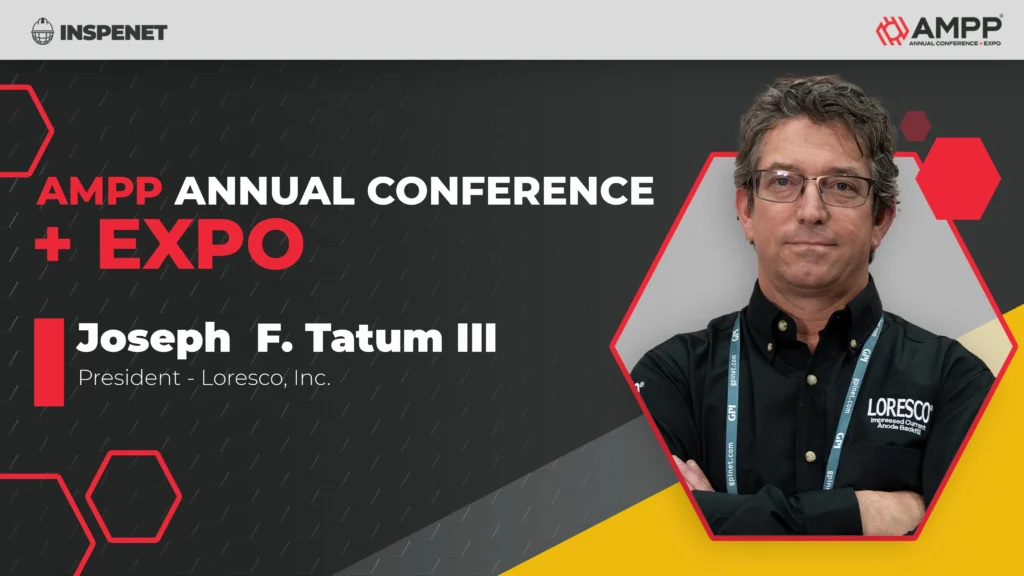
As part of the AMPP Annual Conference + Expo 2026, one of the industry’s main meeting points, Joseph F. Tatum III, president of Loresco, Inc., shared his perspective on the evolution of cathodic protection systems and the role conductive materials play in their performance.
He also highlighted the technical value of conductive backfill and its direct impact on the operational efficiency of critical infrastructure, from pipelines to industrial facilities.
Loresco International positions itself as a specialized manufacturer of materials for cathodic protection systems, with a clear focus on developing carbon-based conductive backfills. The company works on applications related to both corrosion protection and grounding solutions and AC interference mitigation.
In this context, the company has strengthened its market presence thanks to a value proposition focused on improving anode performance and optimizing costs over the systems’ life cycle.
One of the most relevant aspects addressed during the interview is how conductive backfill works within cathodic protection systems.
This material increases the anode’s effective surface area, enabling a more uniform current distribution.
As Tatum explained.
In addition, carbon backfill serves an additional function as a consumable material, which helps extend the service life of the anode. This feature is especially relevant in environments where maintenance or component replacement involves high costs.
Likewise, this improvement in current distribution translates into higher overall system efficiency, a decisive factor in long-duration projects.
On the other hand, material resistivity is a critical factor in cathodic protection system design. Using low-resistivity backfills reduces circuit resistance, which directly impacts the system’s energy consumption.
As a result, this reduction translates into lower operating costs over time, a key aspect in large-scale installations or industrial environments where energy efficiency is a priority.
In this way, proper backfill selection influences not only technical performance, but also the project’s economic viability.
Regarding field applications, Tatum highlighted the importance of backfill behavior in deep anode installations, especially in the oil & gas sector. In these cases, factors such as settling rate and material compaction play a decisive role.
Proper compaction ensures intimate contact between particles, improving conductivity and ensuring stable system operation. This is essential to prevent premature failures or efficiency losses under demanding operating conditions.
Likewise, the material’s adaptability to different soil types and groundwater conditions reinforces its versatility across a wide range of projects.
Another important point discussed during the conversation is material safety in sensitive applications. In this regard, the backfills developed by the company have NSF certification, allowing their use in potable water environments.
This factor is especially relevant in urban projects or critical infrastructure where compliance with health regulations is a non-negotiable requirement.
In addition, the material’s performance in high-resistivity soils reinforces its suitability for complex scenarios where other solutions may have limitations.
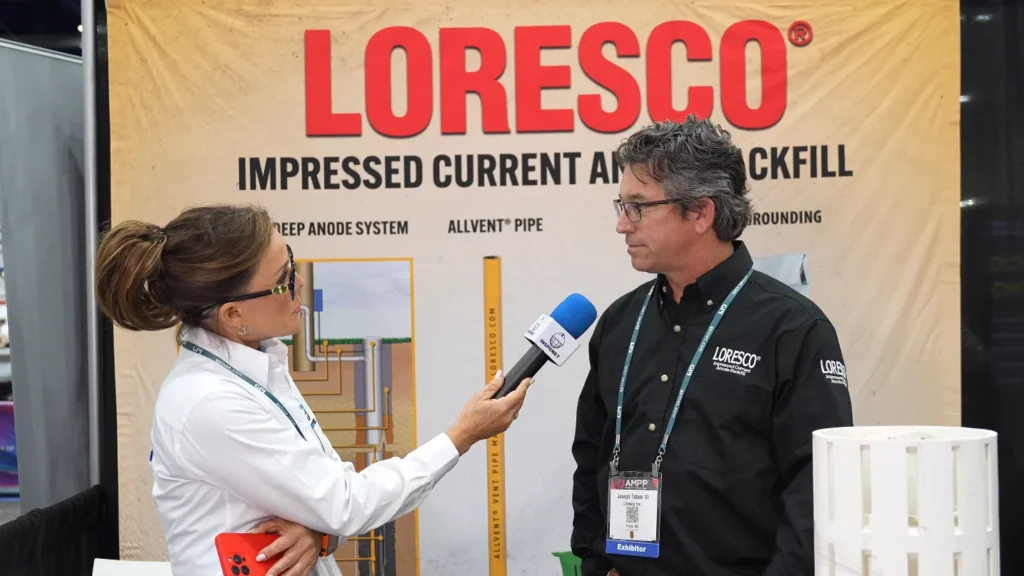
From a competitive perspective, Loresco’s differentiating value lies in its technical specialization and in developing solutions tailored to the specific needs of each installation.
The combination of engineering expertise and a materials-focused approach enables the company to offer products that optimize both performance and durability in cathodic protection systems.
Likewise, this technical orientation supports decision-making during design and implementation phases, reducing risks and improving operational outcomes.
Regarding the sector’s evolution, Tatum was clear in stating that corrosion protection will continue to be a constant need. The ongoing presence of metal infrastructure ensures the long-term relevance of cathodic protection systems.
In this sense, materials innovation and solution optimization will continue to make the difference in an environment where efficiency and durability are key factors.
The company’s participation in events like AMPP reflects the need to maintain direct contact with customers and distributors. With a long track record at this trade show, Loresco uses this space to strengthen relationships and share knowledge with other industry players.
These types of gatherings also make it possible to identify new opportunities and trends, consolidating the company’s role within the industry.
Ultimately, the reflection shared by the president of Loresco captures the nature of the sector: corrosion is a constant phenomenon that requires reliable technical solutions tailored to each context.
Therefore, the development of materials such as conductive backfill will continue to be essential to ensure the efficiency and durability of cathodic protection systems in the coming years.
For more content about AMPP 2026, please visit our LinkedIn profile.
Source: Inspenet.