
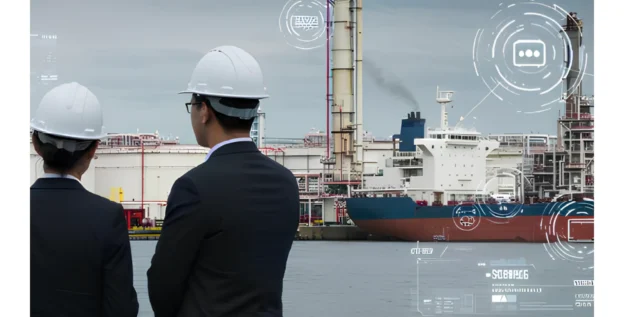
Managing tank farms and terminals has never been more complex. As storage capacities grow and global energy demands accelerate, operators face increasing challenges in safety, efficiency and environmental compliance. While digital transformation has incorporated advanced tools such as SCADA systems, terminal management software and digital twins, the human factor remains at the heart of decision-making.
Technology provides unprecedented data, but it is people with their experience, judgment and ability to collaborate who ensure safe and smooth operations. In this context, effective terminal management is not about replacing people, but empowering them to lead with knowledge and precision.
What does “integrated” in tanks and terminals really mean?
In the context of modern oil terminals and tank farms, “integration” is often misunderstood as simply implementing the right software. In reality, true integration involves aligning people, data and assets within a single operating ecosystem. Successful terminals are those where operations, maintenance, safety and logistics teams work in a coordinated way, sharing information and collaborating across functions.
Eliminating data silos allows field operators, maintenance engineers and control rooms to access the same information in real time, making decision-making faster and more accurate. Integration not only optimizes workflows, but also creates a connected environment where human expertise and digital tools combine to strengthen performance, resilience and reliability in terminal management.
The technology stack that needs people to run
Modern terminal management systems (TMS), along with SCADA platforms, IIoT sensors, automatic tank gauging (ATG) systems and digital twins, have transformed the way terminals operate. These technologies generate huge volumes of data, automate monitoring and simulate operational scenarios with great accuracy. However, advanced as they are, these tools are no substitute for human judgment.
Automation can collect and process data, but it cannot validate its quality. Systems generate hundreds of alarms, but only experienced operators can filter out what is really important. Even digital twins can predict operational risks, but they cannot decide when to stop a transfer or adjust the flow rate in real time. The reality is clear: automation strengthens operations, but human oversight remains critical to maintain safety, reliability and efficiency in complex environments.
Human decision-making: the true differentiator
In high criticality environments, such as marine terminals and tank farms, the human-in-the-loop (HITL) concept is critical. Technology alone does not guarantee operational reliability; it depends on competent professionals making informed decisions at key moments.
Structured competency frameworks, robust operating procedures and effective shift relays reduce information loss and ensure operational continuity. However, even with all these processes, human intuition often makes the difference.
Consider a near-miss scenario: an SCADA system detected abnormal pressure in a tank, but it was the operator’s expertise-interpreting subtle contextual data-that prevented a potential spill. These cases underscore a key reality: technology enables, but people lead. Human expertise turns data into actionable intelligence, ensuring safe, resilient and efficient operations.
Maintenance discipline for storage tanks
A robust storage tanks maintenance program is the basis for safe and reliable terminal management. According to the API 653, integrity management begins with well-defined inspection programs that combine internal and external assessments with advanced monitoring techniques. Operators must carefully plan inspection shutdowns, balancing production demands with operational availability.
The choice of NDT (non-destructive testing) techniques is key:
- Magnetic Flux Leakage (MFL) allows complete floor inspections to detect corrosion under the plates.
- Ultrasonic mapping (UT mapping) provides detailed thickness profiles.
- Pulsed Eddy Current (PEC) is ideal for inspections under coatings or isolated areas.
The industry is moving toward risk-based inspections (RBI), where intervals depend on historical data, equipment criticality and real-time monitoring. This disciplined approach reduces unplanned shutdowns, optimizes resources and ensures that tank farms operate safely and efficiently, even under more stringent regulations and environmental requirements.
Marine Terminal Operations: Dockside Decisions
In marine terminal operations, some of the most critical decisions occur at the dock during ship-to-shore transfers. From mooring maneuvers and cargo arm alignment to weather window control, every step requires impeccable coordination between systems and people.
SCADA platforms provide real-time visibility into flow rates, tank levels and transfer pressures. However, human checks are essential to validate information and execute safe operations. Specialized operators play a key role in:
- Confirm mooring conditions to ensure safe berthing.
- Adjust transfer rates as environmental or operating conditions change.
- Activate spill prevention and emergency response protocols when deviations arise.
This integration of digital systems with human supervision ensures safe, efficient and sustainable operations in high-risk maritime contexts.
Conclusion
In modern terminal management, technology alone is not the differentiator: the key is how people use it. Advanced system’s integration, maintenance discipline and human decision-making create the foundation for operational reliability. When digital innovation converges with human expertise, terminals and tank farms achieve superior levels of safety, efficiency and sustainability. In this new era, it is not technology leading people…it is people leading technology.
This article was developed by specialist Antonio Zavarce and published as part of the sixth edition of Inspenet Brief September 2025, dedicated to technical contents of the energy and industrial sector.