
Table of Contents
- Port facilities: A proactive role in safety
- Infrastructure and operational readiness
- Real-time data and decision-making
- Competence and standards in terminal operations
- The role of a safety and risk management system (SRMS)
- Risk assessment and operational readiness
- Training and competency development
- Conclusion
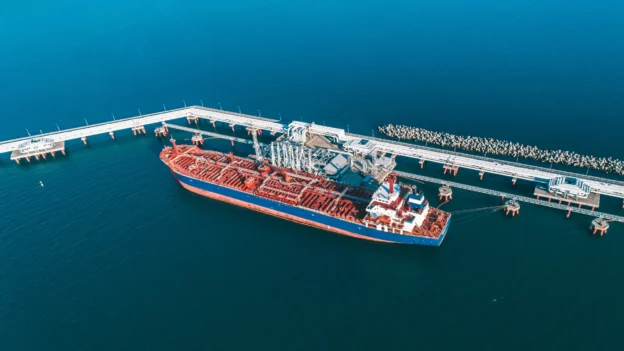
Oil and gas port facilities play a critical role in ensuring the safety of maritime operations. Through strategic and technical actions implemented from shore, a significant portion of maritime accidents can be prevented — especially those occurring at the ship–shore interface.
Over the past decade, maritime traffic has grown steadily, and with it, the risks associated with port operations. Statistics from the UNCTAD Review of Maritime Transport 2024 and Allianz’s Safety and Shipping Review 2023 confirm that a significant percentage of maritime accidents and incidents occur during vessel arrival and departure maneuvers. The greater the concentration of vessels within a port, the higher the interface-related risks. This is where the real challenge lies.
Port facilities: A proactive role in safety
Port facilities must take a proactive role. Their responsibility goes beyond receiving vessels — it includes implementing solid preventive measures from shore. This requires strict compliance with international standards, including SOLAS, ISM, STCW, and other IMO regulations aimed at ensuring vessel safety, thereby strengthening ship–port interfaces.
Equally important is applying the technical recommendations of organizations such as IMPA and OCIMF.
Infrastructure and operational readiness
Preventing accidents starts with well-planned and properly maintained port infrastructure. Essential measures include:
- Certified fendering systems in good condition.
- Mooring points with Safe Working Load (SWL) certification.
- Periodic dredging to maintain access channels and maneuvering basins.
- Fully operational navigational aids.
- Proper nighttime lighting to support safe maneuvers.
A detailed understanding of risks associated with vessel maneuvers at each facility allows operators to:
- Define appropriate mooring arrangements.
- Set limits on vessel sizes that can be safely accommodated.
- Ensure proper Under Keel Clearance (UKC).
These criteria must be backed by updated maneuverability studies and precise bathymetric surveys of channels and basins.
Real-time data and decision-making
Access to real-time met ocean data and integrating it into early warning systems is critical. These tools enable operators to approve or restrict maneuvers based on safety parameters, improving decision-making during operational windows.
Furthermore, the direct interaction between port facilities and marine pilots during maneuvers requires:
- Clear, timely, and effective communication.
- Consistent Master–Pilot Exchange (MPX) between vessel captains and pilots.
Guidelines from IMPA and IMO Resolution A.960(23) provide a solid framework for strengthening this ship–shore interface.
Competence and standards in terminal operations
Safe and efficient operations require:
- Trained Loading Masters capable of managing terminal operations.
- Strict safety checklists and continuous operational supervision.
- Effective English communication with tanker crews.
- Robust vetting protocols to ensure compliance with internationally accepted vessel standards.
When addressing the competitiveness and efficiency of oil and gas port facilities, regardless of the type of hydrocarbons, gases, or chemicals transferred, the main challenge — beyond achieving commercial objectives — lies in maintaining efficient, safe, and sustainable operations. These must positively impact terminal operators, the social and environmental surroundings, and the company’s business continuity. No facility can be considered competitive unless its operations are efficient, safe, and environmentally responsible.
The role of a safety and risk management system (SRMS)
Experience has shown that achieving efficient, safe, clean, and profitable operations requires implementing a Safety and Risk Management System (SRMS). This framework should:
- Standardize operational processes.
- Ensure maintenance of port infrastructure.
- Establish robust emergency response protocols.
The SRMS must be based on international standards and industry best practices proven effective through lessons learned within the sector.
This system should also encompass third-party services that directly or indirectly affect port operations and the ship–shore interface. A key question arises: “Do we truly understand the risks associated with our interface with tanker vessels?”
Risk assessment and operational readiness
The implementation of an SRMS begins with a diagnostic evaluation of current operations, which includes a comprehensive risk assessment based on:
- Lessons learned from the facility’s operational history.
- Case studies from similar port environments.
- Best practices established by the oil and gas maritime sector.
The diagnostic stage drives the development of action plans, which should cover the updating of operational manuals related to:
- Port infrastructure integrity and maintenance.
- Cargo transfer equipment.
- Emergency response procedures.
Training and competency development
The successful implementation of an SRMS requires understanding all operational and business risks — from port operations and ship–shore interfaces to cargo transfer.
Once these risks are identified and control measures are defined, the next step is to strengthen training and competency development for all personnel involved in:
- Ship–shore interfaces.
- Cargo transfer.
- Operational safety and environmental protection.
Conclusion
Preventing maritime accidents at the ship–shore interface is a shared responsibility between vessels and port facilities. Port installations must assume an active and technical role, coordinating closely with all maritime stakeholders and integrating:
- Technological tools.
- International standards.
- Industry best practices.
A safe port facility results from informed decision-making, reliable infrastructure, and a culture of prevention that prioritizes human life, environmental stewardship, and operational continuity.
Port facilities should also demonstrate compliance by sharing their SRMS objectives and structure with maritime and port authorities, showing their commitment to standardized processes that strengthen maritime and port safety.
This article was developed by the specialist Ricardo Izquierdo González and published as part of the sixth edition of Inspenet Brief September 2025, dedicated to technical contents of the energy and industrial sector.