
Table of Contents
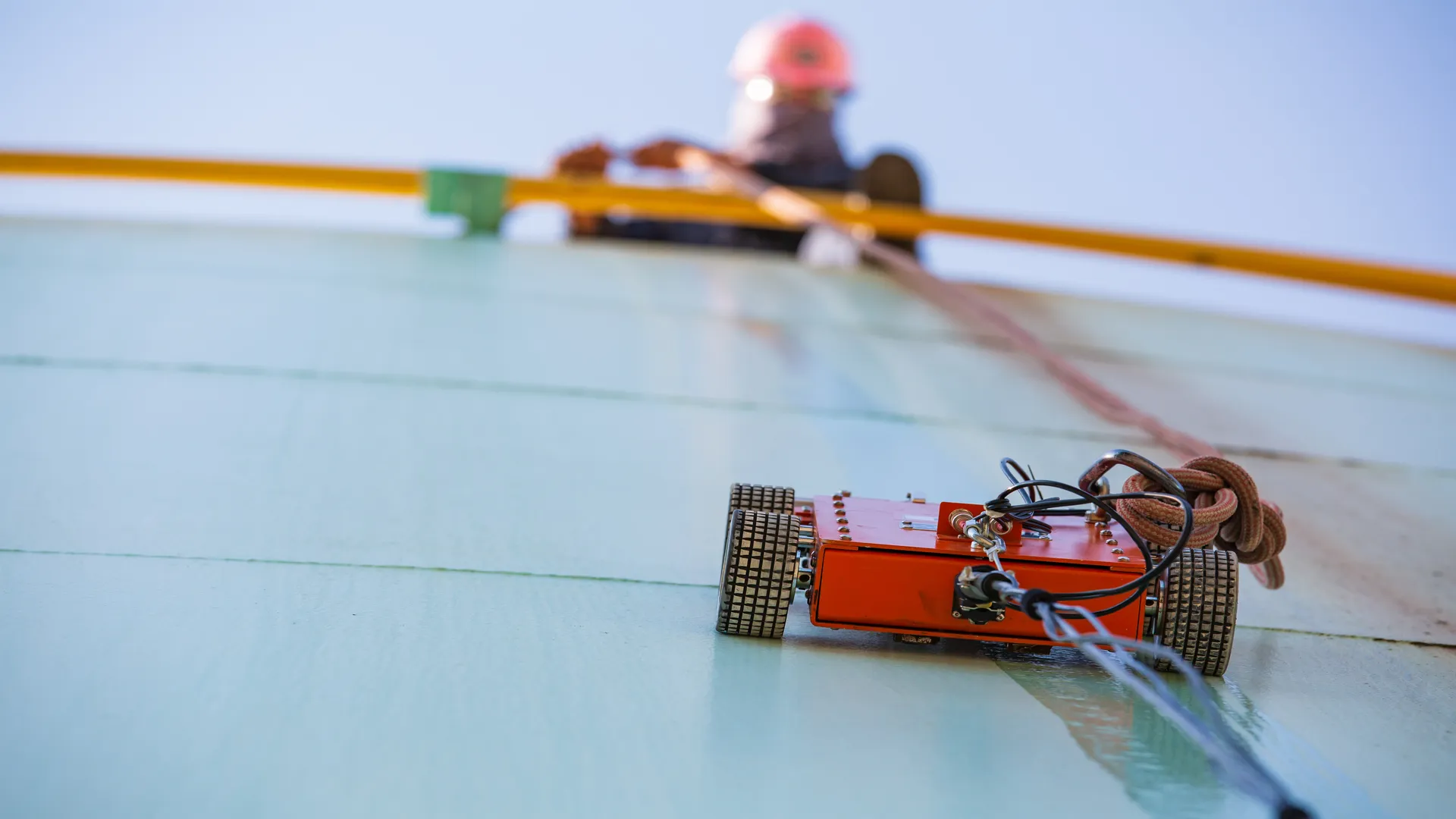
As someone who has been in the aboveground storage tank (AST) industry for over 37 years, I have seen a lot of changes in the world of tanks. This article is the first in what I hope will be a series where I will discuss some of my own experiences and changes that I think are important or potentially impactful to the industry. This first article will focus on robots with future articles planned on overfills, regulations, and new technologies.
I got to see my first robot in an in-service AST inspection all the way back in 1996, almost 30 years ago. It was at a pipeline facility in the suburbs of Atlanta, Georgia. A friend and colleague of mine who worked for the pipeline company invited me to come witness the event, even though I worked for a competitor at the time. While it wasn’t the first robotic tank inspection ever performed (believe it or not, I don’t know when that was), it was so cutting edge at the time that CNN sent a crew out to film and document the project.
The robot was a crawler type device that was lowered into the tank from the top. Obviously, this was a fuel tank, not a gasoline tank, as the robot wasn’t electrically rated for low flash products. It was controlled by an operator in a trailer located outside the tank dike. The best feature of the robot, in my not so humble opinion, was that it had a camera mounted on it. This was the first time that I could see the inside of a tank while the tank was in-service. To me, this was the most important advance.
The robot was exploring the bottom of the tank, everything was going well, and the CNN reporter was getting some great exterior shots and interviewing various people on what they thought. That’s when things took a turn for the worse. Somehow, the operator driving the robot drove it into the 6-foot-deep sump and got the robot stuck! The poor little robot had to be left in the tank until the next time the tank was taken out of service. I’m not sure if CNN even ran the report after that or not but I always hoped it did.
Over the years, I have patiently been waiting for tank robots to improve to the point of being useful and valuable to Owner/Operators. While a number of robotic companies tried, most failed, in my opinion. One of the problems to me was that most tank robot companies tried to convert existing inspection devices into a tank robot.
The first robotic company that I saw that I thought might be on to something was Square Robot. Through a colleague in the tank industry, I was invited to the first public demonstration of their robot in a water tank in 2017 in Houston. Square Robot had taken a different tack, they built a swimming robot and then added inspection tools to the robot.
I continued to follow Square Robot’s progress over the next few years. In 2022, while speaking at StocExpo in Rotterdam, I was introduced to several executives of Square Robot. A few nice dinners (and several bottles of wine later), I was asked to join the Board of Directors of Square Robot. I was honored and surprised, and after a brief discussion, I accepted.
The following year, Square Robot achieved an industry first by successfully performing a side launch into a gasoline tank while the tank was in service. In overly simplified terms, this is done by placing a valve on the side of a manway and attaching a launcher (like a pig launcher, if you know what that is) that the robot is placed into. Then the launcher is filled with whatever product is in the tank. Next the valve is opened and the robot swims into the tank and performs the inspection. When it’s finished, it swims back to the launcher, the valve is closed, product is drained out of the launcher, and the robot removed.
Next, let’s discuss a relevant update to API 653
The API committee that is responsible for maintaining API Standard 653 is called the SubCommittee on Aboveground Storage Tanks or SCAST. This is the API committee that I have served on since 1994 and I had the privilege and honor many years ago to serve as Chairman for 3 years.
For those that don’t know, API’s policy is that they do one of three things to their documents every 5 to 7 years. One, publish a new edition if there have been any significant changes. Two, reaffirm the document if there have been no significant changes. Three, if the document is no longer needed or relevant, then the document is withdrawn.
The 5th edition of API 653 was originally published in November of 2014. Since then, there have been several addendums to the document, the first in 2018. As you may realize by now, SCAST and API have been a little behind. The soon to be published (I hope) API 653 6th edition has several changes, some that are much more significant than others.
One such item is one that I have been personally working on for the last five years and it concerns robotic and other “on- stream” inspections. These inspections have been allowed in API 653 for more than 25 years and are referenced in section 6.4.1.2 of API 653. However, there has always been a problem that Owner/Operators have had to deal with; what if a robot finds something that is below the allowable limits in API 653 but not leaking? Does the tank need to be taken out of service immediately? Who decides?
In the 6th edition of API 653, this issue is now addressed. The new section 6.4.1.3 outlines the steps that an Owner/ Operator can take to address this issue, if they so choose. Obviously, the Owner/Operator can always take their tank out of service, if they want, but now they have some options. It should be noted that once the 6th edition of API 653 is published, Owner/Operators will be able to use this change unless they have to follow a different version of API 653, such as DOT/PHMSA regulated tanks (3rd edition, 3rd addendum) or Texas SB900 regulated tanks (5th edition) as examples.
Hopefully enough people reading this will approve and maybe even find some of this information useful so I will get the chance to share more of my experiences along with the changes in technologies and industry standards.
This article was developed by specialist Earl Crochet and published as part of the seventh edition of Inspenet Brief February 2026, dedicated to technical content in the energy and industrial sector.