
A real problem in NDT
Everyone in the inspection world talks about the same problems: an aging workforce, legacy infrastructure, and a shortage of qualified technicians.
But those are just symptoms. The real problem is that industrial NDT has been operating for decades without a foundational infrastructure.
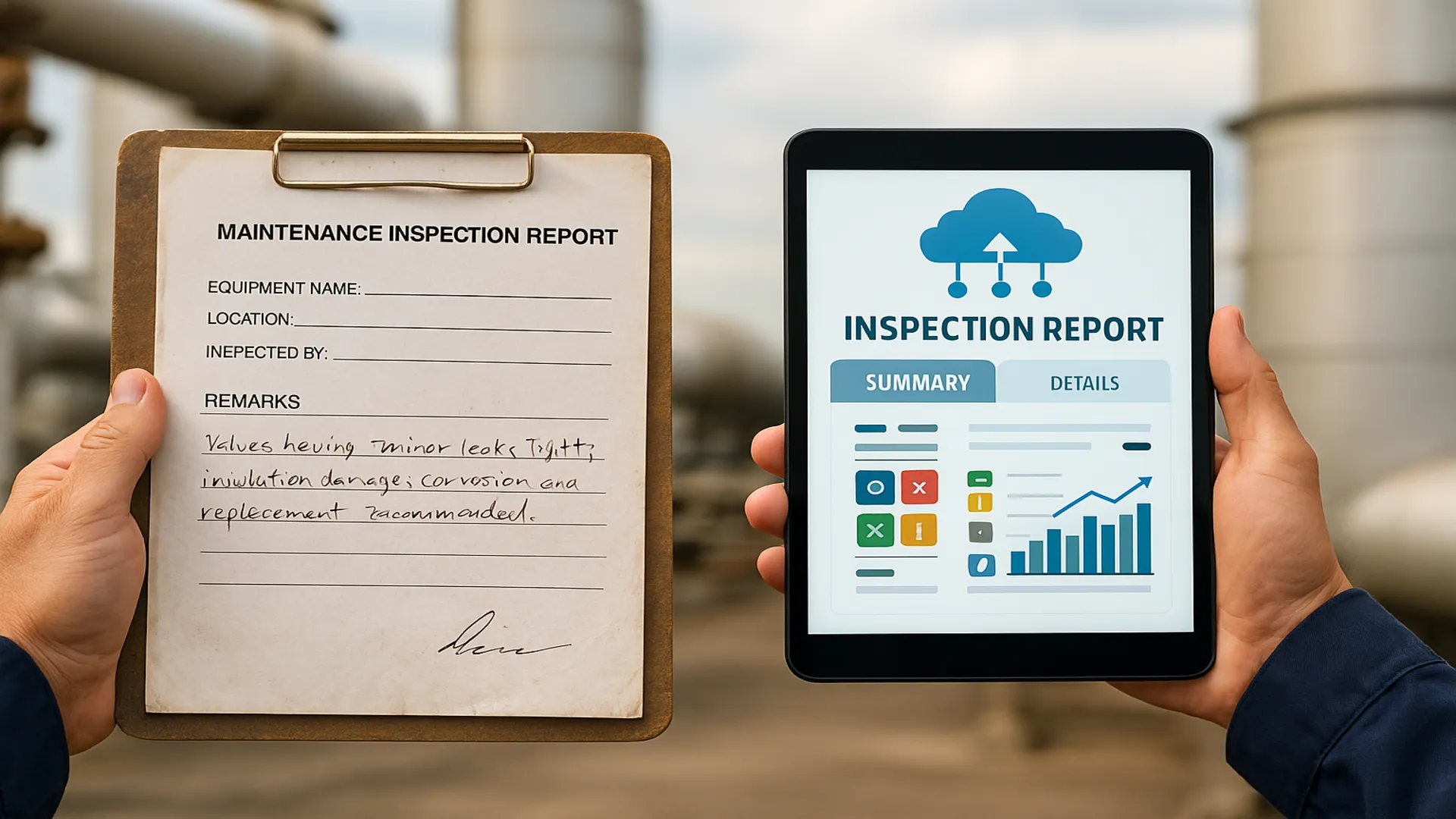
Other sectors have evolved. Manufacturing has builtdigital twins. Logistics runs on real-time data. Finance operates through fully integrated platforms. Inspection? Still fragmented. Still manual. Still reliant on spreadsheets, disconnected tools, and memory.
What fragmentation really costs
Walk into almost any facility and you’ll see the same pattern: inspection data scattered across four or five systems, none of which communicate. Reports are inconsistent, some written by vendors who haven’t worked there in a decade. Historical data lives in scanned PDFs, orphaned Excel sheets, or storage cabinets.
If an engineer wants to assess the condition of a tank with twenty years of service, they’re lucky to get reliable trend data without spending hours or days trying to piece it all together.
Meanwhile, experienced technicians spend half their shift formatting reports and updating certifications instead of performing actual inspection work.
And here’s the result:
- Skilled people burn out.
- The profession looks outdated to new talent.
- Everyone gets overworked, and the talent pipeline dries up.
This isn’t about technology gaps. It’s a cultural failure.
It’s not just inefficient. It’s damaging the profession. Good people are burning out. New talent sees outdated workflows and goes elsewhere. The industry is shrinking from the inside out.
Building the backbone
We didn’t set out to be just another service provider or robotics company. Our goal is broader. We’re building the missing infrastructure that enables the industry to operate at a higher standard.
At the center of that is NEPTUNE: our AI-enabled platform designed to unify every aspect of inspection, regardless of what technology or contractor is used. From job planning to technician tracking, execution to data acquisition, analysis and reporting to long-term data storage, all encrypted, protected, and monitored.
It’s open and scalable. It’s built to unify, not to silo.
NEPTUNE is designed as an intelligent operational hub that connects every part of the inspection and engineering workflow. It brings together project estimating, scheduling, job tracking, accounts receivable, and reporting into one balanced ecosystem. Each function communicates seamlessly with the others, tying field operations to management and financial oversight in real time. Integrated GPS mapping, AI and machine learning tools, and built-in applications for procedure writing and report generation ensure consistency, accuracy, and adaptability across every project. While NEPTUNE’s data management capabilities continue to expand, its current foundation already delivers a unified, automated environment that learns and improves with every inspection.
Everything feeds into a centralized, validated, and accessible dashboard that reflects the true integrity state of your assets at any given moment, not after a shutdown. Not after a quarterly review. Right now.
NEPTUNE accepts inputs from our systems, from partner technologies, from legacy data, and even from manual entries. The result is a long-term, portable, and consistent record of inspections that is not tied to a single technician, contractor, or device.
That is the kind of institutional memory this industry has never had.
Hardware that feeds the system
We’re also building field systems that integrate directly with the platform. One of those is TITAN, our automated ultrasonic testing system for large-area C-scan inspection of tanks, vessels, and piping.
TITAN produces standardized, time-stamped datasets that flow directly into NEPTUNE, eliminating transcription errors, data loss, or miscommunication between field techs and engineers.
Our approach to hardware isn’t to build every solution in- house. We actively collaborate with and integrate systems from other forward-thinking robotics and sensor companies, bringing them into the NEPTUNE ecosystem. This keeps our tech stack open, collaborative, and flexible for our clients.
Rethinking standards for modern workflows
The standards we use today were written for a different era. They assume manual processes and heavy documentation. They weren’t designed for platforms with real-time feedback, automated validation, or AI assistance.
We’re contributing to the next generation of standards, ones that keep the technician in control, while leveraging intelligent systems to reduce human variation and raise baseline quality.
Here’s what that looks like in practice:
- Two Level II techs might deliver different results due to interpretation or fatigue.
- With automation, the system manages coupling pressure, scan speed, and probe angles.
- The technician still makes the calls but with better data and built-in QA support.
NEPTUNE gives real-time data quality checks, baseline comparisons, and immediate alerts when something looks off. It shifts the technician’s focus back to inspection, not paperwork.
Reports generate automatically from validated data. No chasing formats. No after-the-fact admin.
Fixing the workforce problem
You can’t fix the technician shortage by training more people into broken systems. You fix it by making the profession worth entering.
That starts with giving field crews modern tools. Tablets, clean interfaces, automatic reporting, and AI-supported callouts. Real-time feedback. Sync-to-cloud results. Built-in certification tracking and performance metrics.
When inspection looks and feels like modern tech work, it attracts modern tech talent.
With our platform, a Level II tech can safely handle more complex work because they’re supported by built-in validation, historical context, and decision-support tools.
Even better, NEPTUNE captures institutional knowledge automatically. As veteran inspectors work through the system, it learns their methods, areas of concern, and how conditions evolve. That intelligence stays behind when they retire, giving the next tech a 10-year head start.
What the market is telling us
The response has been immediate. We’re seeing buy-in from global operators, regional contractors, defense clients, and infrastructure asset owners. Across the board, they’re all reaching the same conclusion: the old way is no longer sustainable.
They don’t just want better equipment. They want:
- Systems that restore trust in inspection data
- Workflows that don’t burn out their people.
- Platforms that let small teams perform at enterprise- level scale
Facilities that delayed digital transformation are now moving forward. Contractors who resisted vendor lock-in are happy to have a neutral ecosystem. Engineers sick of inconsistent reporting are implementing validated inspection pipelines.
Final thought
Inspection is at a turning point. The tools are available. The need is urgent. What’s been missing is the foundation.
In the military, we learned that reliable capability is built on infrastructure, equipment, systems, and training that allow people to do the job right, every time.
We’re applying that same mindset here.
Because reliability isn’t just measured in uptime. It’s measured in whether the next generation inherits functioning infrastructure, or the broken systems we were handed.
We’re building for them.
This article was developed by specialists from SUBSEA NDT & Engineering and published as part of the seventh edition of Inspenet Brief February 2026, dedicated to technical content in the energy and industrial sector.