
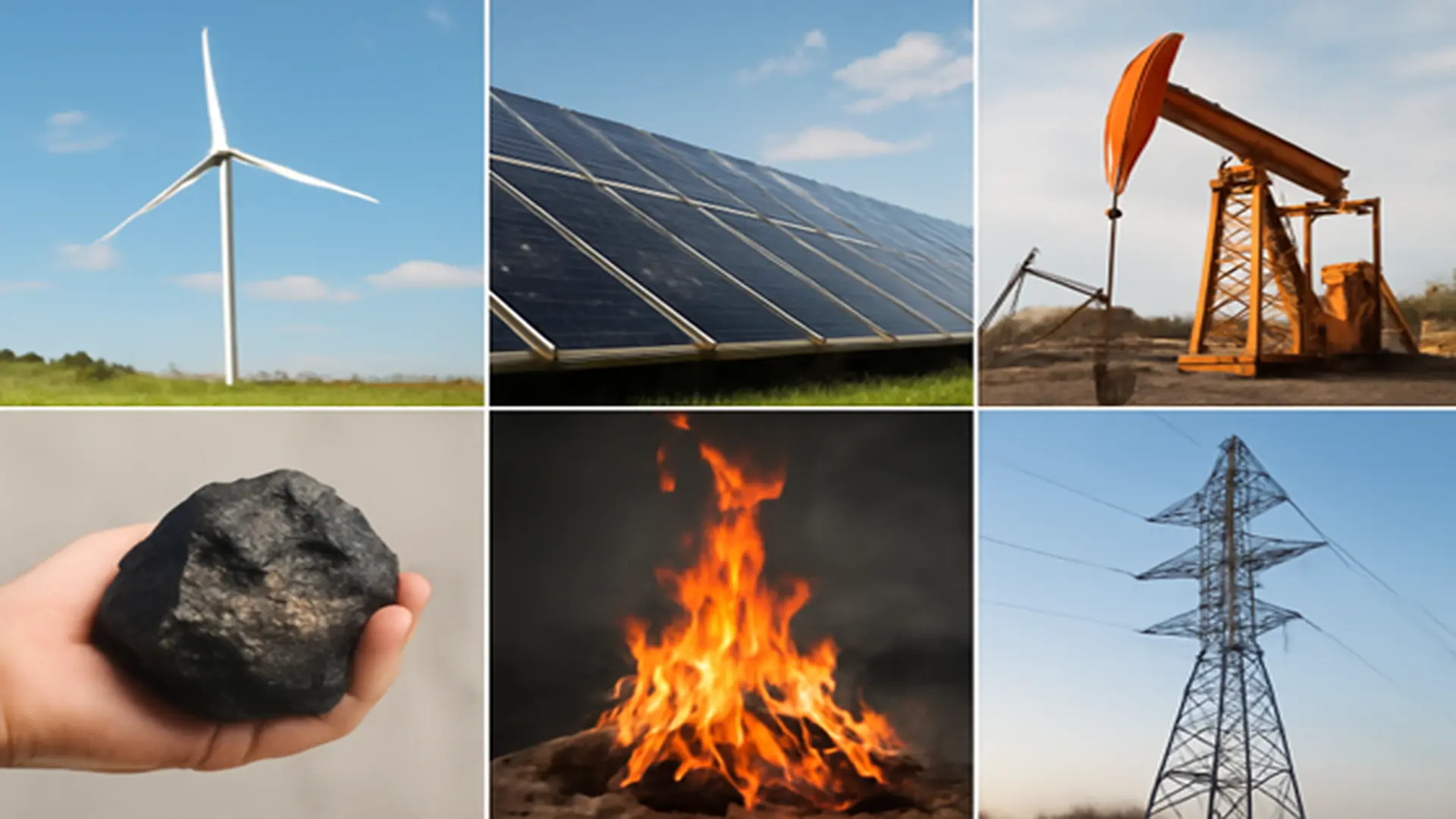
The energy industry plays a fundamental role, as it is responsible for transforming, converting, storing, and distributing the different forms of energy that sustain economic and social development. From electricity generation to fuel supply, this industry acts as the backbone of industrial, technological, and productive activity on a global scale.
Despite being an everyday concept, the technical understanding of energy and its strategic relevance within the energy industry are often underestimated. In a global scenario marked by the transition to cleaner sources, competition for natural resources, and ever-growing electricity demand, understanding what energy is is no longer a purely academic exercise. Rather, it becomes a necessity for interpreting current challenges, anticipating trends, and visualizing the future of the energy industry and society as a whole.
It is impressive how people talk about energy in their daily lives. And sometimes the concepts and definitions are so broad that, paradoxically, we understand the term very clearly and with its respective classifications. It is present in the movement of galaxies, in the photosynthesis of a plant, in the operation of an industrial turbine, and in the transmission of a digital signal from a cell phone. Without it, there would be no cities, no industry, and no organic life.
Energy: Industrial and strategic of the future
Energy is present at all levels of existence: in the movement of galaxies, in the photosynthesis of a plant, in the operation of an industrial turbine, and in the transmission of a digital signal from a cell phone. It is the ability to produce change, perform work, and sustain physical, chemical, and biological processes. Without energy, there would be no modern cities, no industrial processes, no transportation systems, and no organic life as we know it.
Despite being an everyday concept, its technical understanding and strategic relevance are often underestimated. In a global context marked by energy transition, competition for resources, and growing demand for electricity, understanding what energy is is not just an academic exercise: it is a requirement for visualizing the future.
We usually ask ourselves four essential questions to understand energy, ranging from its scientific basis to its geopolitical value:
- What is energy in technical terms?
- What are the types of energy and how are they classified?
- Why is energy strategic for countries?
- What challenges does energy face today?
What is energy in technical terms?
If we refer to the literal concept in physics, energy is defined as the ability of a system to perform work or generate change. It can manifest as movement, heat, radiation, or stored in chemical bonds; but it never appears out of nowhere or disappears: it only transforms, as established by the law of conservation of energy (first law of thermodynamics).
There’s a saying that what we don’t know, we can’t measure, and perhaps that’s why the measurement of energy began by calculating individual manifestations like mechanical work and heat, using methods and units that weren’t related or conventional.
Primitive concepts like Leibniz’s “vis viva” dealt with motion. However, heat measurement became more precise with the thermometer in the 18th century, while galvanometers allowed for the measurement of electricity in the 19th century.
The turning point occurred with James Prescott Joule in the 1840s, when his experiments demonstrated that heat and mechanical work were interchangeable and forms of the same conserved entity, leading to the unification of the energy concept under the first law of thermodynamics as mentioned earlier.
The International System of Units adopted the “joule” (J) as the standard unit to measure this universal quantity, finally standardizing how science and industry measure energy. Since then, energy has been measured in Joules (J) in the International System, although in electrical contexts, kWh (kilowatt-hour) is also used.
Energy can be transferred from one body to another through processes such as mechanical work, thermal convection, or electromagnetic exchange.
However, two fundamental concepts help understand its behavior:
- Potential energy: associated with the position or configuration of a system. For example, water held in a dam, or a compressed spring.
- Kinetic energy: the product of the movement of a mass. For example, a speeding car or wind flow.
The sum of both is mechanical energy, one of the most studied and used forms in engineering.
Types of energy: classification and applications
There are criteria for energy that bifurcate its concept, but what is clear is that energy can be classified by its physical nature and origin:
- Mechanical energy: This is derived from the movement or position of bodies.
- Applications: hydraulic turbines, windmills, rotary engines.
- Thermal energy: It results from the microscopic movement of particles — heat, temperature. Examples: industrial furnaces, combustion engines, thermoelectric power generation.
- Chemical energy This is one of the energies we don’t feel because it’s stored in molecular bonds. Examples: fossil fuels (oil, gas), organic fuels, batteries.
- Nuclear energy: This is released by the fission or fusion of atomic nuclei; of high energy density. Used in power generation in nuclear plants, with large, constant production.
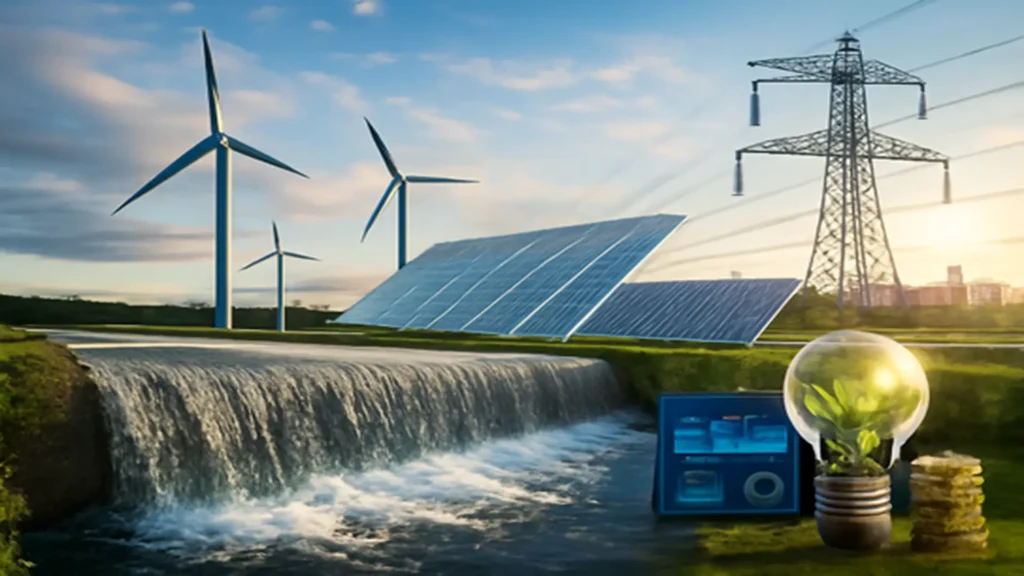
The following image shows forms of energy such as wind, solar, and ocean energy.
Renewable energies and others
Solar, wind, hydro, geothermal, biomass
These are currently under development, although they have always been there. They come from natural sources and, in many cases, are inexhaustible on a human scale. Used for electricity, heat, transportation.
Comparative table of energies
| Type of energy | Main advantage | Critical limitation or current challenge |
|---|---|---|
| Solar / Wind / Hydro / Renewables | Abundant, low emissions, renewable | Intermittency, climate/geography dependence, need for storage or infrastructure |
| Fossil (chemical energy) | High energy density, reliable source | CO₂ emissions, external dependency, finite resources |
| Nuclear | High continuous power, low CO₂ emissions | Radioactive waste, security costs, public perception |
Why is energy strategic for countries?
Energy is strategic because it allows a country to function beacause it powers factories, transportation, hospitals, etc. Without energy, there is no production or development. And whoever controls it is independent and secure. Energy not only drives machines: it structures economies, defines alliances, and can trigger conflicts. In other words, it’s a productive, political, and military resource, and its control has determined global power for centuries.
Economic dimension
Energy is costly. Not only the fact that it is produced, generated, and distributed, but because a considerable investment is required to achieve these three aspects. Securing sufficient, clean, and accessible energy is vital for the well-being and future of any nation. Energy sustains transportation, manufacturing, food production, and the tech sector. The more energy a country has, the more capacity it has to generate wealth. Energy demand is directly linked to economic growth and industrial development.
Energy efficiency and optimal resource utilization can reduce dependence on fossil fuel imports, improve trade balances, and mitigate energy vulnerabilities.
National security and stability dimension
On the other hand, a country with sufficient energy resources is better equipped to protect its economy and influence others whose resources are limited. An example is the energy that powers telecommunications networks, defense, hospitals, and supply chains. An energy disruption can paralyze entire cities or provoke social conflicts.
Moreover, with the transition to renewable energy and more complex electrical grids, supply security, grid stability, and resilience against natural disasters or extreme weather events are becoming key strategic priorities.
Geopolitical dimension
We are well aware of the advantage of a country located strategically on the world map. Energy resources, fossil fuels, critical minerals, renewable sources — generate international influence. Countries with an abundance of natural resources (oil, gas, uranium, minerals, favorable conditions for solar/wind) have many competitive advantages. The ability to generate cheap and stable energy can attract investment, define alliances, and strengthen energy sovereignty.
Current challenges: transition, demand, and sustainability
The arrival of the 21st century faced a paradox: as insatiable beings, humans of this era demand more energy than ever, but to achieve this, we need to produce it with less environmental impact and greater resilience.
What are the main energy challenges?
Given the circumstances for the dynamics of those of us who coexist on this planet, the main current energy challenges are: reducing fossil fuel use, increasing clean energy, improving energy efficiency, ensuring universal access to energy, confronting climate change, modernizing outdated infrastructure, and ensuring supply during crises. All of this requires innovation, investment, and global cooperation to achieve a sustainable and fair future for all. How to do it, we know; but, are we doing it? I’ll quote a few excerpts from texts that have referred to this point:
Energy transition and decarbonization
Migrating from fossil fuels to renewable energy requires infrastructure, investment, storage technology, and grid modernization.
Intermittency and storage
Currently, renewable sources like solar and wind do not produce energy constantly. Logically, this requires robust energy storage capabilities (batteries, hydrogen, pumped hydroelectric, other emerging technologies) to balance supply/demand.
Without reliable storage solutions, the mass adoption of renewables is limited.
Supply security and climate/geopolitical vulnerabilities
One of the challenges we constantly face is climate change — with extreme events, droughts, floods — which threatens existing energy infrastructure, especially in factories, refineries, power plants, and distribution networks.
Moreover, the growing demand for electricity (due to data centers, transport electrification, digitalization) requires more resilient and diversified grids.
Conflict between energy security and green transition
It’s interesting to see, in some contexts, the concern for securing supply, as well as continuous availability and stable prices for the environmental urgency to reduce emissions. And as expected, this complicates the acceptance of certain technologies in the social sphere, even renewables, especially in vulnerable regions or areas with limited infrastructure.
Global access to energy and sustainable development
In some emerging economies, still in the mid-21st century, they lack access to clean and reliable electricity. This is why there is repeated thought about the essential expansion of renewable capacity for sustainable development, reducing inequalities, and mitigating negative environmental impacts.
Energy will always be a substantial part of our lives. The detail lies in how we use it in relation to our existence.
Conclusion
Studying energy reveals that it is not only a physical quantity, but a resource that shapes the economic, industrial, and geopolitical direction of nations. In a world driven by digital transformation, efficiency, and environmental sustainability, the energy industry plays a central role by combining technological innovation, supply security, and environmental responsibility. Understanding its fundamentals is no longer merely technical—it is a strategic necessity for the future.
References
- Britannica Editors. (n.d.). Energy. Encyclopaedia Britannica. Retrieved from https://www.britannica.com/science/energy
- OpenStax. (n.d.). Basic concepts of energy. In Chemistry 2nd ed. Retrieved from https://openstax.org/books/chemistry-2ed/pages/5-1-basic-concepts-of-energy
- U.S. Energy Information Administration. (n.d.). What is energy?. Retrieved from https://www.eia.gov/energyexplained/what-is-energy/index.php
- OECD. (2025). The imperative of energy security: Old concerns, new challenges. In Economic Security in a Changing World. OECD Publishing. https://doi.org/10.1787/4eac89c7-en
- World Meteorological Organization (WMO). (2022, October 11). Climate change puts energy security at risk. Retrieved from https://wmo.int/media/news/climate-change-puts-energy-security-risk
- IEA & Analysts. (2025, March 26). Electricity security relies on the smooth flow of electrons [Commentary on congestion and energy transition]. Insight EU Monitoring. Retrieved from https://ieu-monitoring.com/editorial/iea-commentary-grid-congestion-poses-challenge-for-energy-security-and-transition/551774/
- Author(s) Unidentified. (2024). Energy access challenge and the role of fossil fuels in meeting electricity demand: Promoting renewable energy capacity for sustainable development. Geoscience Frontiers, 15(5), 101873. https://doi.org/10.1016/j.gsf.2024.101873
- International Renewable Energy Agency (IRENA); Various. (2024). Geopolitics of the energy transition [Report]. Retrieved from https://www.irena.org/-/media/Files/IRENA/Agency/Publication/2024/Apr/IRENA_Geopolitics_transition_energy_security_2024.pdf