
Table of Contents
- Inherent risks in an SPM buoy
- Strategic planning of the overhaul
- Integration of safety into O&M
- Management of human safety culture
- Technology as an ally in prevention
- Active prevention through critical questions
- Risk matrix for SPM buoy overhaul
- Categories of critical risks
- Preventive and mitigating barriers
- Conclusions
- References
Overhaul of SPM buoys constitutes a critical component within operation and maintenance (O&M) strategies in marine terminals. These structures, subjected to severe environmental loads, cyclic stresses, and aggressive corrosive conditions, require planned interventions that ensure structural integrity, operational reliability, and regulatory compliance. A major overhaul involves not only inspection and replacement of components, but also the comprehensive evaluation of the mooring system, fluid transfer system, and associated subsea elements.
In the context of terminal safety, the overhaul of SPM buoys is integrated into risk-based integrity management programs, where technical planning, quality control, and documentary traceability are decisive in minimizing critical failures, spills, and unplanned shutdowns. A structured execution of the process allows extension of the asset’s service life and ensures safe operations in highly demanding offshore environments.
Inherent risks in an SPM buoy
SPM buoys operate in an environment where dynamic loads, variable metocean conditions, and simultaneous high-risk operations converge. One of the most critical scenarios is collision or uncontrolled vessel movement during mooring and unmooring maneuvers. This is where an overhaul is required, as an approach error, poor communication, or a sudden weather change can generate excessive stresses on the buoy, causing structural failures or hose ruptures with severe environmental consequences.
Added to this is the progressive fatigue of mooring lines. Although they may visually appear to be in good condition, these elements are subjected to continuous loading and unloading cycles that degrade their internal strength. Without a condition-based inspection and replacement program, the risk of sudden failure increases exponentially during critical operations.
Mechanical failures and maintenance errors represent another determining factor. A poorly reinstalled valve, incorrect torque application, or a hose exceeding its service life can become the starting point of a major incident. Finally, direct personnel exposure during diving operations, heavy lifting, or hot work cannot be ignored, where even a minimal operational slip may have fatal consequences.
Strategic planning of the overhaul
Planning the overhaul of an SPM buoy must be conceived as a risk management process and not merely as task scheduling. The first step is to understand the actual condition of critical components by assessing their remaining life through technical inspections, operational history, and accumulated load data. This information allows prioritization of interventions and avoidance of reactive maintenance.
Early coordination among terminal operators, maritime personnel, contractors, and authorities is essential. Each stakeholder must understand their role, operational limits, and communication protocols. Poor planning at this stage often results in operational interferences and improvised field decisions.
Likewise, defining safe operational windows is key. The overhaul should not be executed under commercial pressure or marginal weather conditions. Incorporating metocean analysis and contingency scenarios allows informed decisions on when to proceed and when to suspend an activity.
Integration of safety into O&M
Safety in SPM buoy operations and maintenance must be integrated as a living system, not as a set of static documents. Prior to each intervention, pre-operational inspections validate the condition of equipment, tools, and mooring lines, reducing the likelihood of unexpected failures during execution.
The human factor is equally critical. Ensuring that personnel possess technical training, valid certifications, and specific SPM experience is not a formality, but a fundamental preventive barrier. A trained operator recognizes early warning signs of risk and acts before escalation occurs.
The rigorous application of work permits, especially for hot work and simultaneous operations, creates a control framework that organizes activities and requires verification of safety conditions before initiating any task. When integrated into daily O&M practices, these measures drastically reduce incident rates.
Management of human safety culture
No technical system is stronger than the safety culture that supports it. In terminals with SPM buoys, where operations often become routine, there is a risk of normalizing deviations. Countering this trend requires continuous training, practical drills, and simulations that keep awareness active.
Open communication of risks and lessons learned strengthens trust and enables identification of unsafe conditions before they materialize into accidents. When personnel feel they can report without fear of retaliation, the organization gains real visibility into its vulnerabilities.
Safety leadership is the element that consolidates this culture. Supervisors and managers who actively participate in safety briefings and risk assessments send a clear message: safety is non-negotiable, even under operational pressure.
Technology as an ally in prevention
Modern technology provides tools that transform the way safety is managed in SPM buoys. Real-time monitoring systems for tension in cables and hoses allow detection of abnormal conditions before failure occurs.
Redundant communication systems, combined with clear procedures, reduce errors during critical maneuvers. Additionally, the use of historical data analysis and predictive models allows anticipation of degradation patterns and planning of condition-based maintenance rather than assumption-based maintenance.
Integrating these tools into the O&M system does not eliminate risk, but significantly elevates the level of control and informed decision-making.
Active prevention through critical questions
Effective prevention begins with uncomfortable but necessary questions. Before initiating an overhaul, the team must question whether all risks have been realistically identified and mitigated, not merely documented.
It is also essential to verify whether emergency response systems are operational and tested, and whether personnel clearly understand what to do in the event of a spill, mooring failure, or medical emergency.
Finally, confirming that safety responsibilities are clearly defined and communicated prevents authority gaps during critical moments. These systematically formulated questions transform prevention into an active practice rather than a simple statement of intent.
Below, we present the essential protocols for mitigating mechanical failures and ensuring safe operations in demanding offshore environments.
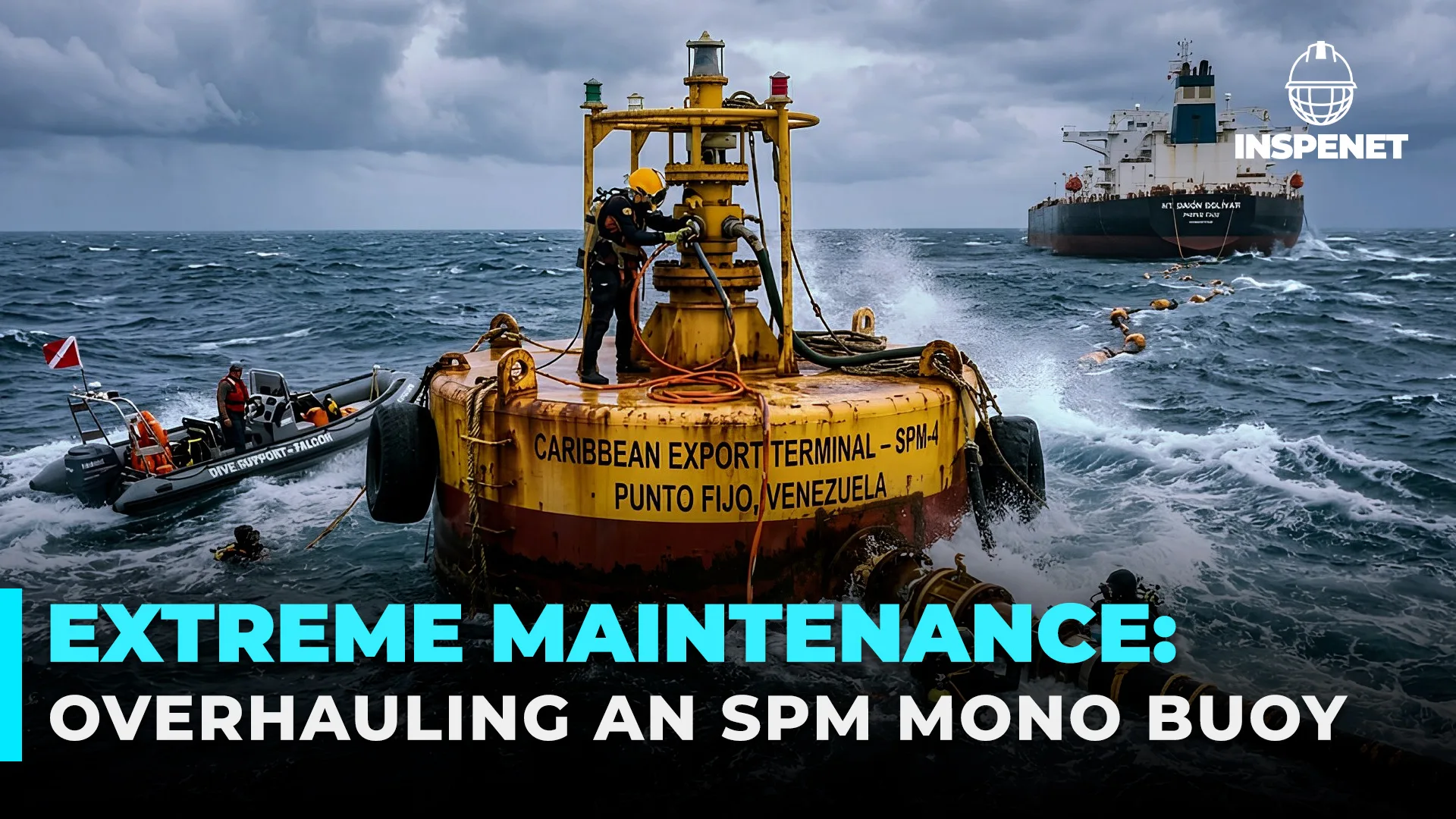
Risk matrix for SPM buoy overhaul
Objective and scope
The risk matrix for SPM buoy overhaul is a preventive tool designed to identify, assess, and control hazards associated with critical operations in marine terminals. Its primary objective is to reduce the likelihood of major incidents (serious injuries, hydrocarbon spills, asset damage, and environmental impact) through the systematic application of technical, operational, and human barriers.
This matrix applies to all phases of the overhaul: planning, mobilization, execution, testing, and return to operation, and involves both in-house personnel and contractors and associated crews.
Risk assessment methodology
The assessment is based on a classical probability versus consequence approach, adapted to the maritime and offshore context of SPM buoys. Each identified hazard is analyzed considering the likelihood of occurrence and the severity of its consequences, before and after the application of controls.
Inherent risk represents the scenario without controls, while residual risk reflects the acceptable level of risk after implementing preventive and mitigating barriers. This approach allows prioritization of actions and allocation of resources where they are truly required.
Within this framework, Grupo HB is a Mexican company with more than three decades of experience, founded in 1987 by architect Hernán González Garza, specializing in the development of civil, maritime, port, and energy infrastructure projects. Throughout its history, the company has successfully executed more than 100 projects, consolidating itself as a reliable player in highly complex technical and regulatory environments.
Grupo HB has extensive experience in the design, construction, operation, and maintenance of maritime infrastructure, including ports, piers, offshore structures, and specialized systems for the operation and maintenance of Single Point Mooring (SPM) buoys, ensuring high standards of safety, operational reliability, and service continuity in hydrocarbon terminals.
Its portfolio is complemented by the execution of civil and electromechanical projects, coastal protection and restoration works, dredging of dams and channels, as well as critical operations such as the replacement of loading arms in fuel storage and distribution terminals—activities that require precise planning and strict HSE controls.
In the technological field, Grupo HB incorporates advanced solutions such as Jack-Up Barge platforms for offshore operations, subsea inspection using remotely operated vehicles (ROVs), and modern mooring and fuel offloading systems, enabling optimization of execution times, reduction of operational risks, and improvement of technical decision-making.
Categories of critical risks
Mechanical and structural risks
During the overhaul, mechanical risks intensify due to the handling of large and heavy components such as cables, hoses, and mooring system elements. A structural failure, improperly executed lifting operation, or rupture of a tensioned line can result in serious or fatal accidents.
Prevention focuses on prior inspections, lifting equipment certification, control of dynamic loads, and establishment of clearly defined exclusion zones.
Operational and navigation risks
Support vessel maneuvers and the proximity of tanker vessels during the overhaul introduce risks of collision, unintended contact with the buoy, or operational interference. Lack of coordination or poor communication can rapidly escalate into a major incident.
Key barriers include clear maneuvering procedures, redundant communication, marine traffic control, and defined authority to stop operations under unsafe conditions.
Human and organizational risks
The human factor remains one of the primary causes of incidents in marine terminals. Fatigue, overconfidence, pressure to meet schedules, and deficiencies in supervision significantly increase the probability of error.
Managing these risks requires specific SPM training, adequate shift rotation, visible safety leadership, and a culture that prioritizes safe work stoppage when necessary.
Environmental risks
Environmental risk is inherent in any intervention involving hydrocarbon transfer systems. A leak during the overhaul may result in spills with significant environmental and legal impact.
Prevention is based on hose and valve integrity, spill response plans, availability of containment equipment, and trained personnel capable of immediate response.
Preventive and mitigating barriers
Preventive barriers aim to avoid the occurrence of an event, while mitigating barriers reduce its consequences. In the context of SPM buoys, these barriers include standardized operating procedures, work permits, real-time monitoring, emergency response plans, and periodic drills. The effectiveness of the risk matrix depends on ensuring that these barriers are not limited to documentation, but are verified and validated before and during each overhaul phase.
The risk matrix must be used as a living tool. Before initiating each critical activity, the team should review it, adapt it to the actual conditions of the day, and confirm that defined controls are implemented. Any change in scope, weather conditions, or available resources requires immediate risk reassessment. This dynamic approach transforms the matrix into a key instrument for real-time safe decision-making.
Conclusions
The overhaul of SPM buoys constitutes a strategic intervention within operation and maintenance (O&M) programs, as it restores design conditions, mitigates degradation mechanisms associated with fatigue and marine corrosion, and reduces the probability of structural failures or environmental events. Proper planning and execution directly impact operational continuity and risk management in marine terminals.
The integration of overhaul into a risk-based integrity management system strengthens operational safety and regulatory compliance in offshore terminals. The combination of specialized technical inspection, quality control, documentary traceability, and compliance with international standards ensures asset life extension and environmental protection in hydrocarbon transfer operations.
References
- American Petroleum Institute. (2021). API Recommended Practice 2SK: Design and analysis of stationkeeping systems for floating structures (4th ed.). API Publishing Services.
- American Petroleum Institute. (2020). API Recommended Practice 2A-WSD: Planning, designing and constructing fixed offshore platforms—Working stress design (22nd ed.). API Publishing Services.
- Oil Companies International Marine Forum. (2018). Guidelines for the purchasing and testing of SPM hawsers (2nd ed.). OCIMF