

Table of Contents
- Scope and limitations of the SNT-TC-1A standard
- Why does it add value in industry?
- NDT Written Practice for SNT-TC-1A
- Levels I, II, and III: competence, not hierarchy
- Training and experience: competence logic
- Examinations: validity and bias control
- Vision requirements: verifiable sensory capability
- Validity and continuity: interrupted service
- SNT-TC-1A vs ASNT CP-189 and ISO 9712
- Typical errors that trigger nonconformities
- Conclusions
- References
- Frequently asked questions (FAQs)
NDT SNT-TC-1A certification is a competence assurance system that protects inspection quality, data traceability, and asset integrity. The SNT-TC-1A NDT approach is widely adopted because it is employer-based: it allows scope definition by method, technique, product, code, and procedure, without losing metrological control or governance.
When properly implemented, it reduces human variability (decision and interpretation), strengthens client/regulator/third-party audits, and prevents “paper NDT”: credentials without objective evidence of performance. This guide outlines a model so that the program becomes audit-ready, technically defensible, and operational in both field and plant environments.
Scope and limitations of the SNT-TC-1A standard
SNT-TC-1A is an ASNT recommended practice that describes how to structure a qualification and certification program for NDT personnel. The distinctive feature is clear: certification is employer-based; the employer defines the scheme, trains, examines, authorizes, and maintains verifiable evidence of competence.
Under this employer-based approach, the employer retains responsibility for the program and the certification, even when using an external agency (outside agency) for training and/or exam administration; therefore, the employer must ensure that the external service is consistent with the Written Practice and the authorized scope.
In compliance terms, SNT-TC-1A formalizes a personnel qualification scheme: it requires verifiable evidence of training, experience, and evaluation, and assigns technical responsibility to a Responsible Level III within the quality system. The Written Practice must explicitly declare the adopted edition of SNT-TC-1A (and applicable addenda) and formally control changes.
For this reason, referring to “ASNT certification” can be misleading: ASNT publishes the framework, but operational authority and legal responsibility fall on the organization issuing the internal certification. What it does guarantee, when properly executed, is consistency: minimum requirements for training and experience, evaluations (general/specific/practical), vision control, and rules for validity and recertification.
It does not guarantee automatic transferability between employers or universal equivalence with third-party schemes; this depends on the contract, the industry sector, and the complementary standard adopted. In an audit, less attention is paid to “the card” and more to the evidence trail: authorized scope, change control, recent performance, and coherence between procedure, examination, and work performed.
Why does it add value in industry?
In manufacturing, maintenance, and operational environments, the real risk is not “performing NDT,” but making decisions based on NDT data: accepting or rejecting welds, sizing damage, closing repairs, or maintaining fitness-for-service. SNT-TC-1A adds value because it converts competence into a controlled mechanism: it defines authorization by method/technique and allows restrictions by geometry, materials, thickness, procedure, code, and acceptance criteria.
This level of granularity reduces dangerous extrapolations (for example, interpreting outside the technique or outside the procedure) and strengthens control over inspector variability, which is the factor that most degrades repeatability when the process is not properly governed.
From a Probability of Detection (POD) perspective, qualified personnel tend to reduce false positives (false calls) and the risk of missed flaws, improving result reliability when the procedure, equipment, and testing conditions are controlled.
In quality management terms, this translates into three measurable impacts: improved repeatability of results, fewer reworks due to inconsistent interpretations, and greater resilience during audits. When properly structured, the program functions as a control barrier comparable to a QA/QC plan: it defines requirements, evidence, responsibilities, and periodic verification mechanisms.
NDT Written Practice for SNT-TC-1A
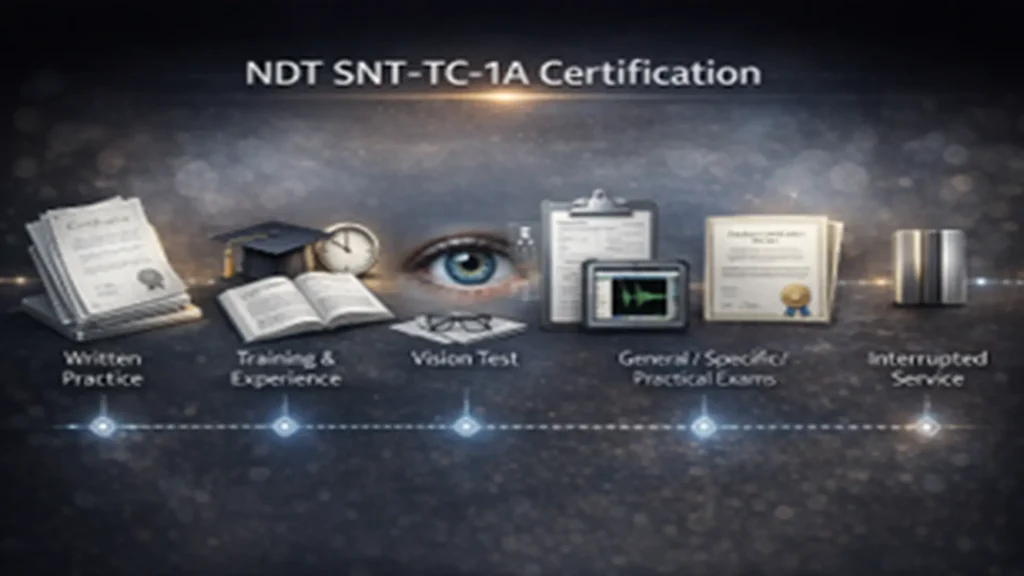
The NDT Written Practice is the governing document of the program. It defines, using internal normative language, the “how” of certification: responsibilities, levels, approval criteria, record control, and limits of the authorized scope. To be technically defensible, it must operate as a living document, with revision control, traceability of changes, and consistency with the inspection procedures actually executed in field or plant environments.
To be audit-ready, it must describe the system with the rigor of a QA/QC procedure: define scope and definitions, establish training and experience requirements, define the examination architecture, and specify explicit rules for issuance, suspension, and recertification. In addition, it must link certification with execution: what each level is authorized to sign, under what supervision conditions, and how the use of subcontracted or transitional personnel is controlled without breaking traceability.
A solid Written Practice translates the recommended practice into a verifiable operational model: competency matrix by method/technique, minimum hours, supervision rules, measurable performance criteria in practical evaluations, and question bank control. It must provide explicit evidence of technical approval by an NDT Level III, who validates the content, ensures alignment with client codes/standards, and preserves the integrity of the examinations (general, specific, and practical).
If you are updating your Written Practice to make it audit-ready, support the process with an independent review of scope, question bank, and approval criteria by an external Level III (Outside Agency Level III) to reinforce consistency and documentary defensibility; for example, Lavender International provides Level III technical support, Written Practice review, and alignment with the requirements of the employer-based scheme.
Levels I, II, and III: competence, not hierarchy
In a properly designed program, levels represent demonstrable capability in relation to critical tasks and defined responsibilities.
NDT Level I certification
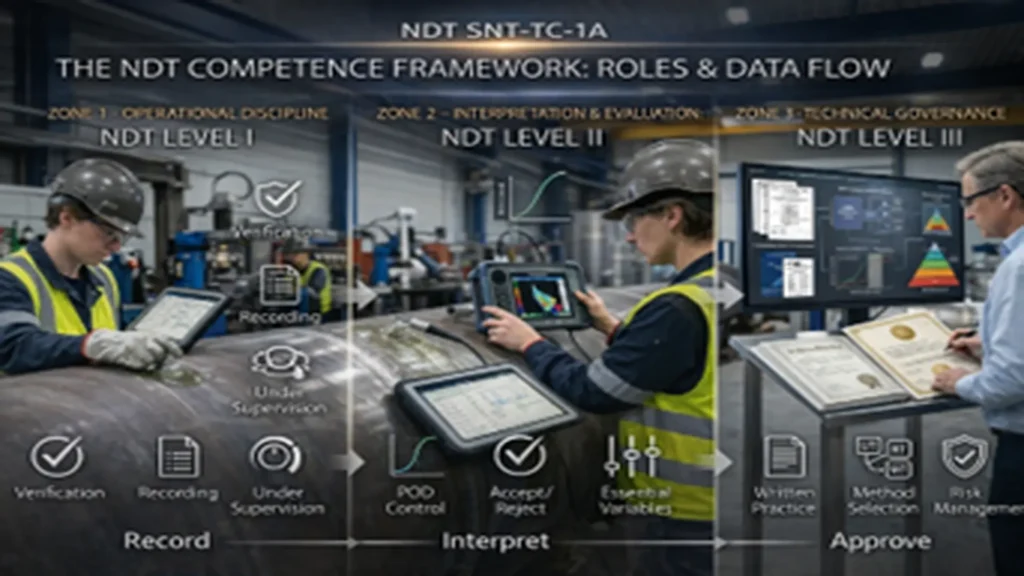
At Level I, specific tasks are performed following approved instructions and procedures. Its value lies in operational discipline: preparation of the area/surface, initial equipment setup with functional verification, complete recording, and repeatability under defined conditions.
In audits, the critical point is that Level I personnel do not interpret or issue judgments beyond their authorization; they must operate under established supervision, with clear escalation criteria and traceability of executed work. In practice, Level I personnel record and report observations and data, but evaluation against acceptance criteria remains at the authorized level (typically Level II/III).
NDT Level II certification
NDT Level II certification is fundamental in the inspection process: it standardizes equipment, interprets indications, evaluates them against acceptance criteria, and guides trainee or Level I personnel.
In practice, Level II is where the reliability of the report is determined; therefore, it requires mastery of the procedure, technique limitations, error sources, and metrological control of the system (equipment performance verification, gain/range/dynamic adjustments, linearity, signal-to-noise ratio, coupling, and parameters governing Probability of Detection (POD)), as well as disciplined documentation, acceptance criteria, and limits of applicability and validity of the procedure.
In practical terms, Level II must understand the variables that degrade detectability, how to compensate for them, and when the technique ceases to be valid within the certified scope, controlling essential variables of the technique (for example, coupling, frequency/angle, and attenuation in UT; image quality, optical density, or SNR/contrast in RT; or field intensity and orientation in MT) that govern detectability and result repeatability.
NDT Level III certification
Level III NDT functions encompass the technical direction of the program: developing, reviewing, and approving procedures, selecting methods and techniques, interpreting code/standard requirements, defining competence criteria, and administering the examination system.
Level III is not necessarily the “field specialist”; rather, it integrates standards, methodology, and risk management, ensuring that the certified scope, acceptance criteria, and documentary evidence are coherent, traceable, and defensible during audits.
Additionally, Level III defines the domain of validity of techniques and establishes criteria for determining when a configuration, procedure, or NDT condition is no longer technically acceptable.
Training and experience: competence logic
SNT-TC-1A establishes minimum hours of training and experience by method/technique because NDT performance depends on real learning curves: perception, signal discrimination, variable control, and the ability to differentiate relevant indications from noise. Methods such as UT and RT generally require longer qualification paths because they combine propagation/attenuation physics, instrumental adjustments, and interpretation criteria with high sensitivity to testing conditions.
The system also allows direct routes to Level II by adding Level I + Level II requirements, which is practical when the candidate already has a technical background and real exposure. Additionally, the Written Practice may adjust requirements according to education or professional background, but this flexibility must be justified and supported by evidence of competence; otherwise, it becomes a typical source of nonconformities.
For advanced techniques such as PAUT and TOFD, the correct approach is to treat them as specializations: they require a solid UT foundation, mastery of software/hardware, parameterization, and interpretation criteria with a high analytical load. In RT, it is also essential to integrate training and compliance with radiological safety according to the applicable jurisdiction; technical competence is not acceptable if radiological control is weak.
Examinations: validity and bias control
Examination structure
The classical model integrates general, specific, and practical examinations. The general exam validates method principles (physical fundamentals, limitations, and critical variables), while the specific exam defines competence within the employer’s context: equipment, operating procedures, applicable techniques, and defined acceptance criteria.
What the practical exam validates
The practical exam is the most valuable technical filter because it requires demonstrating equipment operation, acquisition/recording, and analysis of information. It must include, at a minimum, testing a specimen containing discontinuities and evaluation of the result by the candidate, leaving evidence of the applied procedure, checkpoints, and results.
A robust program does not measure “memory”; it measures discrimination capability and variable control: correct technique selection within the method, control of parameters governing detectability, differentiation between relevant indications and interference, and consistency with the procedure and acceptance criteria. Therefore, the practical exam cannot remain at “found/not found”: checkpoints must require demonstration of mastery over essential variables and procedural requirements; if they fail, the exam must fail.
Evaluation criteria and technical direction
At Levels I and II, a minimum detection performance (typically ≥80%) is usually required, and the control of false positives or false calls must be defined in the Written Practice when required by the Level III, aligning the evaluation with real reliability metrics. To ensure that the evaluation is defensible and audit-resistant, technical direction is mandatory: the NDT Level III must approve the question bank, control difficulty, and ensure examination consistency with the level (I or II) defined in the Written Practice.
Written exams are closed-book, although tables, codes, or procedures may be allowed; when permitted, questions must require understanding, not merely “locating” answers. The approval criterion requires a composite score ≥80%, with no individual exam <70% and each practical exam ≥80%. Finally, to eliminate bias and conflicts of interest, individuals may not evaluate themselves nor be evaluated by a subordinate.
Vision requirements: verifiable sensory capability
In NDT, vision is a measurement variable, not a medical detail. Minimum near vision and contrast evaluation (color or grayscale, as applicable) control a silent risk: human error due to poor discrimination, particularly critical in VT, PT, and MT, and also relevant in image or indication pattern interpretation.
The requirement for periodic evaluations and associated records strengthens audits because it demonstrates control over a condition that directly impacts result reliability. Verification of chromatic perception using Ishihara tests or equivalent is imperative to ensure inspection integrity in methods dependent on spectral contrast. As a typical system control, near vision is verified at least annually, and color/contrast perception upon entry and periodically (for example, every five years), as defined in the Written Practice.
Good practice integrates vision verification into the competence system: linking it to certification status, blocking authorization if expired, and maintaining documentary traceability including dates, method used, and acceptance criteria.
Validity and continuity: interrupted service
A robust program certifies and maintains competence over time. It is essential to manage validity periods (typically five years) and continuity rules: if a person stops practicing within the certified scope for defined periods, it is considered “interrupted service,” requiring recertification or revalidation.
The logic is technical: inspection ability is partly cognitive and partly psychomotor; without practice, interpretive accuracy and execution discipline degrade. In audits, the most common findings occur when companies fail to connect continuity with work authorization: the technician “continues signing” reports, but there is no evidence of recent practice, intermediate reevaluation, or formal scope control.
SNT-TC-1A vs ASNT CP-189 and ISO 9712
When the contract specifies an employer-based approach, SNT-TC-1A is efficient because it integrates competence with the employer’s procedures, equipment, and criteria. If the client requires a more prescriptive framework to reduce ambiguity, ASNT CP-189 is used as a complementary standard to strengthen minimum requirements and technical direction of the system.
Unlike employer-based models, ISO 9712 establishes a centralized certification scheme managed by an independent Certification Body (CB), facilitating credential portability and, in practice, requiring the employer to authorize work within its own system and procedures. The current edition is ISO 9712:2021, which replaces ISO 9712:2012, and in Europe it is adopted as EN ISO 9712:2022.
In addition, there are national adoptions aligned with ISO 9712:2021 (e.g., through ANSI/ASNT), establishing its recognition in international contracts.
Main differences between SNT-TC-1A, ASNT CP-189 and ISO 9712
| Characteristic | SNT-TC-1A | ASNT CP-189 | ISO 9712 |
|---|---|---|---|
| Nature | Recommended practice (flexible) | Standard (prescriptive) | International standard |
| Who certifies | Employer | Employer | Certification body |
| Examinations | According to Written Practice | Prescriptive minimum requirements (structure/criteria) | Independent (third party) |
| Technical direction | Defined in the Written Practice | Prescriptive (mandatory minimums + control) | Defined by the certification body |
Typical errors that trigger nonconformities
The most costly failures are rarely purely technical; they are usually related to the program’s technical direction. Recurring examples include: generic Written Practices that do not reflect real operations; question banks without Level III control; documented experience without traceability (non-verifiable hours or lack of supervision); certificates without clear scope limits; and expired vision or continuity controls without operational blocking.
In an audited environment, any of these situations turns certification into a fragile document because it cannot support the key question: “Where is the objective evidence of current competence applicable to the work performed?”
Conclusions
NDT certification based on SNT-TC-1A acquires operational value when it ceases to be treated as a simple documentary requirement and is implemented as a structured system for qualification and competence control. This implies a dynamic Written Practice, clear definition of responsibilities between Levels I, II, and III, verifiable evidence of training and experience, traceable examination processes, and formal mechanisms for controlling certification continuity. In this context, personnel competence is not declared nominally; it is demonstrated through verifiable records and maintained under the technical supervision of the Level III, with clearly defined scope limits.
When the objective is to improve inspection result reliability, reduce rework, and sustain technical audit processes without deviations, compliance with the standard cannot be limited to issuing individual certificates. It requires documentary traceability, control of variables in the qualification process, and operational discipline in the management of certified personnel. Under this approach, SNT-TC-1A ceases to be an administrative requirement and becomes an effective mechanism for assuring technical competence within the organization’s integrity and quality system.
References
- Scribd; SNT-TC-1A 2024: NDT Certification; (2024); https://es.scribd.com/document/888443169/Snt-Tc-1a-2024-Espanol-Asnt-Tc-1a
Frequently asked questions (FAQs)
What does SNT-TC-1A require to certify NDT personnel?
Employer Written Practice, training and experience by method, general/specific/practical examinations, vision requirements, approval criteria, and traceable records for validity and recertification.
What does an audited NDT Written Practice include?
Scope and limitations, training/experience requirements, examination structure, vision requirements, issuance/suspension/recertification rules, record control, Level I–III roles, and authority of the Responsible Level III.
How many hours does SNT-TC-1A require for UT Level II?
For UT Level II (pulse-echo), 40+40 hours of training (Level I + Level II) and 210+630 hours of method experience are established (depending on the route), with adjustments only if justified and documented in the Written Practice.
When does interrupted service apply in ASNT NDT?
When the certified scope has not been practiced for more than 1 continuous year or more than 2 accumulated years within 5 years; revalidation or recertification is required according to the Written Practice.