
Table of Contents
- What is considered work at height in Oil & Gas industry?
- Evolution of rope access toward industrial use
- Application in offshore and onshore assets
- Rope access and NDT: planning, permits, and rescue
- NDT methods applicable with rope access
- Rope access vs. scaffolding in O&G assets
- Training and certification in rope access
- Operational experience in rope access inspection
- Integration of rope access into integrity programs
- Conclusions
- References
- Frequently Asked Questions (FAQs)
- What criteria determine whether rope access is viable for an industrial asset?
- What is the difference between work at height and rope access?
- Can ultrasonic testing (UT) be performed at height without removing complete insulation?
- What is the role of a Level 3 supervisor in rope access operations?
- Does rope access truly reduce operational costs in Oil & Gas?
The growth of work at height in the Oil & Gas industry is a direct consequence of aging assets, the expansion of offshore infrastructure, and the need for more frequent inspections in hard-to-reach areas. Process columns, flare stacks, storage spheres, pipe racks, and marine structures require technical interventions that, only a few years ago, relied almost exclusively on conventional scaffolding or lifting equipment.
However, scaffold erection involves extended preparation times, operational interference, and increased exposure to risk during both installation and dismantling. Cranes and elevated work platforms also present limitations in terms of reach, space, and stability, particularly in offshore environments or congested plants.
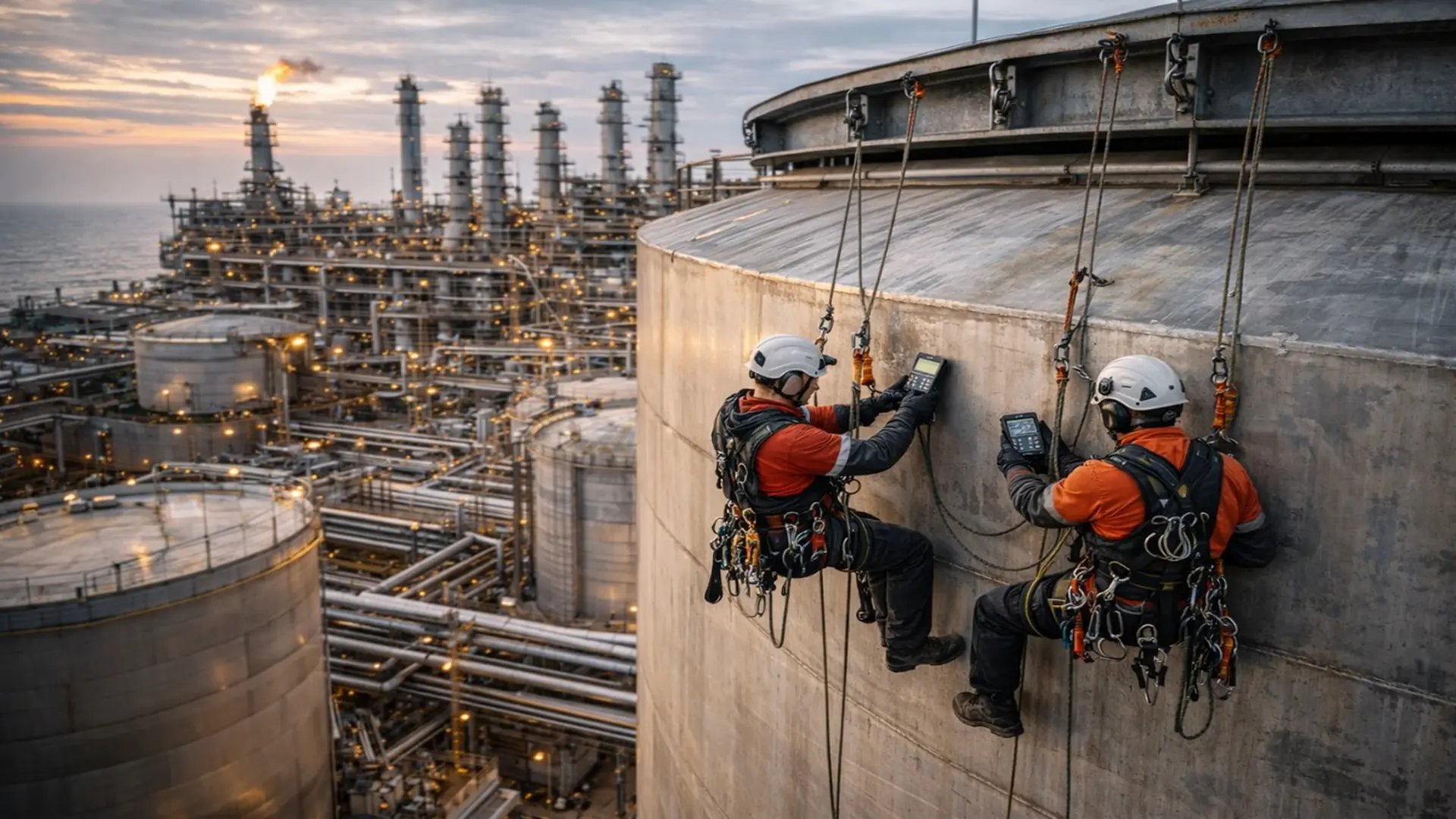
In this context, industrial rope access has evolved as a safe, efficient, and technically viable alternative for performing inspections at height. Its integration with NDT inspection methods enables thickness measurements, advanced visual inspections, and localized assessments without compromising operational continuity. In critical assets where accessibility directly affects reliability, industrial rope access has become a strategic tool within modern mechanical integrity programs.
What is considered work at height in Oil & Gas industry?
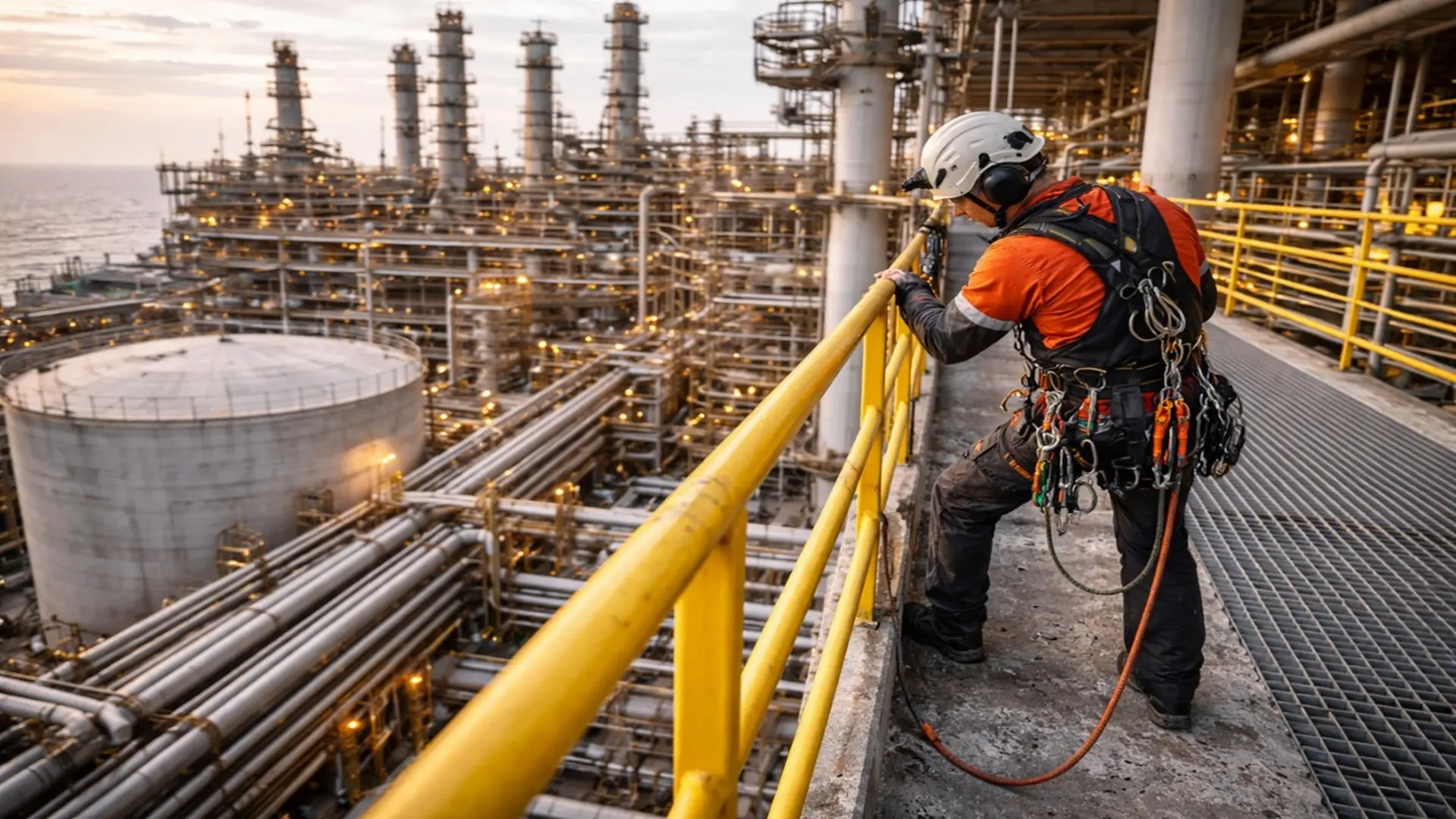
In the Oil & Gas sector, the concept of work at height is not limited to tasks performed several meters above ground level. It encompasses any activity carried out in a position where there is a risk of falling to a lower level, whether from permanent structures, process equipment, or temporary installations. This includes inspection, maintenance, repair, or assembly activities conducted on platforms, towers, tanks, steel structures, and offshore units.
From an operational standpoint, work at height requires specific planning, risk assessment, formal permits, and control measures such as lifelines, certified fall protection systems, fall arrest devices, or industrial rope access techniques. In industrial environments, risk evaluation is not determined solely by height, but also by factors such as wind exposure, marine conditions, explosive atmospheres, and proximity to energized equipment.
Regulatory definition and operational limits
From a regulatory perspective, work at height is defined as any activity performed above a level where there is a possibility of a fall with potential for injury. Many industrial regulations use heights greater than 1.8 meters (6 feet) as a reference threshold; however, in Oil & Gas, the practical criterion is the actual fall risk rather than the exact elevation.
Operational limits are determined by site-specific risk assessment, hazardous area classification, weather conditions, and personnel competency. Any intervention must be supported by a formal work permit, a documented risk assessment, and a clearly defined rescue plan.
What is NOT considered work at height?
Not every elevated activity is automatically classified as work at height. For example, tasks performed from fixed platforms with certified perimeter protection and no risk of falling to a lower level may not fall within this category. Likewise, work carried out on industrial ladders equipped with integral fall protection systems may be excluded, depending on applicable regulations.
Simple transit across structures designed for safe access is also not considered work at height when there is no exposure to open edges or fall hazards. The key factor is the evaluation of actual risk, not merely the physical elevation above ground level.
Rope access in industrial inspection
Industrial rope access is a specialized technique used to perform work at height through redundant positioning and fall protection systems. In the context of rope access inspection, its application is focused on enabling technical interventions in industrial assets where conventional access is complex, costly, or logistically unfeasible.
Evolution of rope access toward industrial use
Rope-based work techniques originated in climbing and caving, disciplines that developed safe vertical progression systems in natural environments. During the 1980s, particularly in the North Sea, these techniques began to be adapted to the offshore industry to reduce reliance on scaffolding in oil platforms.
As their use expanded in critical industrial environments, the need for standardization emerged. Organizations such as IRATA (Industrial Rope Access Trade Association) were established, defining fundamental principles including the mandatory twin-rope system, personnel certification levels, operational audits, and formal rescue protocols.
From that point onward, the term “rope access” ceased to be associated with adapted recreational techniques and became recognized as a regulated industrial method, supported by documented procedures and structured risk control. Today, rope access inspection forms an integral part of maintenance and inspection programs in refineries, petrochemical plants, and offshore assets.
Application in offshore and onshore assets
In onshore environments, industrial rope access is used on process columns, storage spheres, cooling towers, and pipe racks. It enables localized NDT inspections without significantly interfering with operations.
In offshore facilities, where space is limited and scaffolding logistics involve high costs and extended timelines, rope access inspection provides a flexible and efficient solution. Its implementation reduces mobilization time, minimizes operational disruption, and allows technical interventions in structurally complex areas.
From a mechanical integrity perspective, industrial rope access is not merely an access alternative, but a strategic tool that supports the safe and efficient execution of critical inspections on high-value assets.
Rope access and NDT: planning, permits, and rescue
The integration of rope access with NDT inspection requires rigorous planning. Having certified technicians is not sufficient; each intervention must be part of a structured framework that includes risk analysis, formal permits, and coordination with the HSE team. In critical Oil & Gas assets, the combination of work at height and non-destructive testing involves additional risks related to portable equipment, electrical cables, hot surfaces, and potentially explosive atmospheres.
Before performing any rope access inspection, the technical scope, inspection points, NDT method to be applied, and operating conditions of the asset must be clearly defined. This planning includes the preparation of a specific ATS or JSA, validation of weather conditions (in offshore environments), and verification of compatibility between the rope system and the structural setting.
Emergency management constitutes one of the core pillars of the system. Every task must be supported by a documented rescue plan, with assigned roles and defined response times. Coordination among technical supervision, operations, and industrial safety is essential to ensure that the intervention meets mechanical integrity standards without compromising personnel safety.
Twin-rope system and risk control
The twin-rope system is the foundation of modern rope access. It consists of two independent lines: a working rope and a safety rope equipped with an autonomous fall arrest device, forming part of a redundant fall protection strategy designed to prevent uncontrolled descent. This redundancy principle minimizes the risk of free fall in the event of component failure.
Risk control is not limited to the rope system; it also includes prior inspection of anchor points, verification of certified structural attachment locations, and continuous assessment of technician stability during NDT execution. Redundancy and constant monitoring are critical elements in industrial environments.
Work permits and risk analysis
All industrial rope access activities in Oil & Gas must be integrated into the formal work permit system, including verification of fall protection equipment and fall arrest systems prior to execution. This involves coordination with operations, validation of energy isolation where applicable, and evaluation of hazardous atmospheres.
The ATS or JSA must identify specific risks associated with work at height, handling of NDT equipment, and environmental conditions. This document is not merely an administrative requirement, but an operational tool that defines preventive controls, responsibilities, and mitigation measures.
Rescue plan in work at height
The rescue plan is a mandatory requirement for any intervention involving industrial rope access and integrated fall protection systems. It must establish clear procedures for rapid evacuation in the event of an incident, controlled fall, medical emergency, or adverse weather conditions.
Rescue planning includes the availability of trained personnel, recovery equipment, effective communication, and coordination with the industrial safety department. In offshore environments, response times and evacuation logistics must be considered in advance, ensuring that emergency management aligns with corporate HSE protocols.
NDT methods applicable with rope access
The combination of rope access inspection with non-destructive testing (NDT) has significantly expanded the ability to evaluate assets in hard-to-reach areas without resorting to invasive or high operational impact solutions. In Oil & Gas environments, where many critical areas are located at height or in structurally complex positions, industrial rope access allows the technician to be positioned directly at the inspection point, optimizing time and accuracy.
NDT methods applicable to rope access are those that can be performed using portable equipment, under operational control, and without compromising the stability of the suspension system. The selection of the method depends on the expected damage mechanism, base material, and environmental conditions. Among the most commonly used are ultrasonic testing for thickness measurement, direct and assisted visual inspection, liquid penetrant testing, and magnetic particle testing. In offshore assets, these methods enable the evaluation of external corrosion, wall loss, surface cracking, and structural conditions without significantly interfering with operations.
Ultrasonic testing and thickness measurement
Ultrasonic testing (UT) for thickness measurement is one of the most frequently used methods in rope access operations. Its portability and precision make it ideal for assessing material loss due to external corrosion, particularly in elevated piping, steel structures, and vertical vessels.
The technician must ensure adequate stability before applying the transducer, as well as proper surface preparation. In areas where insulation has been removed, rope access allows for localized inspections without extensive dismantling, optimizing integrity monitoring programs.
Advanced visual inspection at height
Visual inspection remains the first level of evaluation in many mechanical integrity programs. With rope access, the inspector can position themselves at proximity to the component, enabling direct assessment of welds, structural supports, bolted connections, and protective coatings.
The incorporation of high-resolution cameras, portable borescopes, and specialized lighting systems enhances the ability to detect surface anomalies, localized corrosion, or structural deformation, particularly in areas where visibility from ground level is limited.
Liquid penetrant and magnetic particle testing
Liquid penetrant testing (PT) and magnetic particle testing (MT) are applied when surface discontinuities must be detected, especially in welds, structural supports, or components subjected to cyclic loading.
In rope access operations, their execution requires additional planning for the safe handling of consumables and environmental control. These methods are particularly useful in corrective maintenance inspections or in verifying localized repairs performed at height.
To illustrate how magnetic particle testing (MPI) can be executed using rope access techniques in real industrial conditions, the following video demonstrates a technician performing overboard NDT inspection while suspended with a twin-rope system.
This video was originally published on YouTube by its respective creator and is embedded here for educational and technical reference purposes. All rights remain with the original author.
Source: DIY Phil – Rope Access NDT Working Overboard (Magnetic Particle Inspection)

Rope access NDT work overboard.
Offshore inspection in critical assets
On offshore platforms, rope access enables the application of NDT methods on structures exposed to highly corrosive environments, such as jacket legs, flare booms, or elevated supports. The flexibility of the system facilitates interventions in areas where scaffold erection would be complex or economically unfeasible.
From a structural integrity standpoint, this technical combination reduces intervention time and improves responsiveness to critical findings in offshore assets.
Rope access vs. scaffolding in O&G assets
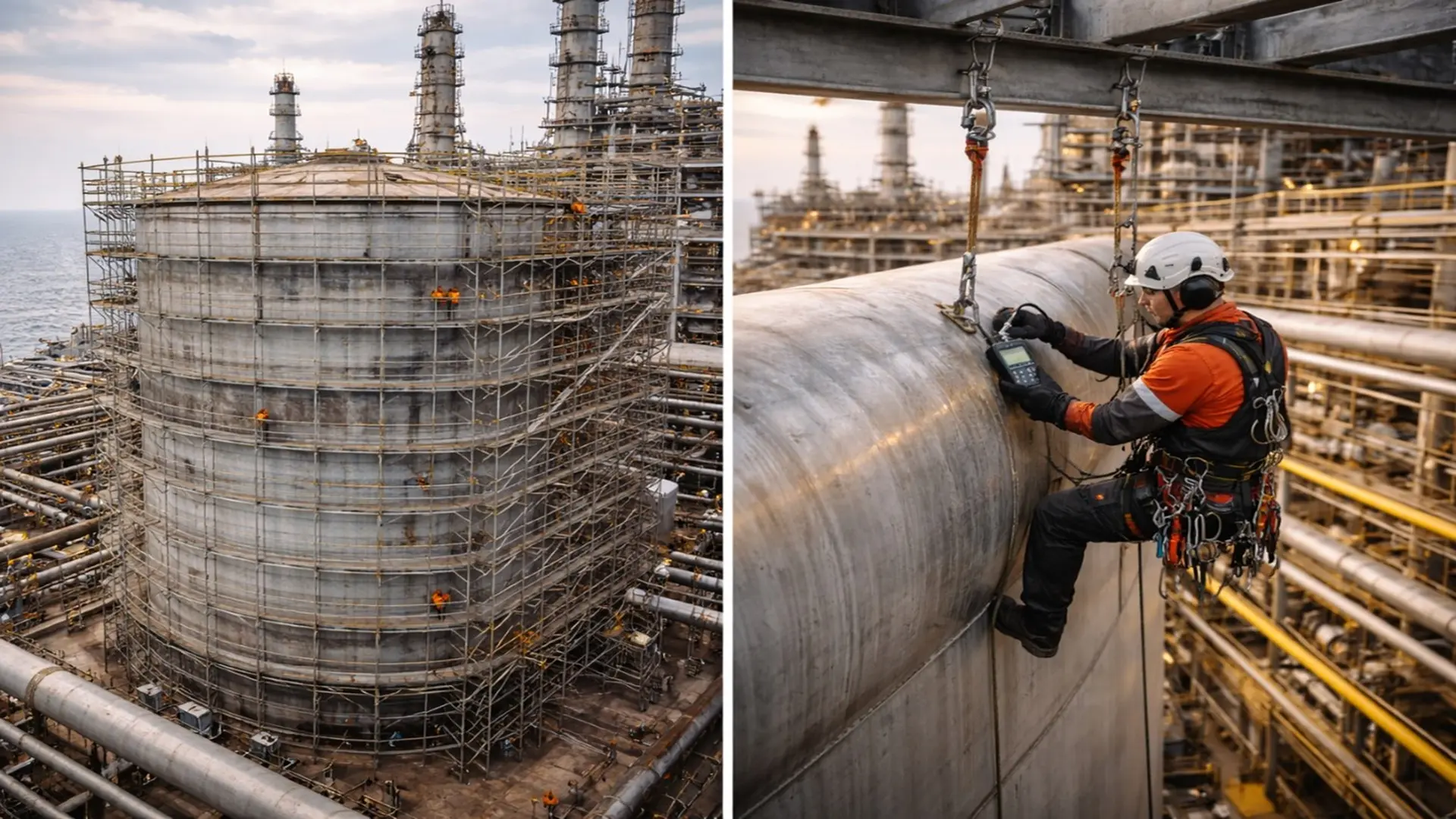
Traditionally, the different types of scaffolding used in industrial environments have been the standard solution for accessing elevated areas; however, their implementation involves significant indirect costs. The design, transportation, erection, inspection, and dismantling of scaffolds can represent a considerable percentage of the total budget of an intervention, especially in offshore facilities where logistics are complex.
In terms of mobilization time, industrial rope access offers a clear advantage. While scaffold erection may require days before inspection activities can begin, rope access allows interventions to be performed within much shorter timeframes, reducing the impact on maintenance scheduling and operational continuity.
From a safety standpoint, industrial rope access reduces prolonged exposure of personnel on temporary structures and minimizes the number of workers involved in the task. However, it is not always the most suitable option. In projects requiring extended duration, continuous transport of heavy materials, or multiple simultaneous work fronts, scaffolding may prove more efficient and stable.
Ultimately, industrial rope access is preferable when localized inspections, rapid interventions, and minimal operational interference are required; scaffolding is more appropriate for extensive or long-duration work.
The comparison between rope access and scaffolding in Oil & Gas assets must be analyzed from a technical, economic, and operational safety perspective.
Training and certification in rope access
The safe application of industrial rope access in Oil & Gas environments depends directly on the level of training and certification of personnel. Unlike other maintenance activities, rope access is regulated by international standards that require formal training, practical assessment, and periodic recertification.
Recognized certifications, such as those issued by IRATA or SPRAT, establish progressive levels of competency, from entry-level technician to supervisor. Each level involves specific requirements in terms of documented work hours, rescue knowledge, and mastery of twin-rope systems.
For rope access inspection to be effectively integrated into mechanical integrity programs, the technician must not only master vertical progression techniques but also understand the industrial risks associated with the environment in which they operate.
How to become a rope access technician
Becoming a rope access technician requires completing a course accredited by a recognized certification body. The process includes theoretical training in safety, anchoring systems, ascent and descent techniques, as well as intensive practical training under supervision.
After passing the assessment, the technician obtains an entry-level certification and must accumulate documented experience to advance to higher levels. Periodic recertification is mandatory to maintain the validity of the credential.
NDT competencies at height
When rope access is combined with NDT inspection, the professional profile requires dual competency. In addition to rope access certification, the technician must be qualified in the corresponding NDT method under recognized schemes such as ASNT or ISO 9712.
Performing inspections at height requires additional skills: control of portable equipment, stability during measurement, cable management, and adaptation to variable environmental conditions. The combination of technical NDT competency and mastery of the rope system is essential to ensure reliable results without compromising safety.
International rope access certifications: IRATA vs SPRAT
The safe application of industrial rope access in critical Oil & Gas assets does not depend solely on the technical skill of the operator, but on compliance with formal international certification schemes. Within the industry, the two primary reference organizations are IRATA International and SPRAT, entities that have developed specific standards to regulate training, assessment, and personnel competency in industrial rope access operations.
Although widely recognized by operators and contractors, it is important to clarify that they are not governmental bodies, but private certification organizations that structure their technical frameworks based on international best practices and in alignment with occupational safety regulations issued by authorities such as OSHA in the United States or HSE in the United Kingdom.
IRATA (Industrial Rope Access Trade Association), founded in the United Kingdom in 1988 with strong development in the North Sea offshore sector, governs its operations through the IRATA International Code of Practice (ICoP). This document establishes mandatory operational principles such as the redundant twin-rope system, the required presence of a Level 3 supervisor on site, and formal rescue protocols.
Its certification scheme includes three progressive levels: Level 1 for technicians working under direct supervision; Level 2 for personnel with documented experience (typically a minimum of 1,000 hours) capable of rigging systems and performing rescues; and Level 3 for supervisors responsible for planning, operational control, and safety management. IRATA also maintains a strict audit system for member companies, reinforcing organizational oversight within the scheme.
SPRAT (Society of Professional Rope Access Technicians), founded in the United States in 2001, develops the Safe Practices for Rope Access Work standard and follows a similar three-level structure (Level I, II, and III). Its technical framework is strongly aligned with OSHA regulations and has broad adoption across North America. While technically comparable to IRATA in requiring redundant systems, independent practical assessment, periodic recertification, and rescue competency, its organizational model is less centralized in terms of company auditing.
In the Oil & Gas context, the distinction between the two schemes does not lie in vertical progression techniques, but rather in geographic reach and organizational control structure. IRATA has a stronger predominance in international offshore projects, whereas SPRAT is widely used in the United States and North American industrial projects. Selection typically depends on contractual requirements, regulatory jurisdiction, and corporate safety policies.
When rope access is integrated with non-destructive testing (NDT), professionals must hold dual formal qualifications: rope access certification (IRATA or SPRAT) and certification in the specific NDT method under recognized schemes such as ASNT or ISO 9712. A Level 2 or Level 3 rope access technician is not automatically qualified to perform ultrasonic testing, magnetic particle testing, or liquid penetrant testing without the corresponding NDT certification.
This dual competency is particularly critical in mechanical integrity programs under API 570, API 510, or risk-based inspection (RBI) frameworks, where technical traceability and personnel qualification form an essential part of risk control.
Operational experience in rope access inspection
The application of rope access inspection in Oil & Gas assets has evolved from isolated interventions to becoming an integrated solution within structured maintenance and integrity programs. In operational practice, its greatest value is evident when inspections must be performed in elevated or hard-to-reach areas without affecting production continuity or generating high indirect costs.
In refineries and petrochemical plants, industrial rope access has been used to assess wall loss in elevated piping, inspect welds in process columns, and verify structural conditions in pipe racks. In offshore environments, its implementation is particularly strategic for inspections on flare booms, jacket legs, and upper structures, where scaffold erection would involve extended timelines and logistical complexity.
Specialized companies such as TEAM Group have documented the effective integration of rope access with advanced NDT inspection methods on offshore and onshore projects, combining safe vertical access with non-destructive evaluation technologies to minimize intervention time and optimize resource use. This technical approach, described within their advanced asset and project services solutions, demonstrates how coordination between industrial rope access and specialized testing can be executed under strict safety and operational control standards.
In real-world scenarios, the synergy between rope access inspection and NDT enables localized intervention on critical assets, reducing downtime and maintaining full technical traceability throughout each inspection.
Integration of rope access into integrity programs
From a mechanical integrity perspective, industrial rope access should not be viewed solely as an access method, but as a strategic tool within frameworks such as RBI (Risk-Based Inspection). Its incorporation allows the evaluation of areas classified as higher risk without requiring extensive dismantling or causing significant operational interruptions.
In inspections under API 570 (piping) and API 510 (pressure vessels), rope access facilitates the assessment of elevated zones, structural supports, and critical sections where historically limited accessibility reduced inspection frequency. This contributes to improving the quality of condition data and optimizing risk-based decision-making.
Additionally, reduced mobilization time has a direct impact on minimizing downtime, supporting operational continuity. From a reliability standpoint, the ability to perform more agile and focused inspections strengthens condition monitoring programs and extends the service life of strategic assets within Oil & Gas facilities.
Conclusions
Rope access inspection in critical Oil & Gas assets should not be interpreted as a universal substitute for all access solutions, nor as a technique applicable to every operational scenario. Its true value lies in understanding it as a strategic tool within a comprehensive maintenance and mechanical integrity framework. When properly selected, considering scope, work duration, operational load, and risk level, industrial rope access delivers technical and economic advantages that are difficult to match with conventional methods.
From a safety perspective, the redundant twin-rope system, formal planning through ATS/JSA, and the mandatory implementation of a documented rescue plan significantly strengthen risk control in work at height. In terms of efficiency, reduced mobilization time and minimal operational interference directly contribute to lowering downtime, particularly in offshore facilities where each hour of shutdown carries substantial implications.
The trend in offshore inspection confirms this evolution: industrial rope access is no longer an emerging alternative, but a consolidated practice that supports risk-based decisions, optimizes resources, and enhances asset reliability within modern mechanical integrity programs.
References
- American Petroleum Institute. (2016). API RP 580: Risk-Based Inspection. API Publishing Services.
- American Petroleum Institute. (2016). API RP 581: Risk-Based Inspection Methodology. API Publishing Services.
- American Petroleum Institute. (2022). API 570: Piping Inspection Code—In-service inspection, rating, repair, and alteration of piping systems. API Publishing Services.
- American Petroleum Institute. (2021). API 510: Pressure Vessel Inspection Code—In-service inspection, rating, repair, and alteration. API Publishing Services.
- International Organization for Standardization. (2021). ISO 9712: Non-destructive testing—Qualification and certification of NDT personnel. ISO.
- IRATA International. (2023). IRATA International Code of Practice (ICoP). IRATA International.
- Society of Professional Rope Access Technicians. (2022). Safe Practices for Rope Access Work. SPRAT.
- U.S. Department of Labor, Occupational Safety and Health Administration. (2023). 29 CFR 1910 Subpart D – Walking-Working Surfaces. OSHA.
Frequently Asked Questions (FAQs)
What criteria determine whether rope access is viable for an industrial asset?
Viability depends on the site-specific risk assessment, structural geometry, area classification, duration of the work, and the nature of the intervention. Environmental factors such as wind, marine conditions, and thermal exposure are also evaluated.
What is the difference between work at height and rope access?
Work at height is a general category that includes any activity involving a risk of falling to a lower level. Rope access is a specific technique within that category, based on redundant suspension and fall protection systems.
Can ultrasonic testing (UT) be performed at height without removing complete insulation?
Yes. Rope access allows localized measurements after removing only the necessary sections of insulation, reducing extensive dismantling and optimizing external corrosion monitoring programs.
What is the role of a Level 3 supervisor in rope access operations?
The Level 3 supervisor is responsible for technical planning, risk assessment, anchor validation, team coordination, and rescue plan management. Their presence is mandatory under standards such as IRATA.
Does rope access truly reduce operational costs in Oil & Gas?
For short-term, localized interventions, yes. It reduces mobilization time, operational interference, and the number of workers exposed. However, it does not always replace permanent solutions such as scaffolding in large-scale or long-duration projects.