

Table of Contents
- Strategic role of Non-Destructive Testing
- From routine inspection to critical evaluation
- Risk Based Inspection in shutdowns
- Regulatory framework applicable to NDT
- Selection of methods according to damage mechanism
- Comprehensive inspection cycle in shutdown planning
- Impact on rReliability and asset management
- Conclusions
- References
- Frequently Asked Questions (FAQs)
Non-Destructive Testing (NDT) is a critical component in the intervention strategy within the energy and industrial sectors. Its proper integration makes it possible to evaluate damage mechanisms, reduce technical uncertainty, and prioritize assets before executing major interventions on static equipment and piping systems.
When a maintenance shutdown is scheduled without technical criteria such as RBI, downtime increases and costs escalate. Incorporating these inspection techniques into inspection planning transforms integrity management into a process based on verifiable data and technically justified decisions.
Strategic role of Non-Destructive Testing
During a shutdown, decisions must rely on reliable technical information. These methodologies make it possible to determine the actual condition of assets without compromising their structural integrity or operational continuity.
More than a control activity, they represent a determining element within technical planning. It is not merely about inspecting; the objective is to reduce operational uncertainty and support decisions with traceable data before and during the general maintenance shutdown.
From routine inspection to critical evaluation
Under normal operation, inspections are executed according to established periodic programs. During the pre-intervention stage, the level of technical demand increases, as the work window is limited and every decision impacts the schedule.
Detailed knowledge of damage mechanisms, applicable codes, and the specific technique determines the strategic success in applying these evaluation tools, especially in critical processes within the energy sector.
In Delayed Coker fractionation units, for example, phenomena such as High-Temperature Sulfidation (HTS) and creep may progress without evident external manifestations. Early identification through a proper inspection plan makes it possible to anticipate repairs and avoid unplanned corrective interventions:
- Identify active corrosion
- Detect fatigue cracking
- Assess creep degradation
- Validate fitness for service (API 579)
Correct interpretation of these results directly impacts the definition of technical scope and operational reliability.
Risk Based Inspection in shutdowns
Risk-Based Inspection (RBI), defined in API 580 and API 581, establishes:
Risk = Probability × Consequence
This approach allows prioritization of resources in critical assets within the technical preparation process.
Technical eoundations of RBI
Risk-Based Inspection is based on the following elements:
- Expected damage mechanisms
- Failure history
- Operating conditions
- Environmental and economic impact
Integrating these methodologies into criticality matrices optimizes the inspection program and redefines the scope of intervention according to the asset’s real criticality.
Application in critical assets
In scheduled shutdowns, RBI guides the selection of methods for:
- Pressure vessels (API 510)
- Process piping (API 570)
- Atmospheric tanks (API 653)
This avoids unnecessary interventions and reduces the probability of undetected risks.
Regulatory framework applicable to NDT
The execution of NDT methods in major or partial plant maintenance must align with recognized international standards.
API 510, API 570, and API 653 regulate in-service inspection, while ASME Section V establishes the technical requirements applicable to NDT methods. These standards ensure traceability, technical competence, and consistency in the inspection plan.
Selection of methods according to damage mechanism
The selection of the method must align with the expected damage mechanism and the shutdown planning strategy.
Not all methods respond to the same type of degradation nor provide the same level of information.
Comparative table of inspection methods
| Method | Damage Detected | Reference Standard | Technical Limitation |
|---|---|---|---|
| Visual Inspection (VT) | Visible corrosion, deformation | API 510 / ASME V Art. 9 | Depends on access |
| Ultrasonic Testing (UT) | Thickness loss, laminations, discontinuities | API 510 / ASME V Art. 4 | Requires surface preparation |
| Radiography (RT) | Volumetric discontinuities | ASME V Art. 2 | Requires radiological control |
| Liquid Penetrant Testing (PT) | Open surface cracks | ASTM E165 / ASME V Art. 6 | Detects surface defects only |
| Magnetic Particle Testing (MT) | Cracks in ferromagnetic materials | ASTM E709 / ASME V Art. 7 | Applicable only to steel |
| Eddy Current Testing (ECT) | Corrosion in non-ferromagnetic tubes | ASTM E243 | Limited to conductive materials |
| Remote Field Testing (RFT) | Internal and external corrosion in ferromagnetic tubes | ASTM E2096 | Mainly used in heat exchangers |
| Guided Wave Testing (GWT) | Corrosion in long pipe sections | ISO 18211 | Sensitive to geometric changes |
| Magnetic Flux Leakage (MFL) | Thickness loss in tank bottoms | API 653 | Requires proper cleaning |
| Infrared Thermography (IRT) | Insulation loss, hot spots, thermal anomalies | ASTM E1934 / ISO 18436-7 | Requires adequate thermal gradient |
| Acoustic Emission (AE) | Active crack growth, leaks, plastic deformation | ASTM E976 / ASTM E1106 | Detects dynamic activity, not static defects |
The method selection must align with the damage mechanism, asset criticality, and the inspection cycle phase in which the facility is located, whether in service, during shutdown, or in the post-startup phase.
Comprehensive inspection cycle in shutdown planning
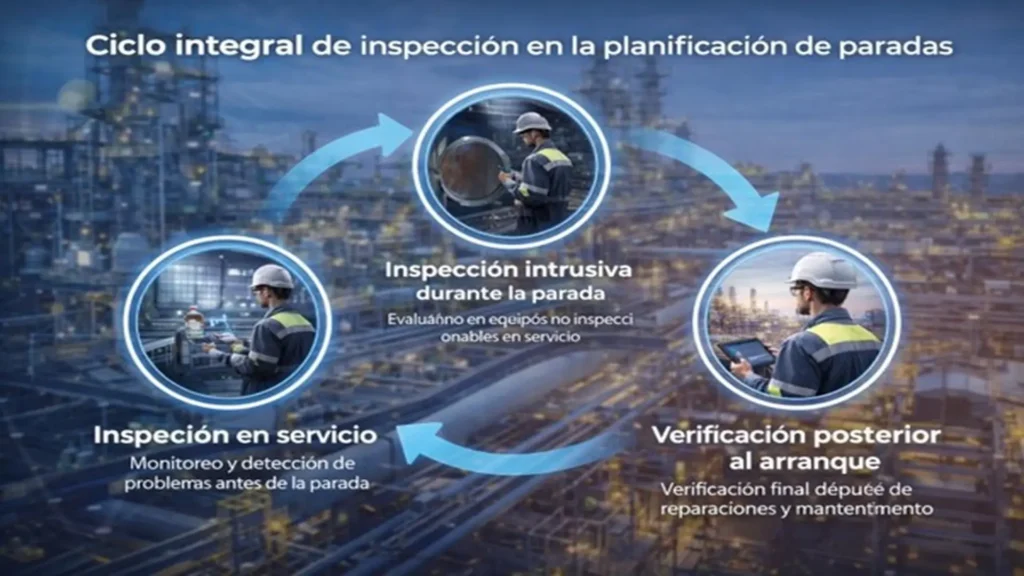
Technical planning of maintenance repair does not begin with plant shutdown. In industrial shutdown planning, these inspection technologies are part of a continuous cycle that integrates in-service evaluation, intrusive inspection during shutdown, and post-startup verification.
This approach prevents the shutdown from becoming an improvised discovery event and allows interventions to be executed with prior technical support.
Inspection with the plant in service
Corrosion under insulation (CUI) and other active mechanisms are managed as part of the routine inspection program. Techniques such as visual inspection, ultrasonics, Guided Waves, thermography, acoustic emission, and radiography define the repair scope before maintenance.
These findings determine what must be addressed during shutdown planning and help minimize unexpected scope expansions.
Practical case: Ultrasonic monitoring prior toshutdown

In this industrial case, permanent ultrasonic sensors detected critical thickness loss in operating pipelines. The information made it possible to redefine technical decisions before executing the general maintenance shutdown. This type of in-service NDT strengthens decision-making prior to shutdown, improves the inspection program, and reduces the likelihood of unforeseen interventions during the shutdown. (Eddyfi Technologies)
Intrusive equipment inspectioduring shutdown
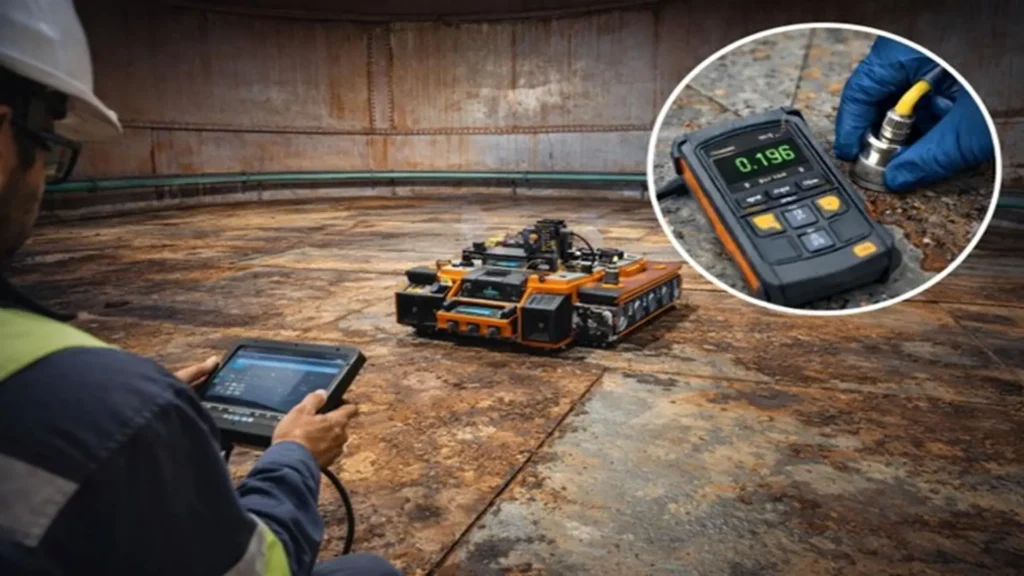
Plant shutdowns are scheduled to intervene in assets that cannot be inspected or repaired while the facility is in service. This includes internal inspections of pressure vessels, piping systems, critical fittings, nozzles, equipment internals, and components that require opening, isolation, or depressurization for safe evaluation.
During this phase, engineering work, equipment replacement, piping section renewal, and necessary technical upgrades are also executed to ensure that the plant resumes operation under optimal safety, reliability, and productive performance conditions.
In tanks inspected under API 653, MFL application allows bottom evaluation (See Image) within the available window. This assessment complements in-service information and supports technical decisions before operational restart.
Post startup inspection
Once the intervention is completed, verifications are carried out to validate the effectiveness of the executed actions. The results feed back into the RBI, the inspection plan, and strengthen future intervention strategies.
Impact on rReliability and asset management
Integrating these techniques into the inspection program strengthens mechanical integrity management.
When results align with RBI, the organization prioritizes critical assets and improves accuracy in future shutdown planning.
Key Benefits:
- Reduction of unexpected failures
- Shutdown time optimization
- Data-driven decisions
- Regulatory compliance
This approach consolidates asset management programs aligned with ISO 55000, integrating reliability, structural integrity, and operational sustainability within a single strategic framework.
Conclusions
Turnaround planning based on non-destructive testing and RBI methodologies transforms maintenance shutdown into the executive phase of a continuous integrity management system.
In a demanding energy environment, NDT represents a strategic pillar for evidence-based technical decisions.
Evaluating whether current inspection planning programs incorporate risk criteria, API standards, and proper technical selection of NDT methods may make the difference in the next scheduled shutdown.
Inspenet continues to develop specialized technical content to strengthen the culture of integrity, reliability, and operational excellence in the global energy industry.
References
- American Petroleum Institute, API 580: Risk-Based Inspection.
- American Petroleum Institute, API 510: Pressure Vessel Inspection Code: In-Service Inspection, Rating, Repair, and Alteration.
- American Petroleum Institute, API 653: Tank Inspection, Repair, Alteration, and Reconstruction.
- American Society of Mechanical Engineers, ASME Boiler and Pressure Vessel Code, Section V: Nondestructive Examination.
- American Petroleum Institute, API 570: Piping Inspection Code: In-Service Inspection, Rating, Repair, and Alteration of Piping Systems.
- American Society for Nondestructive Testing (ASNT), Nondestructive Testing.
- Inspenet TV, “Eddyfi ultrasonic sensors save millions in refinery”
Frequently Asked Questions (FAQs)
What role does NDT play in a shutdown?
It defines the real technical scope of the intervention and reduces uncertainty in shutdown technical management.
How does RBI impact a shutdown?
RBI methodology prioritizes critical assets before the general maintenance shutdown.
Which NDT methods are used in shutdowns?
UT, RT, PT, MT, MFL, and GWT, depending on the damage mechanism.
How are tank bottoms inspected?
Through MFL under API 653 within the inspection plan.
Do they reduce real operational risks?
Yes. They allow degradation to be detected before critical failures.
Is inspection performed before and after?
Yes. There is in-service inspection, during shutdown inspection, and post-startup inspection.