
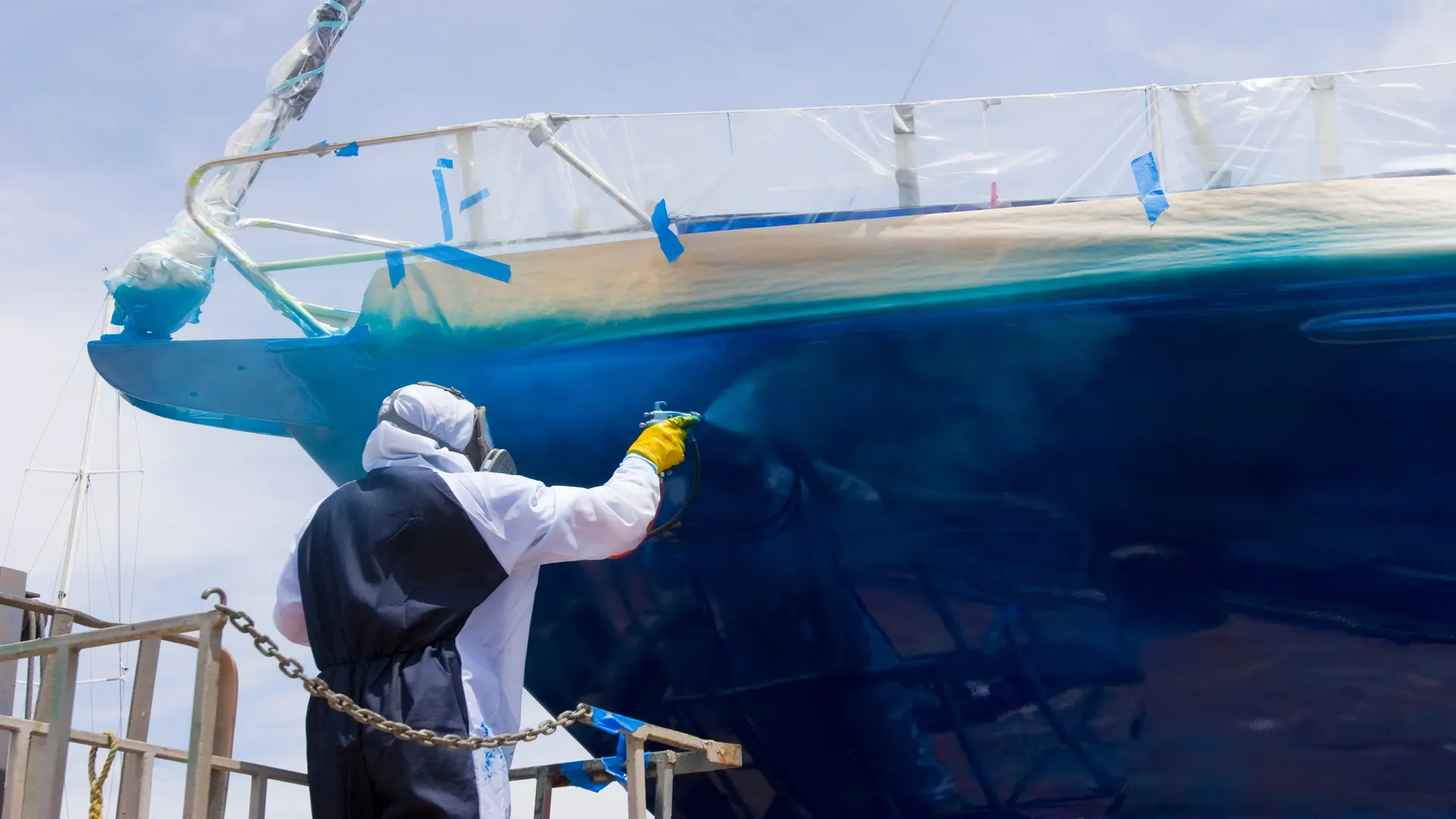
In the maritime sector, the protection of submerged surfaces is a decisive factor in guaranteeing the operational efficiency and durability of vessels. Anti-fouling paints represent an effective control method for preventing the adhesion of marine organisms, such as algae and mollusks, to the hull’s wetted area. This phenomenon, known as biofouling, negatively impacts fuel consumption and overall performance.
Beyond merely preventing corrosion, marine coatings constitute advanced technological systems designed to withstand extreme environmental conditions, including UV radiation, salinity, abrasion, and thermal variations. Proper application protects against deterioration, optimizes hydrodynamic performance, and extends the lifespan of structures. In this context, the implementation of anti-fouling systems is vital for efficient and sustainable management.
What Are Marine Coatings?
Marine coatings are engineered surface protection systems designed to preserve the structural and functional integrity of materials exposed to aggressive aquatic environments. They are primarily applied to vessels, ships, offshore platforms, and submerged structures, where they act as a physicochemical barrier between the substrate and the environment. Their formulation incorporates specialized resins, pigments, and additives that provide resistance to electrochemical corrosion, mechanical abrasion, and degradation induced by ultraviolet radiation, dissolved oxygen, and salts.
From a technical perspective, these coatings mitigate oxidation processes by limiting permeability to water and corrosive ions, thereby reducing the rate of deterioration of the base material. Furthermore, they optimize the hydrodynamic performance of surfaces by decreasing friction and biological accumulation. Performance depends on variables such as adhesion, film thickness, chemical resistance, and durability under extreme temperature and pressure conditions.
Marine coatings constitute a comprehensive solution for extending the service life of maritime assets, reducing maintenance costs, and ensuring operational safety in environments where continuous exposure to salt or fresh water poses a critical challenge.
What Is Biofouling and Why Is It a Global Problem?
Biofouling, or biological fouling, is a sequential colonization process occurring on submerged surfaces in aquatic environments, involving the adhesion and proliferation of complex biological communities. It begins with the formation of a microbial biofilm composed of bacteria and diatoms that modify the substrate’s physicochemical properties, favoring the subsequent adhesion of macroscopic organisms such as algae, mollusks, and crustaceans. This phenomenon significantly alters surface roughness, mass transfer, and the hydrodynamic conditions of affected structures.
On a global level, it constitutes a major problem due to its multidimensional impact on strategic sectors. In maritime transport, it increases a vessel’s drag, raising fuel consumption and pollutant emissions. In marine energy infrastructures, such as wind, wave, and tidal systems, it compromises operational efficiency by interfering with critical components and increasing maintenance costs; likewise, it can obstruct pipes, sensors, and devices, reducing their lifespan.
Types of Anti-Fouling Paints
- Hard Anti-Fouling Paint (Modified Epoxy): This type forms a solid, resistant, and porous film after curing. Biocides are trapped within the pores and released gradually upon contact with water, providing long-lasting protection. Its primary advantage is high mechanical resistance: it withstands frequent cleaning, friction, and maintenance operations without significant degradation; therefore, it is used on high-performance vessels or those that are regularly hauled out. As a technical limitation, the polymer matrix does not degrade, leading to the accumulation of inert layers over time, which requires periodic total removal.
- Soft Anti-Fouling Paint (Ablative or Self-Polishing): Formulated to erode in a controlled manner via hydrodynamic action, this paint continuously exposes active biocide, maintaining uniform protection. Its self-polishing behavior prevents the buildup of old layers, simplifying maintenance. It is suitable for vessels moving at moderate speeds. However, it offers less resistance to abrasion and can wear down quickly under high turbulence or intense currents.
- Biocide-Free Coatings (Silicone or Fluoropolymer): These function through a physical rather than chemical approach: they generate low-energy, ultra-smooth surfaces that make organism adhesion difficult. They are environmentally sustainable as they do not release toxins. While they offer hydrodynamic advantages, they depend on the vessel’s movement to maintain efficacy and require more specialized application processes.
Anti-fouling Systems: Biocides vs. Fouling Release
Anti-fouling systems using biocides and foul-release coatings differ mainly in their mechanism of action. The former employ active chemical compounds released in a controlled manner to eliminate or inhibit the growth of marine organisms. This process ensures continuous protection even in static conditions but involves the release of substances into the environment, which can lead to accumulation and adverse ecological effects. Examples such as the use of tributyltin (TBT) showed severe impacts on marine fauna, leading to strict regulations and the search for more sustainable alternatives.
In contrast, foul-release systems are based on physical principles, creating low-energy, highly flexible surfaces (commonly through silicones or fluoropolymers) that hinder biological attachment. They do not kill organisms but rather prevent permanent fixation, facilitating their detachment when the vessel is in motion. This approach reduces environmental impact and better preserves the integrity of metallic materials by avoiding leaching processes. However, their effectiveness depends on the operating regime, making them less effective on stationary structures. These differences determine their selection based on service conditions and environmental requirements.
Factors for Choosing the Right Marine Coating
- Operating Water Conditions: The aquatic environment largely defines the coating’s performance. Salt, fresh, or brackish water presents different levels of corrosivity, biological load, and chemical variability. For instance, marine environments require systems with high resistance to salts and fouling organisms, while in fresh water, requirements may focus on abrasion and humidity.
- Substrate Material (Hull): Compatibility between the coating and the material (fiberglass, steel, aluminum, or wood) is critical for ensuring adhesion and durability. Epoxy systems act as anticorrosive barriers, while varnishes protect and preserve wooden surfaces without compromising aesthetics.
- Coating Type by Function: Selection must align with the use case: anti-fouling paints for biological control, bottom paints for submerged areas, deck paints for UV exposure and aesthetic finishes, or epoxy systems for structural protection layers.
- Application Method: Final performance depends on correct application. Some systems require specific techniques (mixing, curing, controlled thickness), while others allow simpler methods like brush or roller. Inadequate application compromises the coating’s lifespan.
- Maintenance Strategy: The frequency of cleaning, inspection, and reapplication influences the choice. Ablative systems require periodic renewal, while others prioritize durability with less intervention, affecting operating costs and technical planning.
Conclusions
Marine coatings are a fundamental component for ensuring efficiency, safety, and sustainability in the maritime field. The diversity of available systems (from hard and soft anti-fouling paints to biocide-free coatings) allows for the selection of solutions tailored to the specific environmental conditions, substrate material, and operating regime of each structure.
Beyond their economic impact, these coatings represent a technological advancement that addresses complex environmental and operational challenges, such as corrosion, abrasion, ultraviolet radiation, and thermal variations. The correct application, maintenance, and renewal of these systems ensure the extension of the service life of maritime assets, reducing repair costs and optimizing operational safety.
In a context where competitiveness, safety, and ecosystem preservation are global priorities, these protection systems represent a critical element of strategic management. Their application guarantees the optimal performance of maritime assets as well as the viability of responsible and resilient operations against the challenges of the contemporary marine environment.
References
- JD Marine Paint. (n.d.). What are the main types of marine paint? Antifouling, epoxy, polyurethane, alkyd. Retrieved February 11, 2026, from https://jdmarinepaint.com/es/what-are-the-main-types-of-marine-paint-antifouling-epoxy-polyurethane-alkyd/
- Bottom Paint Store. (n.d.). How to select marine paint. Retrieved February 11, 2026, from https://www.bottompaintstore.com/blog/bottom-paint/how-to-select-marine-paint/