
Table of Contents
- Critical risks in plant shutdowns (STO)
- HSE management system architecture in STO
- Critical HSE controls in plant shutdowns
- Permit to work in safe shutdowns
- HSE management software in shutdowns
- Regulatory framework of HSE in STO
- Deviation management and system integration in STO
- Conclusions
- References
- Frequently Asked Questions about HSE in STO
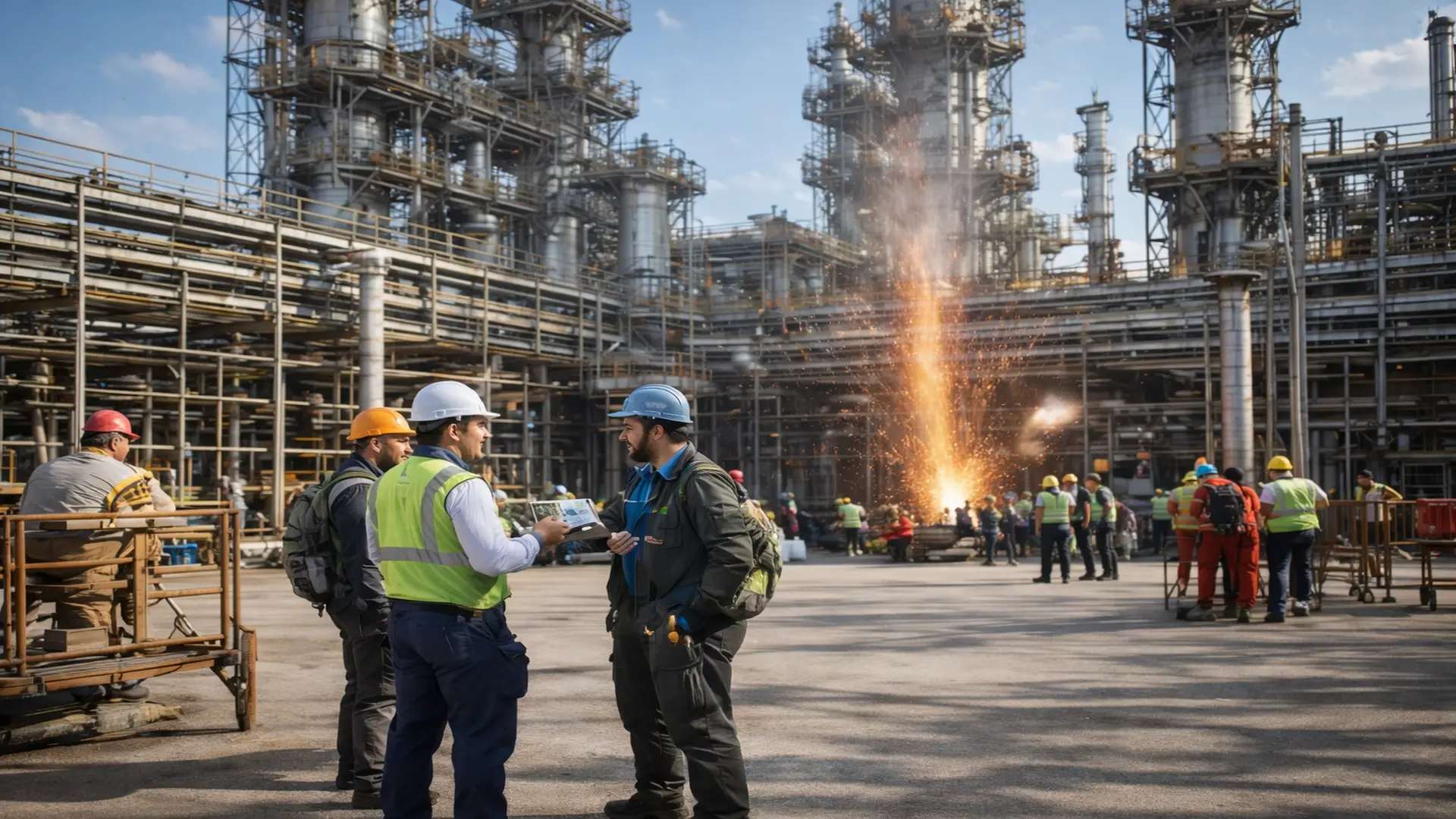
The HSE management system is the structural backbone for controlling risks during plant shutdowns, especially in STO (Shutdown–Turnaround–Outage) events, where simultaneous interventions, contractor involvement, and exposure to hazardous energies increase. In these contexts, safety no longer depends on isolated procedures but requires a risk-based architecture that articulates people, processes, and operational decisions.
The proper integration of the permit to work (PTW), process safety management (PSM), occupational risk analysis, and international regulatory compliance determines whether a shutdown is executed under control or, conversely, leads to operational and regulatory failures.
Critical risks in plant shutdowns (STO)
Increased operational risk in STO
Plant shutdowns (STO) represent one of the highest risk exposure moments in energy and industrial facilities. During these events, critical equipment is intervened, operating conditions are modified, and multiple activities are carried out in parallel, generally under schedule pressure.
Hot work, line openings with possible residual hydrocarbon presence, confined space interventions, electrical isolations, and lifting operations may coincide within the same operational period. This convergence increases the probability of interference and requires a higher level of technical coordination.
The incorporation of contractors and temporary personnel adds variability in competencies and safety culture. Without a structured and risk-aligned HSE management system, these conditions can quickly evolve into major events.
Impact of HSE failures in shutdowns
Failures in management during an STO are not limited to occupational injuries. In high-risk environments, they can trigger uncontrolled energy releases, fires, or environmental impacts with operational and reputational consequences.
From a PSM perspective, a poorly controlled intervention may compromise critical barriers and affect asset integrity before restart. The difference between normal operation and a plant shutdown is therefore structural, not circumstantial.
The following comparison in Table 1 summarizes how the risk level varies during an STO and why the HSE management system requires specific reinforcement during these phases.
Table 1: Normal Operation vs STO (Risk Level)
| Variable | Normal Operation | Plant Shutdown (STO) |
|---|---|---|
| Process Conditions | Stable and controlled | Modified or temporarily outside design |
| Task Simultaneity | Limited | High concentration of critical activities |
| Contractor Participation | Moderate | High and multidisciplinary |
| Operational Interference | Low | High |
| Exposure to Hazardous Energies | Controlled under active barriers | Increased due to openings and interventions |
| Level of Supervision Required | Standard | Reinforced and continuous |
| Probability of Deviations | Controlled | Increased due to schedule pressure |
| Systemic Risk Level | Moderate | High if there is no structured control |
This variation in the operating environment confirms that risk management during an STO requires a more robust HSE architecture, integrated with critical controls, process safety management, and intensive field supervision.
HSE management system architecture in STO
Components of the HSE management system
An HSE management system applied to plant shutdowns functions as an organizational structure designed to anticipate, control, and verify risks before, during, and after the shutdown. It is not limited to isolated procedures; it articulates technical planning, operational supervision, and document control within a coherent framework.
During an STO, this architecture requires a higher level of control that includes:
- Clear definition of responsibilities.
- Prioritization of critical activities.
- Intensive field supervision.
- Traceability and document verification.
When these elements are not aligned, management tends to fragment, increasing the probability of operational deviations.
Risk-based approach in STO
The risk-based approach articulates the system architecture during shutdowns. Its purpose is to anticipate hazards before execution and allocate resources based on potential impact.
In an STO, this involves evaluating interference between simultaneous tasks, classifying activities according to criticality, and establishing preventive and mitigative barriers. Tools such as occupational risk analysis and job safety analysis (JSA) are integrated within this structured framework.
The assessment is not limited to each individual task. It also considers systemic effects that could compromise asset integrity or operational stability.
Process safety management in STO
During a shutdown, process safety management (PSM) takes on a decisive role. Isolations, temporary modifications, and openings of pressurized equipment must be rigorously controlled to protect critical barriers.
The integration between the HSE management system, process safety management, and the permit to work ensures technical coherence in highly complex environments.
In an STO, prevention operates at multiple complementary levels. The HSE management system defines governance, process safety management protects critical barriers, and the PTW controls the execution of specific tasks.
Table 2: HSE + PSM + PTW Integration in STO
| Component | Level of Control | Function in STO |
|---|---|---|
| HSE Management System | Strategic | Governance, planning, and comprehensive supervision |
| Process Safety Management (PSM) | Technical | Protection of critical barriers and control of hazardous energies |
| Permit to Work (PTW) | Operational | Authorization and control of specific tasks |
| Occupational Risk Analysis | Preventive | Identification and prioritization of hazards |
| Job Safety Analysis (JSA) | Tactical | Step-by-step validation of critical activities |
This articulation prevents risk control from being dispersed across areas. In complex shutdowns, structured coordination between HSE, processes, and permits is decisive for maintaining operational stability.
Critical HSE controls in plant shutdowns
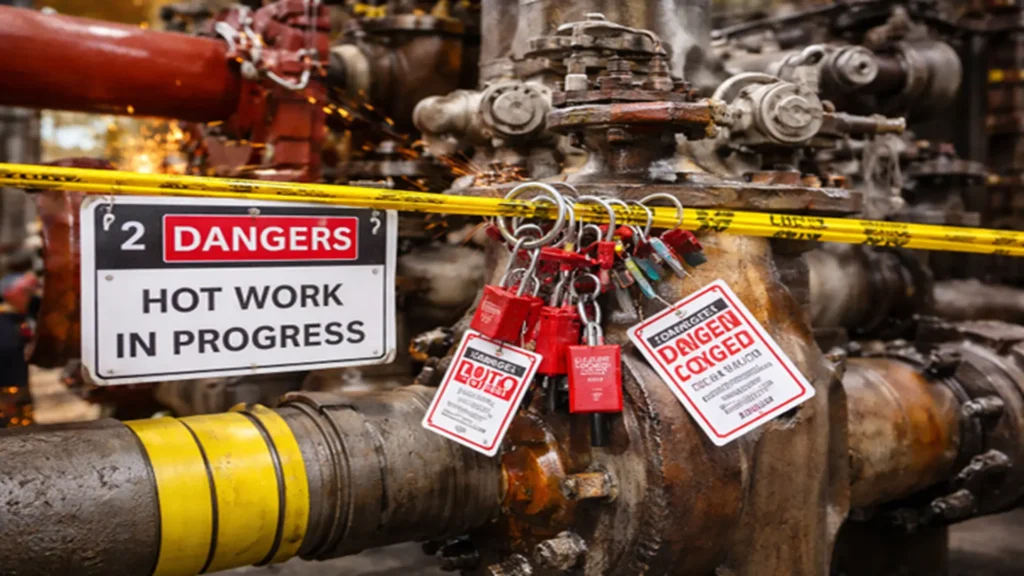
During an STO, critical controls act as technical and administrative barriers intended to prevent high-impact events. Not all have the same operational relevance; priority should be given to those whose failure could compromise asset integrity or personnel safety.
Among the most relevant are:
- Verified mechanical and electrical isolations.
- Formal application of LOTO procedures.
- Atmospheric control in confined spaces.
- Strict management of hot work.
- Reinforced supervision of simultaneous tasks.
The effectiveness of these controls depends on prior validation and operational discipline in the field. Relaxing standards during the shutdown significantly increases the probability of major incidents.
Occupational risk analysis in STO
Occupational risk analysis makes it possible to identify hazards associated with each scheduled activity. During a shutdown, it must consider not only the individual task but also interaction with other ongoing activities.
It is recommended to:
- Conduct prior criticality assessment.
- Identify operational interferences.
- Apply the hierarchy of controls.
- Clearly assign responsibilities.
The risk-based approach facilitates prioritizing resources where potential impact is greatest.
Job Safety Analysis (JSA)
Job safety analysis complements the general risk assessment through the step-by-step breakdown of critical activities. It is especially relevant in hot work, confined spaces, or lifting operations.
The integration between critical controls, occupational risk analyses, and JSA reinforces preventive coherence during industrial shutdowns.

Shutdown Safety Explained in Simple Terms
This video complements the critical controls section, offering a practical view of key operational safety elements during plant shutdowns. Source: HSE STUDY GUIDE.
Permit to work in safe shutdowns
PTW governance
The PTW constitutes one of the most relevant administrative controls during an STO. It is not limited to authorizing tasks; it ensures that technical and operational conditions have been verified before intervention.
In plant shutdowns, the system must contemplate:
- Validation of physical and energy isolations.
- Confirmation of safe atmospheric conditions.
- Evaluation of interference with simultaneous activities.
- Formal approval by designated responsible parties.
PTW governance requires document traceability, validity control, and technical closure before restarting the intervened system.
Integration of PTW with JSA and risks
The PTW does not operate in isolation. It must integrate with occupational risk analysis and JSA, ensuring that each identified risk has verifiable preventive measures.
In complex shutdowns, inconsistency between risk assessment and authorizations can lead to interventions under uncontrolled conditions.
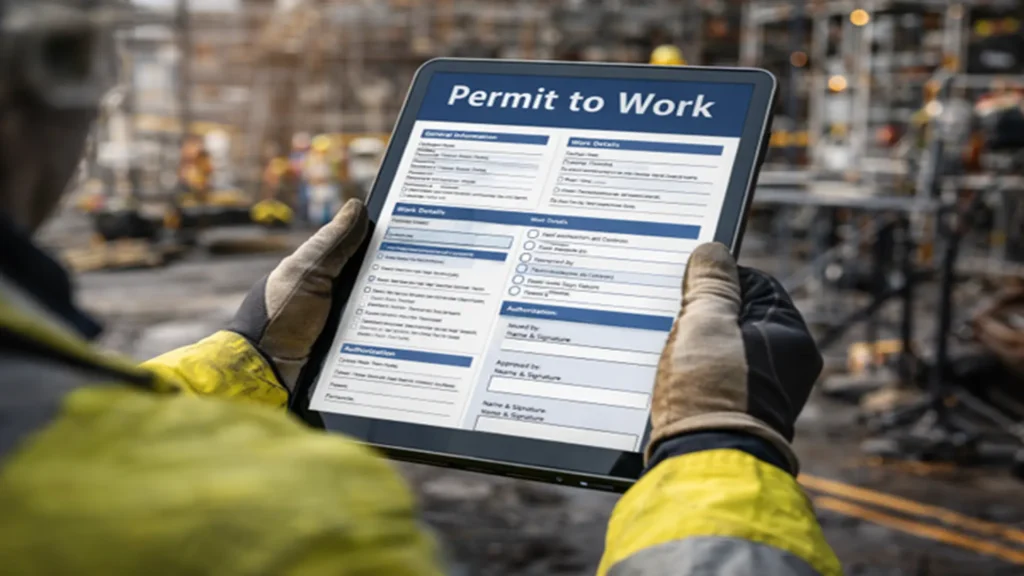
Digitalization through HSE management software strengthens PTW control by improving visibility of active permits, identifying interferences, and maintaining an audited history of authorizations.
In complex industrial environments, this digital integration contributes to reducing human errors and improving real-time decision-making.
HSE management software in shutdowns
HSE management software has become an essential component for managing the operational complexity that characterizes plant shutdowns. In STO events, where multiple critical tasks converge, digitalization allows centralizing technical information, active permits, and risk analyses within a single platform.
Its main functions include:
- Centralized permit to work management.
- Monitoring of occupational risk analyses and JSA.
- Updated document control.
- Real-time indicator monitoring.
- Recording and analysis of operational deviations.
Beyond replacing paper forms, the value of the system lies in integrating operational data under a risk-based approach.
The following scheme in Table 3 summarizes how a digital system strengthens operational control during an STO.
Table 3: Digital Workflow of the Permit to Work
| Stage | Action | Validation |
|---|---|---|
| Request | Digital registration of activity | Technical responsible party |
| Evaluation | Associated risk analysis | HSE Supervisor |
| Approval | Formal authorization | Area Manager |
| Execution | Real-time monitoring | Field Supervisor |
| Closure | Confirmation of safe conditions | Document Control |
This structured workflow improves traceability, facilitates regulatory audits, and reduces interference in environments with high operational simultaneity.
Regulatory framework of HSE in STO
Risk management during plant shutdowns must align with international regulatory frameworks that establish clear requirements regarding occupational safety, environmental protection, and control of hazardous energies.
Standards such as ISO 45001 structure the systematic management of occupational health and safety. ISO 14001 regulates environmental aspects associated with industrial interventions. In process safety, OSHA 29 CFR 1910.119 (PSM) requires formal control of hazardous energies and maintenance of critical barriers.
OSHA 29 CFR 1910.147 regulates energy control through LOTO procedures, fundamental during shutdowns. API RP 754 complements these frameworks through technical performance indicators.
Regulatory convergence requires the HSE management system to operate as an integrating structure capable of articulating occupational safety, process safety, and documentary compliance.
The following comparison summarizes the most relevant regulatory frameworks and their practical application in industrial shutdowns.
Table 4: Regulatory Comparison Applicable to STO
| Standard / Regulation | Main Focus | Application in STO |
|---|---|---|
| ISO 45001 | Occupational safety | Structured risk management |
| OSHA 1910.119 (PSM) | Process safety | Control of hazardous energy |
| API RP 754 | Performance indicators | Event monitoring |
| OSHA 1910.147 (LOTO) | Lockout/Tagout | Verified isolations |
| ISO 14001 | Environmental management | Emission control during shutdown |
Coordinated compliance with these frameworks is decisive for executing shutdowns without compromising operational continuity or asset integrity.
Deviation management and system integration in STO
During a plant shutdown, technical deviations associated with scope changes or unforeseen conditions may arise. Structured management of these variations prevents a specific modification from compromising critical barriers.
An effective HSE management system requires that every deviation be documented, evaluated, and approved before implementation.
System integration throughout the entire STO cycle begins in planning, continues with disciplined execution, and culminates in technical closure. Consistency between these phases sustains operational reliability in high-demand environments.
Technical closure is not limited to verifying intervened equipment. It involves confirming safe startup conditions and consolidating lessons learned with a critical perspective. These must be formally integrated into existing procedures so that each shutdown contributes to strengthening future interventions and elevating organizational maturity.
In complex shutdowns, coherence between planning, execution, and post-evaluation ultimately sustains operational reliability.
Conclusions
Plant shutdowns constitute one of the most technically complex scenarios in the energy industry. The simultaneity of interventions and the temporary modification of operating conditions require structured control that goes beyond the isolated application of procedures.
The disciplined application of an HSE management system, articulated with critical controls and formal authorization mechanisms, reduces the probability of major incidents. It is not merely about regulatory compliance, but about sustained technical coherence throughout the entire shutdown cycle.
In demanding industrial environments, system maturity prior to each STO makes the difference between a controlled intervention and an event with significant operational impact.
References
- International Organization for Standardization. (2018). ISO 45001:2018 occupational health and safety management systems — Requirements with guidance for use. ISO.
- Occupational Safety and Health Administration. (2023). Process safety management of highly hazardous chemicals (29 CFR 1910.119). U.S. Department of Labor.
- Occupational Safety and Health Administration. (2023). The control of hazardous energy (lockout/tagout) (29 CFR 1910.147). U.S. Department of Labor.
- American Petroleum Institute. (2016). API recommended practice 754: Process safety performance indicators for the refining and petrochemical industries. API.
- Center for Chemical Process Safety. (2019). Guidelines for risk based process safety. John Wiley & Sons.
Frequently Asked Questions about HSE in STO
How to apply HSE in a plant shutdown without generating failures?
Applying a structured system before and during the STO is essential. This involves prior planning based on risk assessment, definition of critical controls, verification of energy isolations, and active supervision of simultaneous tasks. Coordination between operations, maintenance, and contractors is decisive in maintaining preventive coherence throughout the shutdown.
What controls reduce risks in industrial shutdowns?
The most effective controls include verified isolations (LOTO), validation of hot work, atmospheric control in confined spaces, and disciplined monitoring of operational authorizations. These must be applied before and during the intervention to avoid interference and systemic failures.
Why is process safety critical during an STO?
During a shutdown, normal operating conditions are modified, which can compromise technical barriers designed to contain hazardous energy. Process safety ensures that isolations, openings, and temporary changes are managed under formal criteria before system restart.
What does management software contribute to plant shutdowns?
Digital platforms allow consolidation of active permits, risk analyses, and control status in real time. This improves traceability, reduces human error, and facilitates regulatory audits in environments with high operational simultaneity.