
Table of Contents
- Growth in energy consumption due to AI
- The strategic imperative: Investment and planning
- Three pillars for energy transformation
- AI vs global electricity demand
- Transforming energy planning models
- Global and regional implications
- Operational and strategic risks
- The challenging road ahead and beyond
- AI as a global energy strategist
- Conclusion
- References
The incursion of energy for AI (artificial intelligence) is transforming industries, economies, and entire societies. However, behind every advanced language model, every image recognition system, and every deep learning algorithm, there is an unavoidable reality: unprecedented energy consumption that is pushing the global electrical infrastructure to its limits.
Artificial intelligence (AI) has ceased to be a technological promise and has become a powerful infrastructure of the digital economy. Its accelerated adoption across industrial, energy, financial, and logistics sectors is generating a profound and, in many cases, underestimated transformation: the exponential growth of energy consumption associated with advanced computing.
Growth in energy consumption due to AI
According to projections from the International Energy Agency (IEA), electricity demand from data centers and hyperscale facilities will more than double by 2030, reaching the astonishing figure of 945 terawatt-hours (TWh). To put this magnitude into perspective, this would exceed the total annual electricity demand of Japan, the world’s third-largest economy.
AI model training processes, which can require thousands of processors operating simultaneously for weeks, demand enormous amounts of energy for AI that go far beyond what existing infrastructures were designed to support.
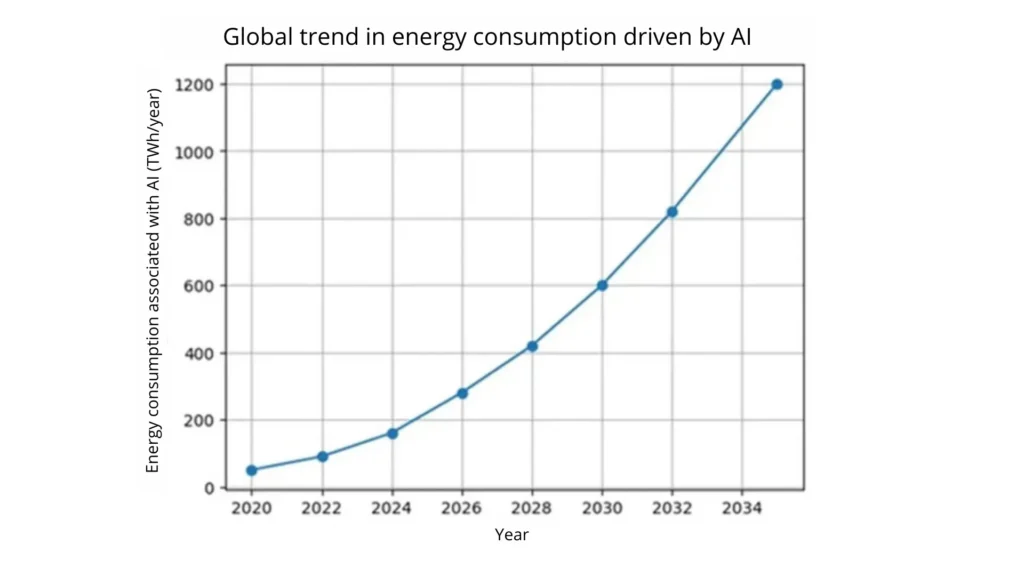
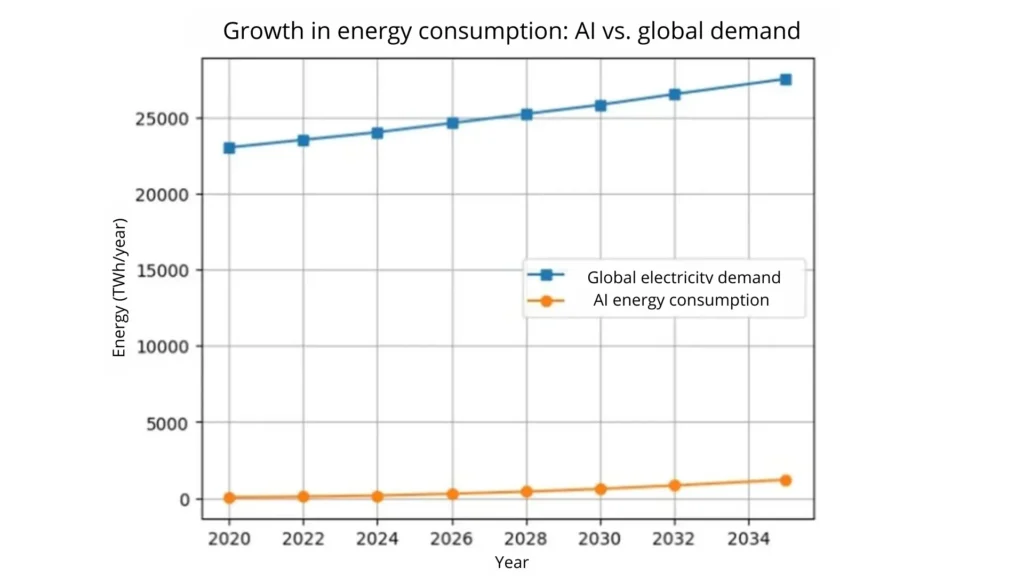
The following graph shows an accelerated and non-linear trend in energy consumption associated with artificial intelligence, rising from approximately 50 TWh/year in 2020 to more than 1,200 TWh/year projected for 2035. This exponential growth reflects a profound structural shift in the relationship between digital infrastructure and the global electrical system. This growth is not merely a statistic. It represents a turning point in global energy history, where AI’s computational needs are redefining the very foundations of how we generate, distribute, and consume electricity.
The strategic imperative: Investment and planning
Countries and companies aspiring to lead in the AI era face a clear imperative: they must deeply understand the repercussions this technology will have on their energy supply chains, infrastructure, and grid stability. More importantly, they must accelerate proactive investment programs that not only respond to these challenges, but anticipate them.
The central question defining this historic moment is: what is the best way to efficiently and sustainably power the data centers of the future?
Today, AI’s computational needs are redefining the very foundations of how we generate, distribute, and consume electricity, introducing new technical, operational, and strategic challenges for governments and industrial operators.
Three pillars for energy transformation
Renewable generation and grid connection
To meet the scale of demand required by AI computational processes and their advanced liquid cooling systems, a radical upgrade in electricity generation for energy for AI and grid connection is required. This implies not only increasing capacity, but also fully modernizing existing infrastructure to handle intensive and continuous workloads.
The transition toward renewable energy sources has become a non-negotiable priority. Modern data centers are actively seeking partnerships with solar, wind, and hydroelectric energy providers to ensure a constant supply that is also environmentally responsible.
Energy efficiency in data centers
Data centers themselves must reinvent their designs to become more energy efficient. This includes the implementation of advanced cooling technologies, optimized hardware architectures, and intelligent management systems that maximize every watt consumed. Innovations such as liquid cooling are enabling much higher computing densities while reducing overall energy consumption.
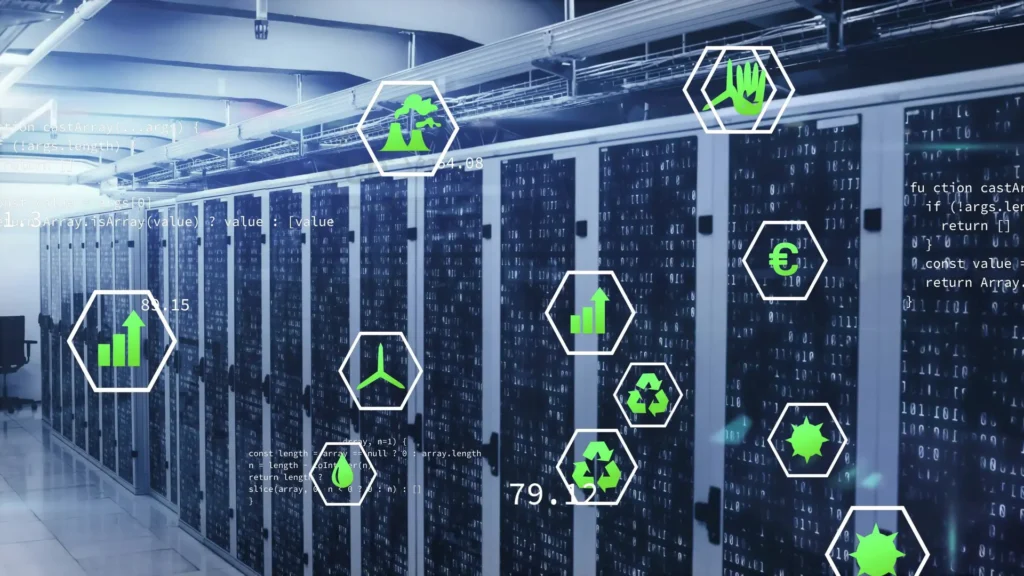
The energy reinvention of high-density data centers, characterized by rows of server racks overlaid with digital icons associated with sustainability, efficiency, growth, renewable energy, and circular economy—illustrates this transformation. This visual overlay is not accidental: it symbolizes the mandatory transition of traditional digital infrastructure toward a new energy paradigm, a concept that can be observed in the following image.
Supply diversification and self-sufficiency
Exclusive dependence on the open energy market exposes data center operators to price volatility and supply instability. This vulnerability is driving a paradigm shift toward energy self-sufficiency.
Achieving self-sufficiency is catalyzing innovative collaborations between traditionally separate sectors. Initiatives such as Chevron–GE Vernova’s “Power Foundry” and the partnership between Google, Intersect Power, and TPG Rise Climate exemplify this new cooperation model. These joint ventures are specifically designed to supply sustainable energy to multiple gigawatt-scale data centers, creating integrated energy ecosystems that reduce risk and optimize costs.
These alliances represent more than simple commercial agreements. They are manifestations of a collective recognition that the future of AI and the future of energy are inextricably linked, and that neither can advance successfully without the other.

AI vs global electricity demand
Comparing the evolution of global electricity demand with energy consumption linked to AI reveals a key dynamic:
While total electricity demand grows at a relatively stable pace (driven by industrial electrification, electric transportation, and economic growth), energy for AI exhibits a significantly steeper growth trajectory.
Although AI currently represents a smaller fraction of total consumption, its growth rate positions it as one of the primary drivers of future demand. From an energy planning perspective, it is not the current volume that generates the greatest concern, but the speed of change.
Strategic message: AI does not yet dominate global electricity consumption, but it dominates the growth dynamics that define future investments.
Transforming energy planning models
The emergence of AI data centers is triggering radical changes in the fundamentals of demand, supply, and distribution of energy for AI. Traditional energy planning models, designed for relatively predictable and distributed consumption patterns, must evolve to accommodate massive, 24/7 demand concentrations.
This transformation requires:
- Accelerated development of renewable capacity: New generation facilities must be built at an unprecedented pace, emphasizing clean and sustainable sources capable of continuous operation to meet energy for AI demand.
- Expansion and modernization of power grids: Transmission and distribution networks must expand and upgrade to handle more intense and directional energy flows, often toward locations that historically were not high-demand centers.
- Integration of advanced technologies: The implementation of energy storage systems, smart grids, and demand management technologies is becoming standard to ensure stability and efficiency.
Global and regional implications
The impact of this energy transformation will vary significantly by region. Countries with robust energy infrastructure and abundant renewable resources hold a natural competitive advantage to become global AI hubs. Those that fail to invest proactively in energy capacity risk being left behind in the emerging digital economy.
For developing economies, this presents both a challenge and a unique opportunity. While the required investment is substantial, building modern energy infrastructure from the ground up can enable the adoption of the most advanced technologies without the constraints of legacy systems.
Operational and strategic risks
The comparison between global electricity demand growth and AI-related energy consumption highlights a critical dynamic:
While total electricity demand grows relatively steadily, AI energy consumption follows a much steeper trajectory.
Although AI currently accounts for a smaller share of total consumption, its growth rate positions it as a major driver of future demand. From an energy planning standpoint, the speed of change, not the present volume, is the central concern.
The challenging road ahead and beyond
The intersection between AI and energy defines one of the most critical challenges of our era. Successfully navigating this transition will determine not only which countries and companies lead in energy for AI, but also how we collectively address sustainability and climate imperatives.
The solution does not lie in choosing between technological advancement and environmental responsibility, but in recognizing that both must progress together. The data centers of the future will stand as proof of our ability to innovate not only in computing, but also in how we generate and use the energy that powers it.
The time to act is now. The investment and planning decisions we make today will determine the viability and sustainability of AI infrastructure for decades to come. In this context, the question is not whether we can afford to make these investments, but whether we can afford not to.
AI as a global energy strategist
Artificial intelligence can no longer be analyzed solely from the perspective of software or digital innovation. Today, it emerges as a global energy strategist, capable of directly influencing public policy, investment decisions, and critical infrastructure.
Understanding this relationship is not optional. It is a strategic requirement to ensure the sustainability, competitiveness, and resilience of future energy systems.
The rapid expansion of artificial intelligence (AI) has shifted the energy debate from the conceptual plane to the physical and operational realm. Behind every trained model, every real-time inference, and every autonomous system lies tangible infrastructure that consumes energy, dissipates heat, and demands absolute reliability.
In this context, AI-oriented data centers have become one of the primary sources of pressure on modern power systems, revealing limits that remained hidden for decades.
Conclusion
The expansion of artificial intelligence is redefining the balance between digital infrastructure and the power system, making it clear that energy for AI will be a critical factor in technological viability. In this context, data centers must reinvent themselves as energy-efficient, intelligent, and resilient infrastructures, capable of optimizing consumption, integrating clean energy sources, and operating within the limits of the electrical system. Energy efficiency ceases to be an operational improvement and becomes an essential condition that will determine the long-term sustainability, competitiveness, and continuity of AI development.
References
- https://www.sciencedirect.com/special-issue/10XVD3QPCGD
- https://blog.google/inside-google/infrastructure/new-approach-to-data-center-and-clean-energy-growth
- https://www.chevron.com/newsroom/2025/q1/power-solutions-for-us-data-centers
- https://www.iea.org