
Table of Contents
- Impact of wakes on wind farms
- Impact of the wake on operational variables
- Wake modeling: From analytical approximations to advanced simulation
- Comparison of wake models
- Wake steering: Operating principle and physical foundation
- Implementation strategies for wake steering
- Comparison of wake control strategies
- Benefits of wake steering control
- Technical challenges and limitations
- The future of wake modeling
- References
Wake control techniques consist of misaligning turbines with respect to the incoming wind to shift their wake zone and reduce the wind speed deficit within the wake, thereby increasing the energy production of other turbines located downwind.
In the context of modern wind generation, the growth in rotor size and turbine installation density has made the aerodynamic wake one of the most determining phenomena for the global efficiency of a wind farm.
As wind passes through a turbine, kinetic energy is extracted, profoundly modifying downstream flow conditions.
This effect, known as a wake, not only reduces wind speed but also introduces high levels of turbulence, directly affecting the performance and service life of turbines positioned further back. Consequently, wake control has emerged as a key discipline within advanced wind engineering.
The development of strategies such as wake steering has enabled a shift from a passive to an active approach in flow management, transforming the way modern wind farms are designed and operated.
The wake in physical terms: Energy transfer and flow structure
From an aerodynamic perspective, a wake is the region of disturbed flow that forms behind a body interacting with a fluid—in this case, a wind turbine rotor. This phenomenon is analogous to observations in other disciplines, such as hydrodynamics (ship wakes) or aeronautics (wake turbulence in aircraft).
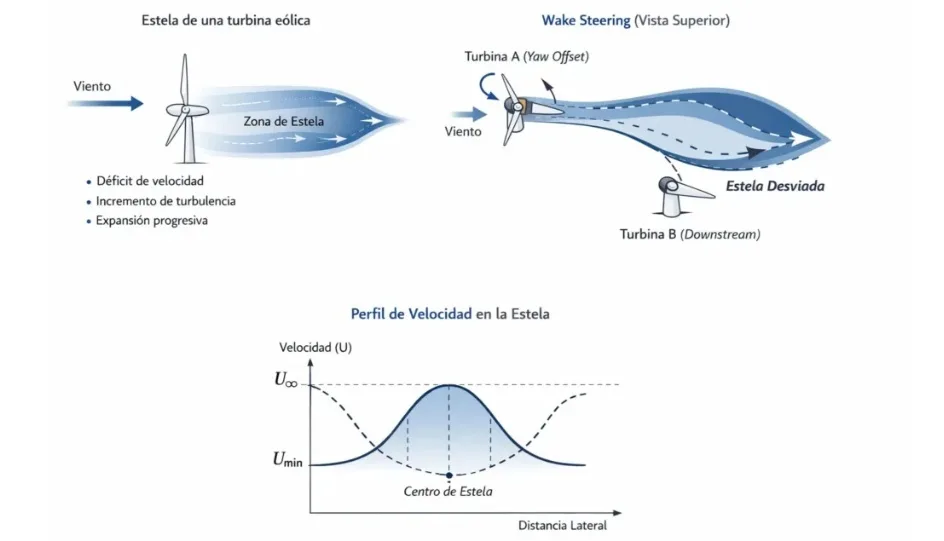
When wind strikes the rotor, part of its kinetic energy is converted into mechanical energy. This process generates three primary effects:
- Flow velocity reduction (velocity deficit).
- Increased turbulence.
- Progressive wake expansion.
The result is a complex flow structure that evolves spatially. In the near wake region, the flow is dominated by rotor geometry and blade dynamics. Further away (far wake), the flow tends to partially recover but maintains turbulent characteristics that impact other turbines. This behavior is governed by fundamental principles of conservation of mass, momentum, and energy, as well as turbulent mixing phenomena.
Improving the energy production of wind farms is fundamental to the transition toward renewable electricity generation. However, in wind farms, wind turbines often operate in the wake of other turbines, causing a reduction in wind speed and resulting energy production while increasing fatigue.
By using wake control strategies to regulate the wake behind each turbine, the total energy production of the wind farm can be increased. To find optimal yaw configurations, analytical wake models have traditionally been used to model interactions between wind turbines through the flow field.
Impact of wakes on wind farms
In a wind farm, turbines rarely operate in isolation. Wake interaction is an inevitable phenomenon that introduces significant losses in total energy production.
When a turbine operates within the wake of another, it experiences:
- Lower inlet velocity.
- Higher turbulence intensity.
- More severe load fluctuations.
This translates into a power reduction that can reach between 10% and 40%, depending on the farm layout and wind conditions. Furthermore, the increase in dynamic loads accelerates structural fatigue processes in critical components such as blades, the tower, and the drivetrain. Therefore, the wake affects not only energy efficiency but also operation and maintenance (O&M) costs, becoming a critical variable in wind farm design and operation.
Impact of the wake on operational variables
| Variable | Without Wake | With Wake | Technical Impact |
| Wind Speed | High | Reduced | ↓ Power |
| Turbulence | Low | High | ↑ Fatigue |
| Energy Production | Optimal | Reduced | -10% to -40% |
| Structural Loads | Stable | Fluctuating | ↑ Maintenance |
Wake modeling: From analytical approximations to advanced simulation
The study and prediction of wakes require modeling tools that capture their behavior with sufficient precision. Different levels of complexity exist:
- Analytical Models: One of the most widely used is the Jensen model (or “top-hat” model), which assumes a linear expansion of the wake and a uniform velocity deficit profile. While computationally efficient, it has limitations in complex scenarios.
- Semi-empirical Models: These incorporate adjustments based on experimental data, improving the prediction of velocity deficits and turbulence. Examples include the Bastankhah-Gaussian model, which is widely used in the industry.
- Advanced Numerical Simulation: Computational Fluid Dynamics (CFD) techniques, especially Large Eddy Simulation (LES), allow for the resolution of turbulent structures with a high level of detail. However, their high computational cost limits their use to specific studies.
Balancing precision and computational cost is key to the practical implementation of real-time control strategies.
Comparison of wake models
| Model | Type | Precision | Computational Cost | Typical Application |
| Jensen (Top-hat) | Analytical | Low | Very Low | Preliminary optimization |
| Larsen | Analytical | Medium | Low | Academic studies |
| Bastankhah (Gaussian) | Semi-empirical | High | Medium | Wind industry |
| Frandsen | Semi-empirical | Medium | Medium | Offshore farms |
| LES (Advanced CFD) | Numerical | Very High | Very High | Advanced research |
Wake modeling is a cornerstone of wind farm engineering. From the classic Jensen model—valued for its simplicity and computational speed—to the modern CFD simulations used by leading manufacturers, understanding wake dynamics is essential for optimizing energy production.
Wake steering: Operating principle and physical foundation
Wake steering is an active wake control strategy that seeks to modify the wake’s trajectory through the intentional adjustment of the turbine’s yaw angle.
Under normal conditions, a turbine aligns itself with the wind direction to maximize energy capture. However, by introducing a small angular misalignment:
- Power from the individual turbine is slightly reduced.
- A lateral deflection of the wake is generated.
- The impact on downstream turbines is diminished.
This phenomenon occurs due to the redistribution of the pressure field around the rotor, inducing a lateral component in the exit flow. From a control perspective, the goal is not to maximize the production of a single turbine, but to optimize the total production of the farm.
Implementation strategies for wake steering
The effective application of wake steering requires a combination of sensors, predictive models, and control algorithms.
- Rule-based Control: Uses predefined misalignment configurations based on wind direction. It is simple to implement but lacks adaptability to changing conditions.
- Model-based Control: Integrates wake models to calculate the optimal yaw angle in real-time. This allows for greater optimization but depends on the accuracy of the model.
- Data-driven and AI Control: The use of machine learning algorithms allows the wake control strategy to continuously adapt based on the real behavior of the farm. This approach is gaining relevance with the digitalization of the energy sector.
Comparison of wake control strategies
| Strategy | Complexity | Adaptability | Energy Benefit | Implementation |
| Passive Control (Layout) | Low | None | Medium | Initial design |
| Wake Steering (Yaw Control) | Medium | High | High (1–5%) | Real-time operation |
| Cooperative Control | High | Very High | Very High | Digital wind farms |
| AI / Machine Learning | Very High | Dynamic | Maximum Potential | Advanced systems |
Benefits of wake steering control
The implementation of wake steering strategies has demonstrated significant benefits:
- Increase in Annual Energy Production (AEP) between 1% and 5%.
- Reduction of fatigue loads on downstream turbines.
- Improved operational stability of the farm.
Although the percentage increase may seem modest, it represents substantial economic gains in large-scale wind farms.
Furthermore, wake control allows for higher installation density without significantly compromising efficiency, which is especially relevant in offshore projects where space is limited and costly.
Technical challenges and limitations
Despite its advantages, wake steering presents several challenges:
- Uncertainty in wind direction.
- Atmospheric variability.
- Complexity in model calibration.
- Mechanical limitations in the yaw system.
Small errors in wind estimation can significantly reduce the effectiveness of wake control. Likewise, the continuous use of misalignment can increase component wear. Therefore, it is essential to develop robust strategies that account for uncertainty and the operational limits of the turbines.
The future of wake modeling
The development of Digital Twins for wind farms, combined with artificial intelligence and real-time operational data, is significantly improving the precision of wake modeling. Current trends include:
- Hybrid CFD + Machine Learning models.
- Dynamic yaw control at the farm scale.
- Continuous optimization of energy production.
These technologies are transforming the design and operation of wind farms, allowing for maximized energy efficiency and reduced aerodynamic losses.
References
- https://www.siemens.com/es-es/technology/computational-fluid-dynamics-cfd-simulation
- https://pmc.ncbi.nlm.nih.gov/articles/PMC12508008