
Table of Contents
- What are offshore systems in maritime terminals?
- Applied engineering in offshore transfer systems
- Predictive maintenance in maritime terminals
- Digitalization and real-time monitoring
- Optimization of offshore assets through retrofit
- Operational safety in hydrocarbon transfer
- Applied case in the industry
- Conclusions
- References
- Frequenly Asked Questions (FAQs)
- How does environmental variability affect offshore system performance?
- What is the difference between continuous monitoring and periodic monitoring in maritime terminals?
- Why do offshore transfer systems require dynamic analysis?
- What risks are associated with the lack of real-time monitoring?
- How does digitalization contribute to safety in offshore operations?
- What factors should be considered to optimize the service life of offshore components?
- How are critical points identified in offshore systems?
- What is the impact of data-driven decision-making in maritime terminals?
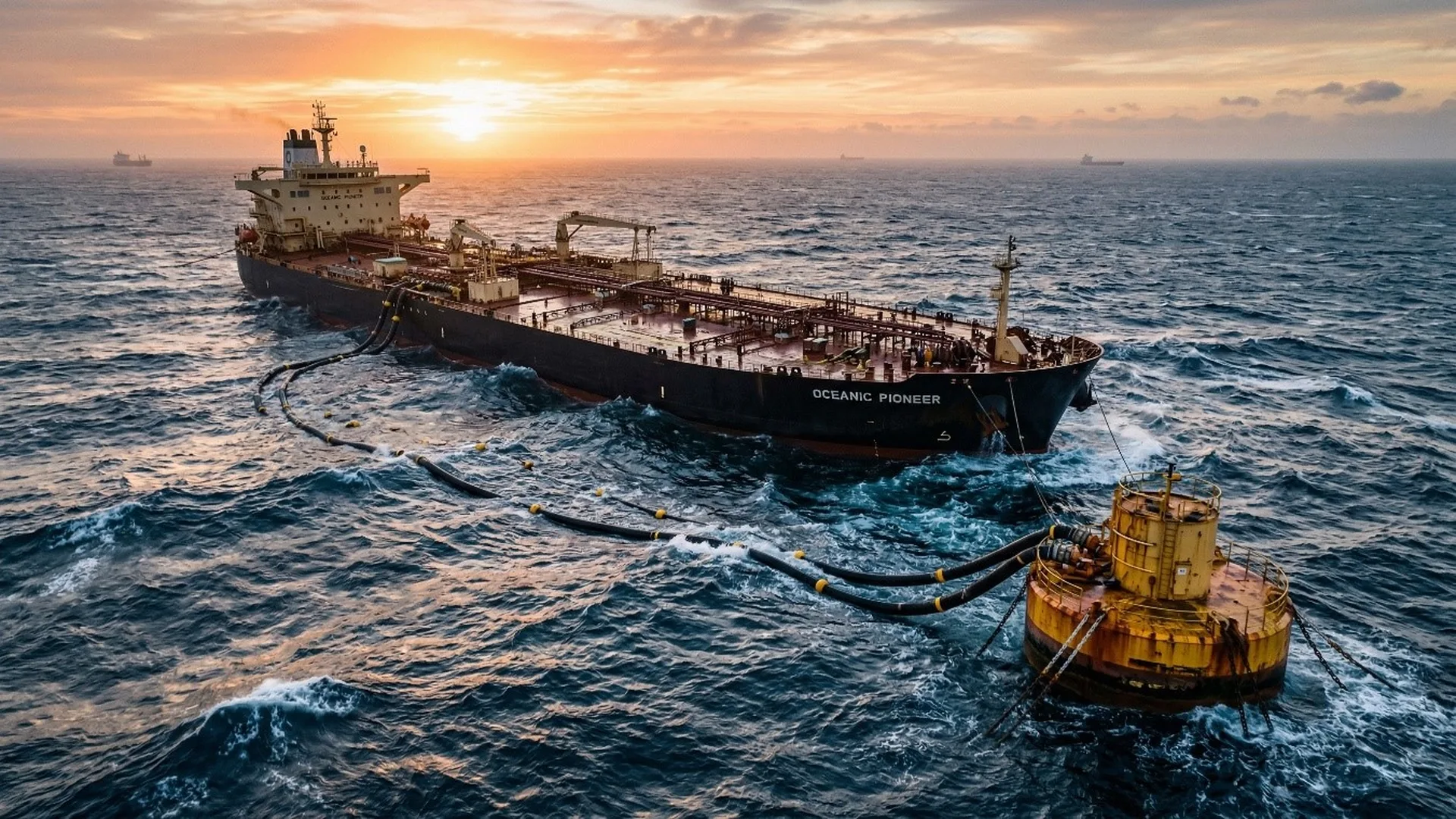
Maritime transportation of hydrocarbons has experienced sustained growth in recent decades, positioning offshore systems as key infrastructure within the global energy maritime transport sector, driven by increasing energy demand and the expansion of international markets. In this context, offshore maritime terminals—including single point mooring systems (SPM), loading and unloading lines, and mooring systems—have become critical assets to ensure the safe and efficient transfer of fluids between vessels and onshore facilities.
However, these systems operate under highly demanding conditions, where factors such as wave action, marine corrosion, and operational variability create a complex environment that increases the risk of failure. In many cases, traditional inspection strategies are no longer sufficient to detect progressive degradation mechanisms, particularly in critical components such as marine hoses and connections.
In response, the industry is evolving toward a more integrated approach, where continuous monitoring of operational conditions and digitalization enhance asset integrity management and support more informed operational decision-making.
Optimizing these systems requires a comprehensive approach that integrates Offshore system analysis has evolved toward the use of models that integrate both static and dynamic conditions, supported by advanced dynamic analysis techniques.
What are offshore systems in maritime terminals?
Offshore systems in maritime terminals comprise the set of infrastructures, equipment, and technologies designed for the safe transfer of hydrocarbons between vessels and onshore facilities in marine environments. These systems include key components such as single point mooring systems (SPM), marine hoses, mooring systems, and loading and unloading lines, all operating under dynamic conditions influenced by wave action, currents, and environmental factors. These systems play a fundamental role in the maritime transportation of hydrocarbons, where infrastructure reliability is critical to ensuring safe and efficient operations.
Unlike onshore installations, offshore systems are subjected to continuous and variable loads that directly affect their structural integrity and operational performance. The interaction between vessel motion, hydrodynamic forces, and environmental conditions generates complex stresses that must be considered from the design stage through to in-service operation.
In this context, offshore terminal systems have evolved toward more integrated configurations, where applied engineering, condition monitoring, and digitalization enable more efficient asset reliability management, supported by optimized system design strategies. This approach not only enhances safety in transfer operations but also optimizes component service life and reduces the likelihood of failures in highly demanding environments.
Applied engineering in offshore transfer systems
Why do offshore systems require specialized design?
Offshore transfer systems are exposed to operational conditions that are not present in onshore facilities. Continuous wave action, marine currents, and wind forces generate dynamic loads that induce mechanical fatigue and variations in mechanical stresses within components, while constant exposure to saline environments accelerates corrosion processes.
In this context, system design must consider not only nominal operating conditions but also transient and extreme scenarios, ensuring that system design criteria address variable loads and real operating conditions. Components such as marine hoses, mooring systems, and associated valves and connections must be selected and engineered based on criteria that ensure reliable performance under variable loads and repeated stress cycles.
Furthermore, the interaction between these elements within the overall system requires an integrated engineering approach, where each component contributes to the stability and operational continuity of the entire system.
Static and dynamic analysis under real operating conditions
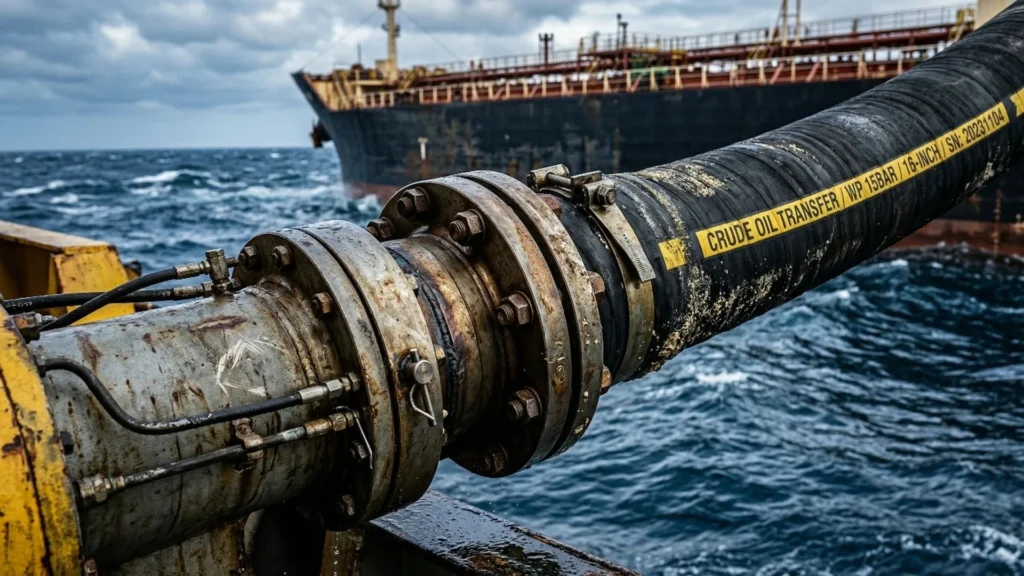
From an applied engineering perspective, models are developed to evaluate system behavior under different operating conditions. Offshore system analysis has evolved toward the use of models that integrate both static and dynamic conditions. Load simulations allow for the assessment of component response under combined stresses, while vessel motion analysis introduces additional variables related to displacement, mooring line tension, and hose behavior during operation.
Fluid–structure interaction is a key aspect of this type of analysis, as it determines system response to changes in the operating environment. This enables the identification of critical stress points, optimization of configurations, and reduction in the likelihood of unexpected failures.
Impact of design on system integrity
Proper design has a direct impact on component service life by reducing stress concentrations and minimizing premature wear. It also enhances operational safety by decreasing the probability of leaks or structural failures under critical conditions. Together, these factors increase overall system reliability, enabling more stable, predictable, and efficient operations in highly demanding offshore environments.
Predictive maintenance in maritime terminals
Limitations of traditional maintenance
In many maritime terminals, maintenance is still based on periodic schedules defined by time intervals or operating cycles. Although this approach has historically been useful, it presents significant limitations when applied to offshore systems, where conditions constantly change and the stresses acting on equipment are not uniform.
Periodic inspections, for example, only allow the system’s condition to be evaluated at specific moments, leaving intervals during which degradation mechanisms may develop without being detected. This is particularly critical in components such as marine hoses or mooring systems, where damage can evolve progressively until it manifests as a sudden failure.
In addition, the traditional approach is essentially reactive. Maintenance decisions are typically made when there is already clear evidence of deterioration or when the equipment has reached its operational limit. In offshore environments, where a failure can involve significant environmental, operational, and economic risks, this model becomes increasingly inefficient.
Critical variables to monitor
Predictive maintenance shifts the focus toward continuous observation of system behavior through condition monitoring, enabling a more accurate understanding of asset performance, establishing itself as a key strategy for predictive maintenance in offshore systems. In maritime terminals, variables such as internal hose pressure, elongation caused by dynamic loads, mechanical stresses in mooring lines, the evolution of these mechanical stresses under dynamic conditions, and operating temperature provide critical insights into component integrity.
Analyzing these variables makes it possible to detect early deviations from normal operating conditions, enabling timely interventions before a failure occurs. Rather than simply identifying damage, the objective is to understand how the system responds in real time under actual service conditions.
Benefits of condition-based maintenance
Adopting a predictive maintenance approach based on condition monitoring helps reduce the occurrence of unexpected failures by enabling intervention at the right moment. It also optimizes replacement programs by avoiding unnecessary substitutions and prioritizing components that truly require attention. Overall, this approach contributes to extending asset service life, improving operational reliability, and optimizing costs in offshore maritime terminals.
Digitalization and real-time monitoring
Integration of sensors in offshore systems
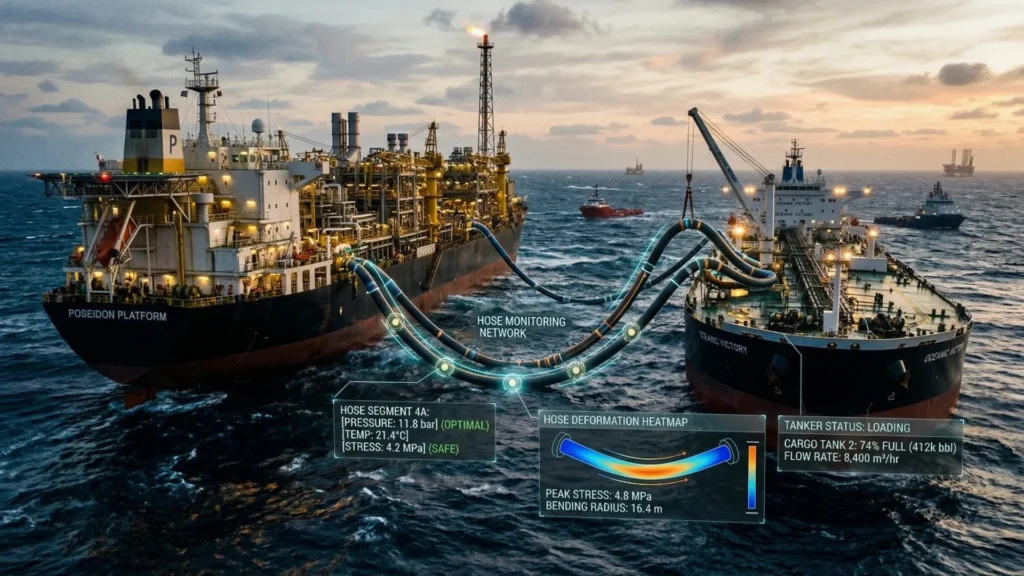
The integration of sensors into offshore systems represents one of the most significant advances in modern maritime terminal management. In components such as marine hoses, these devices enable the monitoring of variables such as pressure, temperature, and deformation, providing continuous insight into their behavior during operation.
Similarly, mooring systems have evolved toward solutions that incorporate real-time tension measurement. This parameter is essential for evaluating system stability during loading and unloading operations, particularly under conditions where vessel motion and environmental forces generate variable stresses.
The integration of these sensors transforms traditional systems into smart assets, also enabling real-time monitoring of mechanical stresses to better understand how loads evolve during operation. These systems are capable of generating data that reflects their actual condition and allows for the anticipation of risk scenarios through the use of digital tools.
Remote supervision and decision-making
This approach is complemented by predictive maintenance strategies that enable the anticipation of failures based on the actual behavior of assets, while also making data accessible and actionable for operations. Through mobile applications and platforms connected to control centers, operators can monitor system conditions in real time, even from remote locations.
The generation of automatic alerts when critical parameters deviate from normal ranges allows for rapid and timely response, reducing reliance on constant manual inspections. This enables more efficient management, where decisions are based on real-time data rather than assumptions.
Impact on offshore operations
Real-time monitoring has a direct impact on safety by enabling the identification of abnormal conditions before they develop into critical failures. It also strengthens operational continuity by reducing unplanned interruptions and improving the scheduling of interventions.
From a risk management perspective, access to reliable, real-time data supports more accurate decision-making, reducing uncertainty in offshore environments where each variable can significantly influence system performance.
Optimization of offshore assets through retrofit
Limitations of traditional maintenance
For years, maintenance in maritime terminals has been based on periodic schemes defined by operating hours or fixed schedules. While this approach has allowed a certain level of asset control, it presents significant limitations when applied to systems subjected to dynamic and variable conditions such as offshore environments.
By their nature, periodic inspections capture only a “snapshot” of the equipment’s condition at a specific point in time. This leaves time windows during which degradation mechanisms may develop without being detected, particularly in critical components such as marine hoses or mooring systems. As a result, many failures occur suddenly, without clear warning signs during scheduled inspections.
In addition, traditional maintenance is inherently reactive, with intervention decisions typically made after damage has already occurred or become evident. In environments where a failure can lead to spills, unplanned shutdowns, or elevated operational risks, this approach is becoming increasingly unsustainable.
Critical variables to monitor
Predictive maintenance introduces a paradigm shift by focusing on the continuous monitoring of variables that reflect the actual behavior of systems in operation. In maritime terminals, parameters such as internal hose pressure, elongation associated with mechanical stresses, tensions in mooring systems, and operating temperature become key indicators of integrity.
Monitoring these variables allows for the identification of deviations from normal conditions, enabling the anticipation of failures before they occur. Rather than simply detecting damage, the objective is to understand how the system evolves under real service conditions.
Benefits of condition-based maintenance
Adopting a condition-based approach significantly reduces the occurrence of unexpected failures by enabling intervention at the optimal time. It also optimizes replacement programs by avoiding premature or unnecessary changes and focusing resources where they are truly needed.
Overall, these benefits contribute to extending component service life, improving system reliability, and reducing operational costs in maritime terminals.
Operational safety in hydrocarbon transfer
Integration of sensors in offshore systems
Digitalization has begun to transform the way offshore transfer systems are managed by incorporating sensors that capture information directly from assets in operation. In components such as marine hoses, these sensors can record variables such as pressure, temperature, and deformation, providing continuous insight into their behavior.
Similarly, mooring systems have evolved toward configurations that allow real-time tension measurement, a critical factor in ensuring vessel stability and maintaining line integrity during loading and unloading operations. This integration of sensors converts traditional systems into smart assets capable of generating relevant data to support decision-making.
Remote supervision and decision-making
One of the main advancements associated with digitalization is the ability to access information remotely. Through mobile applications or platforms integrated into control centers, operators can monitor system conditions in real time, even from locations far from the operation.
The generation of automatic alerts when monitored variables deviate from normal conditions enables timely intervention, reducing reliance on constant physical inspections. This type of supervision not only improves response capability but also facilitates more efficient management of operational resources.
Impact on offshore operations
The implementation of real-time monitoring has a direct impact on safety by enabling the detection of abnormal conditions before they evolve into critical events. It also strengthens operational continuity by minimizing unplanned interruptions and improving the planning of interventions.
From a risk management perspective, having access to reliable and up-to-date information allows for more informed decision-making, reducing uncertainty in complex operational environments such as offshore maritime terminals.
Applied case in the industry
Real-world application in offshore systems
Today, the offshore industry is advancing toward more integrated management models, where engineering, continuous monitoring, and digitalization converge to improve the reliability of transfer systems. Specialized companies in the sector are adopting this approach with the aim of anticipating failures, optimizing operations, and extending the service life of critical components, particularly in environments where operating conditions are highly variable and demanding.
This shift responds to the need to overcome the limitations of traditional approaches by incorporating tools that enable a deeper understanding of asset behavior under real service conditions. The transition toward condition-based and data-driven models is no longer an emerging trend, but an increasingly established practice in maritime terminals worldwide.
Practical example presented at SLOM 2025
An example of this approach was presented during SLOM 2025, where IOCS SRL showcased the application of predictive monitoring and operational analysis in offshore transfer systems. In this case, the monitoring of variables such as hose elongation and pressure control was highlighted as key indicators for assessing system condition in real time.
The integration of these measurements with digital tools enabled not only the detection of operational deviations but also enhanced the use of digital tools for informed decision-making regarding maintenance and component replacement. As a result, this approach contributes to extending equipment service life and improving overall system reliability, aligning with modern integrity management practices in maritime terminals.
Below is a field-based application case that demonstrates the principles discussed in this article, including the monitoring of critical variables, the integration of digital tools, and their impact on the reliability of offshore transfer systems.

Conclusions
The evolution of offshore systems in maritime terminals reflects a profound shift, where predictive maintenance and applied engineering are becoming key elements in modern asset management. The combination of specialized engineering, continuous monitoring, and digital tools is establishing a new industry standard, where decision-making is increasingly driven by data rather than assumptions.
This approach enables a deeper understanding of system behavior under dynamic operating conditions, allowing for the anticipation of degradation mechanisms and reducing the likelihood of unexpected failures. In this context, isolated inspections are no longer sufficient to ensure asset integrity. Instead, a comprehensive approach is required—one that integrates design, analysis, and monitoring as part of a continuous management strategy.
Beyond technology, this shift represents a transformation in operational culture within maritime transport, where prevention replaces reaction and real-time information becomes a strategic asset. For maritime terminal operators, this translates into enhanced safety, improved operational continuity, and more efficient resource management.
Maritime terminals are evolving toward more intelligent models, where data integration and technical analysis enable the anticipation of failures and the optimization of operations in highly demanding environments.
In practice, the difference between conventional and advanced approaches is not defined by the tools themselves, but by the ability to interpret how systems behave under real operating conditions.
Organizations that adopt this perspective are better positioned to anticipate failures, optimize performance, and maintain control over increasingly complex offshore operations.
References
- Oil Companies International Marine Forum (OCIMF). (2025). Guide to manufacturing and purchasing hoses for offshore moorings (GMPHOM) (5th ed.). https://www.ocimf.org/publications/books/guide-to-manufacturing-and-purchasing-hoses-for-offshore-moorings-gmphom/
- Oil Companies International Marine Forum (OCIMF). (2015). Single point mooring maintenance and operations guide (SMOG) (3rd ed.). https://www.ocimf.org/publications/books/single-point-mooring-maintenance-and-operations-guide-smog/
- Oil Companies International Marine Forum (OCIMF). (2010). Guidelines for the design, operation and maintenance of multi buoy moorings (MBM). https://www.ocimf.org/publications/books/guidelines-for-the-design-operation-and-maintenance-of-multi-buoy-moorings-mbm/
- American Bureau of Shipping (ABS). (2022). Guide for smart functions for marine vessels and offshore units. https://ww2.eagle.org/content/dam/eagle/rules-and-guides/current/other/307_smart_functions_marine_offshore_2022/smart-guide-jun22.pdf
- Inspenet TV. (2025). Efficient offshore systems | IOCS SRL | SLOM 2025 [Video]. Inspenet. https://inspenet.com/en/inspenet-tv/efficient-offshore-systems-iocs-slom-2025/
Frequenly Asked Questions (FAQs)
How does environmental variability affect offshore system performance?
Environmental variability, including wave action, marine currents, and changing weather conditions, introduces dynamic loads that continuously impact the structural behavior of offshore systems. These conditions can generate cumulative mechanical fatigue and accelerate degradation processes that are not always detectable through conventional inspections. For this reason, real-time monitoring of these variables is essential to accurately assess performance and anticipate potential failures.
What is the difference between continuous monitoring and periodic monitoring in maritime terminals?
Periodic monitoring evaluates asset condition at specific intervals, which can leave gaps where failures may develop unnoticed. In contrast, continuous monitoring provides real-time visibility into system behavior, enabling early detection of deviations and improving response capabilities under abnormal conditions.
Why do offshore transfer systems require dynamic analysis?
Unlike static systems, offshore transfer systems are exposed to variable forces caused by marine environments and vessel motion. Dynamic analysis allows for the evaluation of how these forces affect components under real operating conditions, providing a more accurate understanding of stress distribution and supporting better design and operational decisions.
What risks are associated with the lack of real-time monitoring?
The absence of real-time monitoring limits the ability to detect changes in system behavior, which can lead to unexpected failures. This increases the risk of spills, operational disruptions, and equipment damage, as well as higher costs associated with unplanned corrective interventions.
How does digitalization contribute to safety in offshore operations?
Digitalization enables the integration of sensors, monitoring platforms, and analytical systems that provide continuous insight into asset condition. This facilitates early detection of abnormal conditions, improves decision-making, and reduces reliance on manual inspections, significantly enhancing operational safety.
What factors should be considered to optimize the service life of offshore components?
Key factors include operating conditions, environmental exposure, design quality, material selection, and the implementation of continuous monitoring strategies. The combination of these elements helps reduce premature wear and extend the service life of critical components.
How are critical points identified in offshore systems?
Critical points are identified through stress analysis, dynamic simulations, and monitoring of key variables during operation. These tools help detect areas with higher load concentration or increased failure risk, enabling the implementation of targeted mitigation strategies.
What is the impact of data-driven decision-making in maritime terminals?
Data-driven decision-making reduces operational uncertainty by relying on real-time, accurate information. This improves efficiency, optimizes resource allocation, and reduces failure risks, particularly in complex offshore environments.